

Table of Content
- Key Takeaways
- What is an Out Of The Money Option?
- Out Of the Money Option Example
- Key Characteristics Of OTM Options
- Common Strategies Involving OTM Options
- Advantages And Disadvantages Of OTM Options
- Risks Involved in OTM?
- Difference Between ITM and OTM
- Why OTM Options Have No Intrinsic Value?
- Role of Time Value in OTM Options
- Impact of Volatility on OTM Options
- Understanding Strike Price in OTM Options
- Conclusion
- Frequently Asked Questions (FAQs)
Link copied!
Out of the Money (OTM)

Out of the Money (OTM) is a term in options trading that describes a situation where an option lacks intrinsic value. Exercising an out-of-the-money option would not be profitable, and it is different for both the call and put options.
Key Takeaways
- OTM (Out-of-the-money) options are those that have no profit value right now. Call options are OTM when the stock price is below the strike price, and put options are OTM when the stock price is above the strike price.
- OTM options are cheaper to buy, but most expire worthless. You can lose all the money you paid as a premium if the price does not move as expected.
- If the stock price moves a lot in your favour, OTM options can give very high returns compared to the small amount you invested.
What is an Out Of The Money Option?
Out-of-the-money options, also called OTM, have no intrinsic value. This means that exercising them before the expiry date will not give any profit. When the option reaches expiry, all OTM options, whether call or put, become worthless.
Here’s how it works for each type:
Call Option (OTM): Stock Price < Strike Price
A call option becomes Out-of-the-Money when the market price of the stock is below the strike price. This means buying the stock through the option would be more expensive than buying it directly from the market, so the option has no intrinsic value.
Put Option (OTM): Stock Price > Strike Price
A put option becomes Out-of-the-Money when the market price of the stock is above the strike price. In this case, selling the stock at the strike price would not be beneficial because the market already offers a higher price, so the option has no intrinsic value.
Premiums of OTMs are relatively cheap because there is very little probability of expiring in the money (ITM) by the time the option reaches its expiration date. Traders often buy OTM options for speculative purposes, hoping for a significant price movement. Still, the chances of them expiring profitably are lower, making them a high-risk, high-reward choice.
Out Of the Money Option Example
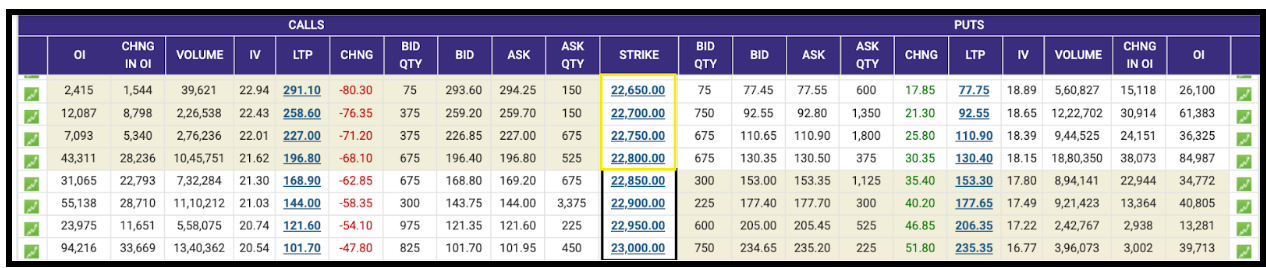
For example, on the Nifty option chain, if Nifty is trading at 22,816, call options with strike prices above 22,816 are OTM and shown in a black box, while put options with strike prices below 22,816 are OTM and shown in a yellow box.
Key Characteristics Of OTM Options
OTM options are the buyer’s favourite because they are relatively cheap, and if the underlying moves according to them, they will make a huge profit. Still, one should also know the characteristics related to OTM before buying or selling them.
OTMs Have No Intrinsic Value
OTM options have no intrinsic value. Intrinsic value is the real value of an option, but for options, it is always zero. This means that if you exercise an OTM option at the current market price, it will not give any profit. Because of this, OTM options depend only on the hope that the price of the stock will move in the expected direction before expiry. They do not have any built-in value.
Premiums Are Less For OTM Options
Premiums for out-of-the-money options are lower compared to other options. This is because their price is mostly based on time value, as there is still a small chance that the stock price may move in your favour before expiry. The premium can also be slightly affected by volatility.
If the stock is more volatile, there is a higher chance that it could move into a profitable range, which can push the premium up a little. But overall, since the chances of OTM options becoming profitable are low, their cost is generally cheaper.
Trading OTM Options Has High Risk and Reward
Most OTM options expire worthless. If the stock price does not move enough before expiry, you lose the entire premium paid. If the stock price moves significantly in your favour, OTM options can give very high returns compared to the small amount you paid as a premium.
Let’s say Nifty is at 22,800, and you buy a 23,200 OTM call option for ₹20 (₹1,000 per lot).
- If Nifty stays below 23,200 → Option expires worthless → Loss = ₹1,000
- If Nifty jumps to 23,400 → Option value becomes ₹200 (₹10,000 per lot) → Profit = ₹9,000
Risk-to-Reward Ratio: ₹1,000 Risk → ₹9,000 Reward (1:9).
Common Strategies Involving OTM Options
Because OTM options are cheaper and can give high returns if the price moves a lot, many traders use them in different ways to try to make profits. Here are some common strategies that involve OTM options.
Speculative plays:
Traders buy OTM options when they expect a big price move in the stock. If the price moves as expected, they can make high returns with a small investment.
Also, read about Speculation in Options Trading.
Hedging:
OTM options can work like insurance. For example, if someone owns a stock, they might buy an OTM put option to protect themselves if the stock price falls.
Also, read about hedging strategies in options.
Income generation:
Some traders sell OTM options to earn a premium as extra income. For example, in a covered call or cash-secured put, they agree to buy or sell the stock if it reaches a certain price. In return, they get a small amount as a premium.
Advantages And Disadvantages Of OTM Options
Here is a table summarising them:
|
Advantages of OTM Options |
Disadvantages of OTM Options |
|
Lower Cost: OTM option premiums are cheaper, so they are easier to buy even with little money. |
Higher Risk of Expiry Worthless: There is a high chance that OTM options will not reach the strike price, and you will lose all the money paid as a premium. |
|
Leverage Potential: A Small investment can give big returns if the price moves a lot in your favour. |
Time Decay: As expiry comes closer, OTM options lose value quickly, especially if the price is not moving. |
|
Flexibility: OTM options can be used for different purposes, like making a profit (speculation), protecting stock (hedging), or earning a small income by selling options. |
High Volatility Sensitivity: Changes in market volatility can significantly affect OTM option premiums and increase price fluctuations. |
Risks Involved in OTM?
Out-of-the-Money (OTM) options may offer high return potential, but they also carry significant risks because they do not have intrinsic value. Their profitability depends heavily on strong price movements before expiry.
High Probability of Expiring Worthless
Most OTM options expire worthless because the underlying asset may not move enough to cross the strike price before expiry. In such cases, the buyer loses the entire premium paid.
Faster Time Decay
OTM options are highly affected by time decay. As the expiry date approaches, the option premium declines rapidly if the market price does not move favourably.
Dependence on Volatility
The value of OTM options depends heavily on market volatility. If volatility decreases, the option premium may fall even if the underlying asset price remains stable.
High Speculative Risk
OTM options are often used for speculative trading because they are cheaper and can deliver high percentage returns. However, the chances of success are generally lower compared to ITM or ATM options.
Difference Between ITM and OTM
|
In-the-Money (ITM) Options |
Out-of-the-Money (OTM) Options |
|---|---|
|
ITM options already have intrinsic value. |
OTM options have no intrinsic value. |
|
Higher premium because of built-in value and lower risk. |
Lower premium because profitability depends on larger price movement. |
|
Higher probability of expiring profitably. |
Higher probability of expiring worthless. |
|
Suitable for lower-risk and steady trading strategies. |
Commonly used for speculative high-risk trades. |
|
Less affected by time decay compared to OTM options. |
Highly sensitive to time decay near expiry. |
Why OTM Options Have No Intrinsic Value?
Intrinsic value is the actual profit value already present in an option contract.
OTM options do not have intrinsic value because exercising them at the current market price would not result in any profit. Their value depends entirely on the possibility that the market may move favourably before expiry.
Role of Time Value in OTM Options
Time value is the extra premium traders pay for the possibility that an option may become profitable before expiration.
Since OTM options have no intrinsic value, their premium mainly consists of time value. As the expiry date approaches, this time value gradually decreases due to time decay.
Impact of Volatility on OTM Options
Volatility plays a major role in the pricing of OTM options.
Higher market volatility increases the chances that the underlying asset may move sharply enough for the option to become profitable before expiry. Because of this, OTM option premiums may rise during periods of high volatility.
Understanding Strike Price in OTM Options
The Strike price determines whether an option is Out-of-the-Money.
For a call option, the strike price is above the current market price, while for a put option, the strike price is below the market price. The farther the strike price is from the current market price, the lower the probability of the option becoming profitable before expiry.
Conclusion
OTM options can be a useful tool in trading, but they come with both opportunities and risks. They are popular because they are cheaper and can give high returns if the stock price moves strongly in the expected direction. This makes them attractive, especially for traders with small capital. However, they also carry a high risk, as most OTM options expire worthless if the price does not move as hoped. Their value depends mainly on time and market volatility, and they lose value quickly as expiry nears.
Traders often use OTM options for speculation, hedging, or generating small income, but it is important to understand that the chances of losing the entire premium are high. Therefore, while OTM options can offer big rewards, they should be used carefully and with proper knowledge to avoid unexpected losses.
Frequently Asked Questions (FAQs)
What is the out-of-the-money option?
A call out of the money (OTM) means that the stock price is lower than the strike price. This means that buying the stock at the strike price through the option would cost more than buying it directly from the market. So, there is no profit in exercising the option right now.
Can you make money with out-of-the-money options?
Yes, traders can make money with OTM options if the underlying asset moves strongly in the expected direction before expiry. Since OTM options have lower premiums, even a small investment can generate significant percentage returns if the option moves into profit.
However, the probability of success is generally lower because the market needs to move substantially before the option gains intrinsic value.
What is the risk of trading out-of-the-money options?
The biggest risk of trading OTM options is losing the entire premium paid if the option expires worthless. OTM options are highly speculative and rely heavily on large price movements and market volatility before expiry.
They are also highly sensitive to time decay, which means their value can decline rapidly as expiration approaches.
What is the best time to buy out-of-the-money options?
Traders generally prefer buying OTM options when they expect strong price movements, high volatility, or major market events such as earnings announcements, economic data releases, or breakout trades.
OTM options may become profitable if the underlying asset experiences sharp directional movement before expiry.
How to hedge with out-of-the-money put options?
Investors often use OTM put options as a hedging strategy to protect their portfolios from sudden market declines.
For example, if an investor owns shares of a company and expects short-term market volatility, they may buy an OTM put option below the current market price. If the stock price falls sharply, the put option gains value and helps reduce losses in the portfolio.
This strategy acts like portfolio insurance because the investor limits downside risk while continuing to hold the underlying shares.
Disclaimer: This content is for educational purposes only and does not constitute financial or investment advice. Investments in securities or other financial instruments are subject to market risk, including partial or total loss of capital. Past performance is not indicative of future results. Always consider your financial situation carefully and consult a licensed financial advisor before making investment or trading decisions.
Table of Content
- Key Takeaways
- What is an Out Of The Money Option?
- Out Of the Money Option Example
- Key Characteristics Of OTM Options
- Common Strategies Involving OTM Options
- Advantages And Disadvantages Of OTM Options
- Risks Involved in OTM?
- Difference Between ITM and OTM
- Why OTM Options Have No Intrinsic Value?
- Role of Time Value in OTM Options
- Impact of Volatility on OTM Options
- Understanding Strike Price in OTM Options
- Conclusion
- Frequently Asked Questions (FAQs)
Engineered for the obsessed. Built for traders.

Purpose-built terminals.
Zero compromise.
Built for speed.

Plot No 1290, 2nd Floor, 17th Cross, 5th Main, Sector-7, HSR Layout, Bangalore 560102
Follow us on


Mintcap Brokers Private Limited
CIN – U66110KA2023PTC178706 | Registered Address: Plot No 1290, Second Floor, 17th Cross, 5th Main, Sector-7, HSR Layout, Bangalore 560102 | Tel: 080 – 49552310 | Email ID: compliance@capmint.com | SEBI registered Stock Broker: INZ000322732 | NSE Cash/F&O Member ID: 90430 | BSE Cash/F&O Member ID: 6903 | MCX Member ID: 57400 | NCDEX Member ID: 1312 | SEBI registered Depository Participant: IN-DP-806-2025 | CDSL DP ID: 12102300 | NSE Clearing Member code: M70108 | AMFI-Registered Mutual Fund Distributor: ARN-289109 (Valid upto 28-Feb-2027) | Category II Execution Only Platform : E6903
Details of Client Bank Account
Compliance Officer: Ms. Shridevi Vungarala | Email ID: compliance@capmint.com | Tel no. + 91 9035330126 | Grievance Redressal Officer (GRO) – Ms. Shikha Gupta | Email ID: Grievance@capmint.com | Tel no: 9035331595.
Procedure to file a complaint on SEBI SCORES: Register on SCORES portal. Mandatory details for filing complaints on SCORES: Name, PAN, Address, Mobile Number, E-mail ID. Benefits: Effective Communication, Speedy redressal of the grievances. You may refer the website https://scores.sebi.gov.in/ for more information. You may also download the SEBI Scores app to log a complaint Android: https://play.google.com > store > apps > sebiscores iOS: https://apps.apple.com > app > sebiscores
Disclaimer
Investment in the securities market are subject to market risks, read all the related documents carefully before investing. Brokerage will not exceed the SEBI prescribed limit.
Mutual fund investments are subject to market risks, read all scheme related documents carefully before investing. Mutual Funds are not exchange-traded products.
Attention Investor:
- Stock Brokers can accept securities as margin from clients only by way of pledge in the depository system w.e.f. September 1, 2020.
- Update your mobile number & email Id with your stock broker/depository participant and receive OTP directly from depository on your email id and/or mobile number to create pledge.
- Pay 20% as upfront margin of the transaction value to trade in cash market segment.
- Investors may please refer to the Exchange’s Frequently Asked Questions (FAQs) issued vide circular reference NSE/INSP/45191 dated July 31, 2020 and NSE/INSP/45534 dated August 31, 2020 and other guidelines issued from time to time in this regard.
- Check your Securities /MF/ Bonds in the consolidated account statement issued by NSDL/CDSL every month.