

Link copied!
Delta Neutral

Delta neutral is a portfolio or trading strategy where the overall delta of the position is zero, meaning the portfolio’s value does not change with small movements in the underlying asset’s price.
Key Takeaways
- Delta-neutral strategies aim to eliminate directional market risk by balancing long and short positions, allowing traders to profit from volatility and time decay.
- They’re commonly used in options trading, where adjustments are made to offset changes in delta caused by price movements or time decay.
- These strategies are complex and require active management, making them more suitable for experienced traders familiar with Greeks and hedging techniques.
- While they reduce directional exposure, they don’t eliminate all risks; you’re still exposed to gamma, theta, and vega.
What Is Delta Neutral?
In options trading, every position has a delta value, which is a measure of how much the option’s price will change based on a change in the underlying asset’s price. A delta-neutral strategy is one where the net delta of a portfolio is zero, meaning it has no directional bias. For example, if you hold a position that gains value when the stock goes up (meaning your position is delta positive), you can add a position with a negative delta to offset it.
Understanding Delta in Options Trading
Let’s take a moment to understand what “delta” really means when you’re trading options. Think of delta as a measure that tells you how sensitive an option is to the movement in the stock price. When the stock price changes by Rs. 1, delta tells you how much the option price is likely to move.
Call options usually have a positive delta, somewhere between 0 and 1. This means they go up in value when the stock goes up. On the other hand, put options have a negative delta, between -1 and 0, because they gain when the stock goes down.
For example,
| Scenario | Value |
|---|---|
| Type of Option | Call Option |
| Delta | 0.6 |
| Change in Stock Price | 1 |
| Expected Change in Option Price | 0.60 |
| Position Type | Quantity | Delta per Unit | Total Delta |
|---|---|---|---|
| Stock (Long) | 100 | 1 | 100 |
| Options (Short) | — | — | -100 |
| Net Delta | — | — | 0 (Neutral) |
How Delta Neutral Strategies Work?
Let’s understand how this strategy works in more detail. To become delta-neutral, traders need to combine different positions to make the overall delta zero. One common example:
- Buy 100 shares of a stock (delta = +100)
- Sell 2 call options with delta = -50 each (total delta = -100)
- Which makes the net delta = 0 (delta neutral)
This setup removes the impact of the stock’s price movements. However, maintaining neutrality requires frequent adjustments as delta shifts.
As noted earlier, as the price moves or time passes, the delta changes. Traders need to dynamically hedge, rebalancing the position regularly to keep the delta near zero.
Popular Delta Neutral Strategies
Let’s talk about some of the common ways traders put the delta-neutral concept into practice.
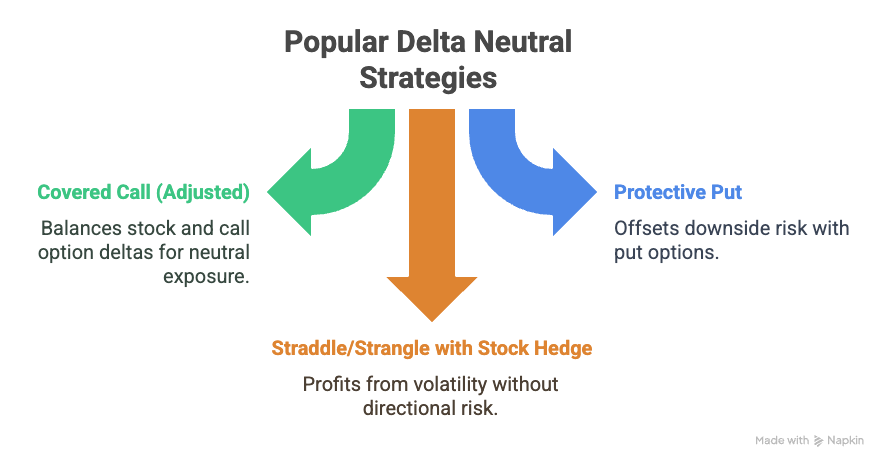
Covered Call (Adjusted)
In a covered call setup, call options are sold against shares already held. In a delta-neutral version of this strategy, the position is adjusted so that the positive delta from the stock is offset by the negative delta from the call options.
This means the ratio is not fixed at one call per 100 shares. Instead, it is based on the option’s delta. For example, if a call option has a delta of 0.4, around 2.5 call options may be sold against 100 shares to bring the overall delta close to zero.
Protective Put
This strategy is straightforward but effective. Here, you buy the stock, which gives you a positive delta, and then you buy a put option to offset downside risk. Since the put has a negative delta, it balances out your exposure to some degree. It won’t make your portfolio fully delta neutral on its own, but it gets you closer and protects you in case of a big drop.
Straddle or Strangle with Stock Hedge
This is where things get interesting. Say you open a straddle (buying both a call and a put at the same strike). On its own, this strategy is sensitive to volatility but not necessarily delta neutral, especially if the stock moves. To keep the whole setup neutral, you might buy or short shares of the underlying stock to offset any net delta from the options. This combo gives you a shot at profiting from big moves in either direction without having to guess which way it’ll go.
Each of these strategies takes a slightly different path to reach the same goal, which is balancing your positions so you’re not exposed to big gains or losses just because the market moves up or down.
Benefits of a Delta Neutral Strategy
Here’s why so many traders rely on delta-neutral strategies:
Reduces Directional Risk
The biggest benefit of delta neutral strategy is that you’re not relying on whether the market goes up or down. This means even if the stock takes a surprise turn, your portfolio stays balanced, helping you avoid big losses from sudden price swings.
More Control
You get a better handle on your trades. Since you’re not focused on predicting market direction, you can manage your positions with more clarity and fewer surprises. This gives you more control over how much risk you’re actually taking.
Profit from Volatility
You don’t need to bet on the market moving up or down, just that it’ll move. If the market is swinging back and forth, delta-neutral setups can help you benefit from that volatility without taking sides.
Useful for Institutions
For large investors like institutions or hedge funds, keeping a huge portfolio hedged all the time is key. Delta-neutral strategies make it easier to stay protected against sudden market shifts while still staying active in trading.
Risks and Limitations of Delta Neutral
Even though delta-neutral strategies can help reduce directional risk, they do not come without any challenges. Some of the key risks and limitations are as follows:
Frequent Rebalancing
Since delta constantly changes with stock price movements and time decay, maintaining neutrality means you’ll have to check and adjust your position regularly, sometimes even daily.
Transaction Costs
With all that frequent rebalancing comes at a cost. Each adjustment means more buying and selling, which leads to higher brokerage fees and slippage over time.
Exposure to Other Greeks
While delta is managed, you’re still exposed to other option Greeks like gamma, time decay, and vega, which can impact your strategy’s performance.
Not Foolproof
A delta-neutral position doesn’t guarantee zero losses. Sudden market movements, volatility spikes, or poor timing in rebalancing can still lead to meaningful drawdowns despite the hedge, because these things can bring a lot of changes in other Greeks, as discussed in the point above.
Conclusion
Delta neutral is a powerful strategy for managing risk in options trading. While it requires a deeper understanding of options Greeks and frequent position management, it can be highly effective in volatile or uncertain stock markets. It’s best suited for traders who want to reduce directional risk and focus on stability or volatility-based gains.
Frequently Asked Questions(FAQs)
Is delta neutral strategy profitable?
Yes, it can be profitable, especially in markets that are volatile or range-bound. Traders using this strategy often benefit from time decay and shifts in implied volatility, rather than relying on directional moves. So, even if the price doesn’t move much, you can still make money from the way options behave.
Can beginners use delta-neutral strategies?
While it’s possible, it’s not the best place to start. These strategies require a solid understanding of options Greeks, regular monitoring, and the ability to rebalance often. Beginners might find it overwhelming, so it’s better to build experience with simpler trades before diving into delta-neutral setups.
How often should I rebalance a delta-neutral position?
There’s no fixed schedule; it depends on how the market moves. You’ll typically need to rebalance when your net delta drifts too far from zero, which could be daily or weekly. Some traders use software tools to track this automatically and alert them when it’s time to act.
Does delta neutral mean no risk?
Not quite. While delta-neutral strategies reduce directional risk, you’re still exposed to other factors like changes in volatility, time decay, and the rate of change of delta (gamma). So while the strategy lowers certain risks, it doesn’t eliminate risk entirely.
Disclaimer: This content is for educational purposes only and does not constitute financial or investment advice. Investments in securities or other financial instruments are subject to market risk, including partial or total loss of capital. Past performance is not indicative of future results. Always consider your financial situation carefully and consult a licensed financial advisor before making investment or trading decisions.
Engineered for the obsessed. Built for traders.

Purpose-built terminals.
Zero compromise.
Built for speed.

Plot No 1290, 2nd Floor, 17th Cross, 5th Main, Sector-7, HSR Layout, Bangalore 560102
Follow us on


Mintcap Brokers Private Limited
CIN – U66110KA2023PTC178706 | Registered Address: Plot No 1290, Second Floor, 17th Cross, 5th Main, Sector-7, HSR Layout, Bangalore 560102 | Tel: 080 – 49552310 | Email ID: compliance@capmint.com | SEBI registered Stock Broker: INZ000322732 | NSE Cash/F&O Member ID: 90430 | BSE Cash/F&O Member ID: 6903 | MCX Member ID: 57400 | NCDEX Member ID: 1312 | SEBI registered Depository Participant: IN-DP-806-2025 | CDSL DP ID: 12102300 | NSE Clearing Member code: M70108 | AMFI-Registered Mutual Fund Distributor: ARN-289109 (Valid upto 28-Feb-2027) | Category II Execution Only Platform : E6903
Details of Client Bank Account
Compliance Officer: Ms. Shridevi Vungarala | Email ID: compliance@capmint.com | Tel no. + 91 9035330126 | Grievance Redressal Officer (GRO) – Ms. Shikha Gupta | Email ID: Grievance@capmint.com | Tel no: 9035331595.
Procedure to file a complaint on SEBI SCORES: Register on SCORES portal. Mandatory details for filing complaints on SCORES: Name, PAN, Address, Mobile Number, E-mail ID. Benefits: Effective Communication, Speedy redressal of the grievances. You may refer the website https://scores.sebi.gov.in/ for more information. You may also download the SEBI Scores app to log a complaint Android: https://play.google.com > store > apps > sebiscores iOS: https://apps.apple.com > app > sebiscores
Disclaimer
Investment in the securities market are subject to market risks, read all the related documents carefully before investing. Brokerage will not exceed the SEBI prescribed limit.
Mutual fund investments are subject to market risks, read all scheme related documents carefully before investing. Mutual Funds are not exchange-traded products.
Attention Investor:
- Stock Brokers can accept securities as margin from clients only by way of pledge in the depository system w.e.f. September 1, 2020.
- Update your mobile number & email Id with your stock broker/depository participant and receive OTP directly from depository on your email id and/or mobile number to create pledge.
- Pay 20% as upfront margin of the transaction value to trade in cash market segment.
- Investors may please refer to the Exchange’s Frequently Asked Questions (FAQs) issued vide circular reference NSE/INSP/45191 dated July 31, 2020 and NSE/INSP/45534 dated August 31, 2020 and other guidelines issued from time to time in this regard.
- Check your Securities /MF/ Bonds in the consolidated account statement issued by NSDL/CDSL every month.