

Link copied!
Bid-Ask Spread

The bid-ask spread is the difference between the highest price a buyer is willing to pay (bid) and the lowest price a seller is willing to accept (ask) for a security.
Key Takeaways
- Bid-ask spread is the gap between the highest price buyers will pay (bid) and the lowest price sellers will accept (ask), representing a hidden cost in every trade.
- Narrow spreads mean high liquidity and lower transaction costs, while wide spreads suggest low liquidity and higher costs, making it harder to trade efficiently.
- They provide liquidity by buying at the bid and selling at the ask, making the spread their profit margin for facilitating trades.
- Trading during peak hours, focusing on liquid securities, and placing limit orders help reduce the impact of wide spreads on your investments.
What is Bid-Ask Spread?
When you look at a stock on your stockbroker’s platform, you will see two prices on your screen. These are known as the bid price and the ask price.
Bid price is the highest price a buyer is willing to pay at the moment, and ask price is the lowest price that a seller is willing to accept for the same asset.
Think of it like a marketplace; buyers want a deal, and sellers want the best price. The buyer is saying, “I’ll pay ₹100 for this,” and the seller is saying, “I’ll sell it, but only if I get ₹101.” That ₹1 difference is what we call the bid-ask spread. This difference may look small, but this difference can reveal a lot about how liquid or easy it is to trade that particular stock.
Example of Bid-Ask Spread
Let’s look at a simple example we discussed above and look at its implications:
- A stock shows a bid of ₹100 and an ask of ₹101.
- The bid-ask spread = ₹101 – ₹100 = ₹1.
If you buy the stock at ₹101 and sell it immediately at ₹100, you incur a loss of ₹1. That ₹1 is your transaction cost due to the spread. Again, it may look very small price difference, but if you buy 100 such shares, you will incur a loss of ₹10, which is 10% of your investment.
In liquid blue-chip stocks bid-ask spread is very small to notice, making them an ideal choice for traders.
The spread is where market makers (entities that provide liquidity) earn a profit by buying at the bid and selling at the ask.
Why the Bid-Ask Spread Matters?
The bid-ask spread may look tiny on the screen, but it can quietly eat into your trades more than you think.
Trading Cost Impact
Every time you buy or sell, you’re doing it through the bid-ask spread. This gap slightly shifts the price against you, acting like an invisible cost.
High-Frequency Trading
When trades are executed frequently, say hundreds or thousands a day, even a small spread of a few paise or cents can accumulate into substantial trading expenses.
Profitability and Spread Width
A wide spread means you’re buying higher and selling lower, making it harder to break even or profit, especially if the price doesn’t move significantly in your favour.
Long-Term Investor Impact
While long-term investors may not feel the pinch immediately, wider spreads can still slightly reduce investment efficiency over time, especially in low-liquidity assets.
Factors That Affect the Bid-Ask Spread
Not all spreads are the same; they change with how active, volatile, or competitive the market is. Let’s take a look at each of them separately
Liquidity
The more liquid a security is, the more people are actively buying and selling it. This strong participation narrows the spread, making trading more cost-efficient.
Trading Volume
High trading volume shows frequent transactions, which leads to greater price agreement between buyers and sellers, which tightens the spread and improves execution.
Volatility
Volatile securities have more unpredictable price swings. To protect against sudden changes, market makers widen the spread, increasing the cost for traders.
Competition Among Market Makers
More competition means market makers are willing to reduce their margins to attract order flow, which helps lower the spread.
Time of Day
Bid-ask spreads can change throughout the trading day based on market activity. During low trading periods, spreads tend to widen, while during peak hours, they usually become narrower due to higher liquidity. External events also play a role, for example, spreads may fluctuate around key announcements by the Reserve Bank of India (RBI) or major economic updates, as trading volume and market participation increase.
Market Bid-Ask Spread
Different markets have varying levels of liquidity and trading activity, which directly impact the width of the bid-ask spread.
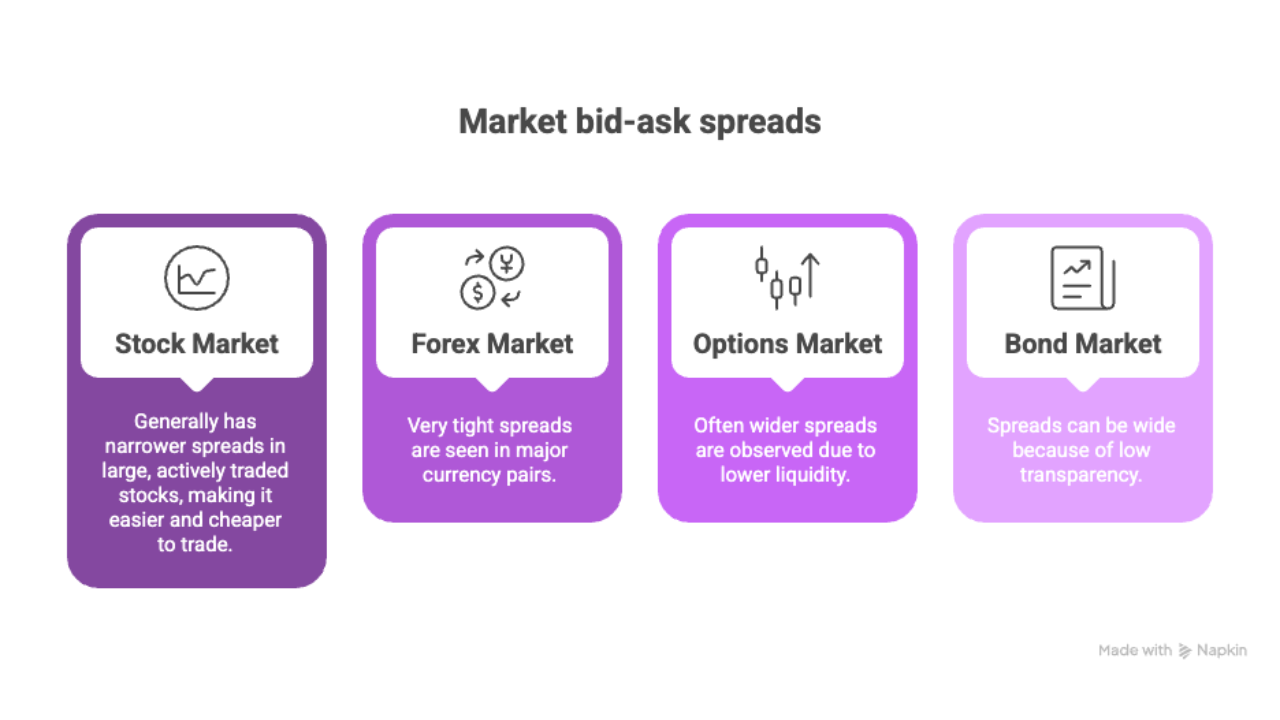
Relationship Between Bid-Ask Spread and Market Liquidity
The bid-ask spread is a strong indicator of liquidity:
Narrow Spread
A narrow bid-ask spread indicates that the stock is highly liquid, with a large number of buyers and sellers actively trading. This makes it easier to enter and exit positions quickly without significantly impacting the stock price, resulting in smoother and more efficient trades.
Wide Spread
A wide bid-ask spread suggests that the stock is less liquid, with fewer participants in the market. In such cases, executing trades becomes more difficult, and even small orders can cause noticeable price movements, increasing trading costs and risk.
This is why institutional investors prefer liquid stocks with minimal spreads.
How to Minimise the Impact of Bid-Ask Spreads?
Trade Liquid Securities
More buyers and sellers mean tighter spreads and better prices, which reduces hidden trading costs significantly. Trading in highly liquid assets ensures your orders are executed quickly and close to the expected price.
Avoid Off-Hours Trading
Liquidity drops after market hours, causing spreads to widen and increasing your cost of trading during these periods. It’s best to trade during peak hours when market activity is high to get tighter spreads.
Use Limit Orders
Instead of accepting the current market price, set your own price to avoid paying unnecessarily wide spreads and control execution. Limit orders give you more control and can save money by preventing trades at unfavourable prices.
Monitor Market Depth
Checking the order book helps you understand available prices beyond the best bid and ask, allowing smarter trade decisions. This insight can help you avoid sudden price moves and find better opportunities to enter or exit positions.
Conclusion
The bid-ask spread is more than just a number. It tells you about the cost of trading, the market’s liquidity, and the level of activity in a security. Understanding this concept helps traders and investors make smarter decisions, avoid hidden costs, and improve overall trading efficiency. Whether you are a short-term trader or a long-term investor, being aware of the bid-ask spread enables you to better manage your entry and exit points in the market. Paying attention to spreads also helps you assess market conditions and choose the best time and asset for your trades.
Frequently Asked Questions (FAQs)
What is a good bid-ask spread?
A good bid-ask spread is usually less than 0.5% of the asset’s price. Narrow spreads lower your trading costs and help active traders execute orders more efficiently, saving money on frequent trades.
Why is the spread wide in some stocks?
Wide spreads often happen in stocks with low liquidity, low trading volume, or high volatility. When buyers and sellers struggle to agree quickly, the gap between bid and ask prices widens, increasing transaction costs.
Does the spread affect long-term investors?
Long-term investors feel less immediate impact from spreads than traders, but wide spreads can still raise the cost of buying or selling positions. Over time, this can slightly reduce overall investment returns, especially in less liquid assets.
Is the bid-ask spread a fee?
The spread isn’t a direct fee charged by brokers, but it works like a hidden cost. When you buy at the ask price and sell at the bid price, the difference effectively acts as a built-in trading cost.
Disclaimer: This content is for educational purposes only and does not constitute financial or investment advice. Investments in securities or other financial instruments are subject to market risk, including partial or total loss of capital. Past performance is not indicative of future results. Always consider your financial situation carefully and consult a licensed financial advisor before making investment or trading decisions.
Engineered for the obsessed. Built for traders.

Purpose-built terminals.
Zero compromise.
Built for speed.

Plot No 1290, 2nd Floor, 17th Cross, 5th Main, Sector-7, HSR Layout, Bangalore 560102
Follow us on


Mintcap Brokers Private Limited
CIN – U66110KA2023PTC178706 | Registered Address: Plot No 1290, Second Floor, 17th Cross, 5th Main, Sector-7, HSR Layout, Bangalore 560102 | Tel: 080 – 49552310 | Email ID: compliance@capmint.com | SEBI registered Stock Broker: INZ000322732 | NSE Cash/F&O Member ID: 90430 | BSE Cash/F&O Member ID: 6903 | MCX Member ID: 57400 | NCDEX Member ID: 1312 | SEBI registered Depository Participant: IN-DP-806-2025 | CDSL DP ID: 12102300 | NSE Clearing Member code: M70108 | AMFI-Registered Mutual Fund Distributor: ARN-289109 (Valid upto 28-Feb-2027) | Category II Execution Only Platform : E6903
Details of Client Bank Account
Compliance Officer: Ms. Shridevi Vungarala | Email ID: compliance@capmint.com | Tel no. + 91 9035330126 | Grievance Redressal Officer (GRO) – Ms. Shikha Gupta | Email ID: Grievance@capmint.com | Tel no: 9035331595.
Procedure to file a complaint on SEBI SCORES: Register on SCORES portal. Mandatory details for filing complaints on SCORES: Name, PAN, Address, Mobile Number, E-mail ID. Benefits: Effective Communication, Speedy redressal of the grievances. You may refer the website https://scores.sebi.gov.in/ for more information. You may also download the SEBI Scores app to log a complaint Android: https://play.google.com > store > apps > sebiscores iOS: https://apps.apple.com > app > sebiscores
Disclaimer
Investment in the securities market are subject to market risks, read all the related documents carefully before investing. Brokerage will not exceed the SEBI prescribed limit.
Mutual fund investments are subject to market risks, read all scheme related documents carefully before investing. Mutual Funds are not exchange-traded products.
Attention Investor:
- Stock Brokers can accept securities as margin from clients only by way of pledge in the depository system w.e.f. September 1, 2020.
- Update your mobile number & email Id with your stock broker/depository participant and receive OTP directly from depository on your email id and/or mobile number to create pledge.
- Pay 20% as upfront margin of the transaction value to trade in cash market segment.
- Investors may please refer to the Exchange’s Frequently Asked Questions (FAQs) issued vide circular reference NSE/INSP/45191 dated July 31, 2020 and NSE/INSP/45534 dated August 31, 2020 and other guidelines issued from time to time in this regard.
- Check your Securities /MF/ Bonds in the consolidated account statement issued by NSDL/CDSL every month.