

Link copied!
Arbitrage

An arbitrage is a trading strategy that involves buying and selling similar assets in different markets to take advantage of the price difference. It involves buying an asset in one market at a lower price and simultaneously selling it in another market at a higher price.
Key Takeaways
- Arbitrage profits from price differences across markets by buying low and selling high simultaneously. It helps correct mispricings and improves market efficiency.
- Speed and precision are critical; automated systems ensure trades are executed instantly without slippage. Any delays can erase the profit opportunity.
- Arbitrage comes in many forms, like spatial, temporal, statistical, and triangular, each with unique setups. Traders pick strategies based on market conditions.
- Arbitrage is not risk-free; execution failures, costs, and regulations can eat into profits or cause losses. Efficient markets also make arbitrage opportunities rare.
Understanding Arbitrage
Arbitrage is the practice of exploiting price discrepancies for the same asset or related securities across two or more markets or platforms. By simultaneously buying low in one market and selling high in another, arbitrageurs aim to realise profits with minimal or no risk. The key components of arbitrage include:
- Price Discrepancy: Differences in quoted prices for the same asset across venues.
- Simultaneous Execution: Executing offsetting buy and sell orders at the same time to lock in the spread.
- Capital Deployment: Having sufficient funds or credit to settle both sides of the trade instantly.
This mechanism is vital for removing mispricings and facilitating accurate price discovery. As arbitrageurs act on these inefficiencies, they narrow bid-ask spreads, enhance liquidity and help drive prices toward fair market value, thus supporting overall market efficiency.
How Does Arbitrage Work?
Let’s break down the operational flow of arbitrage trading and illustrate how traders identify, execute, and profit from price discrepancies across markets.
Step-by-Step Mechanism
- Identify Discrepancy:
Traders must constantly monitor real-time price feeds and order books across multiple venues such as exchanges, OTC platforms, and electronic communication networks to detect price differences for the same or related assets. In practice, most actionable discrepancies on liquid Indian equities last only a few seconds, which is why manual scanning is largely impractical for this step.
- Execute Trades:
Once an opportunity is identified, they must immediately place simultaneous buy and sell orders. This is typically carried out using automated trading systems to ensure both sides of the transaction are executed instantly, thereby locking in the price spread.
- Settle and Rebalance:
After execution, positions must be cleared and settled according to the respective market’s requirements. Traders must also regularly rebalance their portfolios and collateral to maintain optimal exposure and meet margin obligations.
- Repeat:
The process must be continuous. In this era of algorithmic trading, advanced systems scan for new arbitrage opportunities around the clock across multiple exchanges and asset classes.
Arbitrage Example
Suppose Tata Motors shares are trading at ₹900 on the BSE and ₹905 on the NSE. An arbitrageur notices this price discrepancy and simultaneously buys 1,000 shares on the BSE and sells 1,000 shares on the NSE.
After the trade, the arbitrageur delivers the shares purchased from BSE to fulfil the sell order on NSE, effectively closing both legs of the transaction. This locked-in ₹5 per share spread results in a total profit of ₹5,000, assuming no transaction costs or delays. In reality, once brokerage, STT, GST, and exchange transaction charges are factored in, the net profit on a trade like this would be noticeably lower, which is why arbitrageurs typically need to execute at high volumes to make the strategy viable.
The Economics of Arbitrage
Arbitrage is the technique of earning small profits by purchasing and selling shares on separate markets or exchanges at the same time. The difference in price between two markets for the same security, currency, or commodity is called a spread, which represents the arbitrageur’s potential profit.
In the stock market, arbitrage occurs when traders identify a price difference for the same asset across exchanges. They buy the asset in the market where the price is lower and simultaneously sell it in the market where the price is higher. This process locks in the price difference as profit, provided the trades are executed quickly.
While arbitrageurs attempt to profit from market inefficiencies, their actions also help improve overall market efficiency. By exploiting pricing discrepancies, they highlight mispricing in a particular stock or asset. As more traders act on the opportunity, the price difference gradually disappears, and markets move toward fair value.
Arbitrageurs are typically large financial institutions or professional trading firms that deploy significant capital to execute these trades. Since price gaps are usually very small and disappear quickly, traders must execute multiple trades to generate meaningful profits. On liquid large-cap stocks listed on both BSE and NSE, the typical price discrepancy tends to be in the range of ₹0.50 to ₹3, and it often corrects within seconds.
Because markets are constantly evolving and becoming more efficient, arbitrage opportunities are often short-lived. As a result, traders must continuously monitor markets and search for new arbitrage opportunities across different exchanges and asset classes.
Types of Arbitrage
Arbitrage manifests in several forms, each leveraging unique market conditions and offering different ways to extract value from inefficiencies.
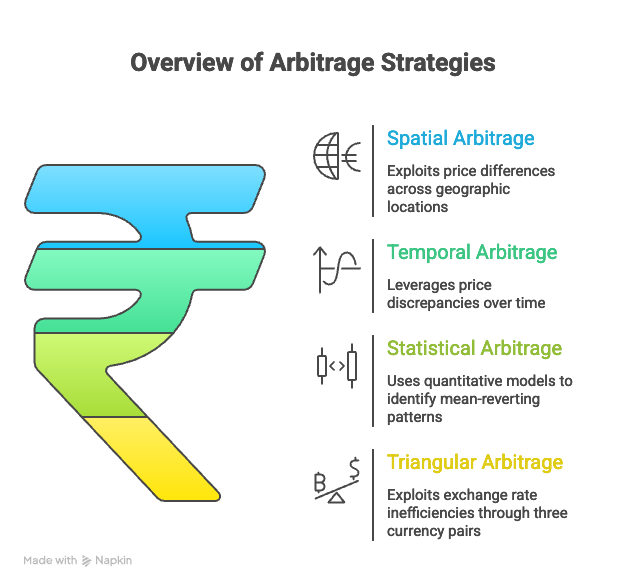
The popular types of arbitrage strategies include:
Spatial Arbitrage
This involves exploiting price differences for the same asset listed on different exchanges in separate geographic locations. For example, a stock may trade at a lower price on the NSE than on the BSE due to differences in local demand or order flow imbalances. Arbitrageurs capitalise by buying in the cheaper market and simultaneously selling in the more expensive one.
Temporal Arbitrage
This type leverages price discrepancies that exist across time. For instance, a commodity may have a different price in the spot market compared to its futures contract. Traders take offsetting positions in both markets to benefit from the convergence of these prices over time. In India, cash-futures arbitrage on Nifty 50 constituents is one of the more commonly observed forms of temporal arbitrage, particularly around monthly expiry dates when the basis tends to narrow sharply.
Statistical Arbitrage
This strategy relies on quantitative models and algorithms to identify mean-reverting price patterns or correlations between related securities. For example, if two historically correlated stocks deviate in price temporarily, traders may go long on the undervalued one and short the overvalued one, anticipating reversion. A common pitfall with this approach is that correlations can break down during periods of sector-wide stress, turning what appeared to be a hedged position into a directional bet.
Triangular Arbitrage
Common in the forex market, this involves converting one currency to another through a sequence of trades involving three different currency pairs to exploit exchange rate inefficiencies. For example, converting USD to EUR, EUR to GBP, and then GBP back to USD might yield a profit if pricing is misaligned.
Risks and Challenges of Arbitrage
Engaging in arbitrage may appear risk-free on the surface, but in reality, it involves several underlying challenges and potential pitfalls that traders must actively manage to maintain profitability and sustainability:
Execution Risk
Traders may face situations where one leg of the trade gets executed while the other fails, leaving them exposed to market risk. This is sometimes referred to as “leg risk” and is one of the most common sources of loss in arbitrage strategies. Even a brief delay between the two legs can turn a profitable setup into a losing position if the price snaps back.
Latency Risk
Arbitrage requires near-instant execution. Any delay, even in milliseconds, can eliminate the price difference, especially in high-frequency environments.
Transaction Costs
Even a small price spread can be completely eroded by brokerage fees, exchange fees, taxes, slippage, or interest on borrowed funds. Therefore, traders must ensure the net profit after all costs justifies the risk and effort involved in executing the trade.
Regulatory Risk
Legal environments differ across markets. Some jurisdictions impose restrictions on short selling, leverage usage, or specific arbitrage strategies like flash trading.
Market Efficiency
As financial markets become more integrated and technologically advanced, arbitrage opportunities become increasingly rare and fleeting. The proliferation of algorithmic trading over the past decade has compressed available spreads significantly, particularly on high-liquidity instruments.
Who Uses Arbitrage Strategies?
Arbitrage is leveraged by a range of market participants, each with distinct objectives, resources, and execution capabilities.
Hedge Funds
Hedge funds often run complex and large-scale arbitrage operations. They deploy advanced quantitative models and large amounts of capital to exploit pricing inefficiencies across markets, asset classes, or financial instruments.
Proprietary Trading Firms
Proprietary trading firms actively use high-frequency and statistical arbitrage strategies. These firms rely on advanced algorithms, ultra-fast trading systems, and direct market access to identify and execute arbitrage opportunities within milliseconds.
Institutional Investors
Large institutional investors, such as investment banks and asset managers, use arbitrage strategies in specific situations like mergers, acquisitions, or convertible securities. They may also perform risk arbitrage or interest rate arbitrage to benefit from temporary pricing gaps.
Retail Traders
Retail traders can also participate in arbitrage, although on a much smaller scale. Realistically, the biggest constraint for retail participants is execution speed. By the time a retail trader spots a discrepancy manually and places orders on two exchanges, the gap has usually already closed. Arbitrage mutual funds in India offer a more accessible alternative, as these funds systematically exploit cash-futures spreads and are taxed as equity funds if held for over a year.
Conclusion
Arbitrage remains a cornerstone of financial markets, driving efficiency and liquidity across asset classes. While opportunities have narrowed with technological advancement, skilled practitioners armed with the right tools can still identify and capitalise on fleeting mispricings. For investors and traders, understanding arbitrage principles is valuable, whether one engages directly or benefits indirectly from tighter spreads and more accurate pricing.
Frequently Asked Questions (FAQs)
What is arbitrage in simple terms?
Arbitrage is buying and selling the same asset across different markets to profit from price differences. It involves spotting mispricings and capitalising on them quickly with minimal risk. This process contributes to efficient pricing in the financial ecosystem, ensuring that values align across trading venues and benefiting all market participants through fairer prices.
Is arbitrage legal?
Yes, arbitrage is legal when executed within regulatory frameworks. It differs from market manipulation and insider trading. Regulatory bodies allow arbitrage because it enhances market liquidity and fairness. However, traders must stay updated on jurisdiction-specific rules to avoid penalties or compliance violations that may arise from technical oversights.
Can individuals do arbitrage?
Retail traders can engage in simple arbitrage, especially in forex and crypto markets, though scale and speed limitations apply. They may use basic tools like trading apps and price alerts. However, competition from institutions and technical barriers makes consistent retail arbitrage challenging without advanced infrastructure or automation. Arbitrage-focused mutual funds are a more practical route for most individual investors.
What are the benefits of arbitrage?
Benefits include low-risk profit potential, contributions to market efficiency, and tighter bid-ask spreads. Arbitrage activity drives price alignment across exchanges, increases liquidity, and accelerates information flow. It also reduces large pricing gaps, improving fairness and transparency for everyday investors and institutional traders alike.
Is arbitrage trading safe?
Arbitrage trading is generally considered lower risk because it involves buying and selling the same asset in different markets to capture price differences. However, it is not completely risk-free. Execution delays, transaction costs, liquidity issues, and sudden price changes can reduce profits or even cause losses, particularly when one leg of the trade fails to execute as planned.
Disclaimer: This content is for educational purposes only and does not constitute financial or investment advice. Investments in securities or other financial instruments are subject to market risk, including partial or total loss of capital. Past performance is not indicative of future results. Always consider your financial situation carefully and consult a licensed financial advisor before making investment or trading decisions.
Engineered for the obsessed. Built for traders.

Purpose-built terminals.
Zero compromise.
Built for speed.

Plot No 1290, 2nd Floor, 17th Cross, 5th Main, Sector-7, HSR Layout, Bangalore 560102
Follow us on


Mintcap Brokers Private Limited
CIN – U66110KA2023PTC178706 | Registered Address: Plot No 1290, Second Floor, 17th Cross, 5th Main, Sector-7, HSR Layout, Bangalore 560102 | Tel: 080 – 49552310 | Email ID: compliance@capmint.com | SEBI registered Stock Broker: INZ000322732 | NSE Cash/F&O Member ID: 90430 | BSE Cash/F&O Member ID: 6903 | MCX Member ID: 57400 | NCDEX Member ID: 1312 | SEBI registered Depository Participant: IN-DP-806-2025 | CDSL DP ID: 12102300 | NSE Clearing Member code: M70108 | AMFI-Registered Mutual Fund Distributor: ARN-289109 (Valid upto 28-Feb-2027) | Category II Execution Only Platform : E6903
Details of Client Bank Account
Compliance Officer: Ms. Shridevi Vungarala | Email ID: compliance@capmint.com | Tel no. + 91 9035330126 | Grievance Redressal Officer (GRO) – Ms. Shikha Gupta | Email ID: Grievance@capmint.com | Tel no: 9035331595.
Procedure to file a complaint on SEBI SCORES: Register on SCORES portal. Mandatory details for filing complaints on SCORES: Name, PAN, Address, Mobile Number, E-mail ID. Benefits: Effective Communication, Speedy redressal of the grievances. You may refer the website https://scores.sebi.gov.in/ for more information. You may also download the SEBI Scores app to log a complaint Android: https://play.google.com > store > apps > sebiscores iOS: https://apps.apple.com > app > sebiscores
Disclaimer
Investment in the securities market are subject to market risks, read all the related documents carefully before investing. Brokerage will not exceed the SEBI prescribed limit.
Mutual fund investments are subject to market risks, read all scheme related documents carefully before investing. Mutual Funds are not exchange-traded products.
Attention Investor:
- Stock Brokers can accept securities as margin from clients only by way of pledge in the depository system w.e.f. September 1, 2020.
- Update your mobile number & email Id with your stock broker/depository participant and receive OTP directly from depository on your email id and/or mobile number to create pledge.
- Pay 20% as upfront margin of the transaction value to trade in cash market segment.
- Investors may please refer to the Exchange’s Frequently Asked Questions (FAQs) issued vide circular reference NSE/INSP/45191 dated July 31, 2020 and NSE/INSP/45534 dated August 31, 2020 and other guidelines issued from time to time in this regard.
- Check your Securities /MF/ Bonds in the consolidated account statement issued by NSDL/CDSL every month.