

Table of Content
- Key Takeaways
- What Is Backwardation?
- Key Causes of Backwardation
- Differences Between Backwardation in Commodities and the Stock Market
- How Backwardation Impacts Market Dynamics?
- How Backwardation Affects Traders and Investors?
- Practical Example of Backwardation
- Backwardation vs Contango
- Conclusion
- Frequently Asked Questions (FAQs)
Link copied!
Backwardation

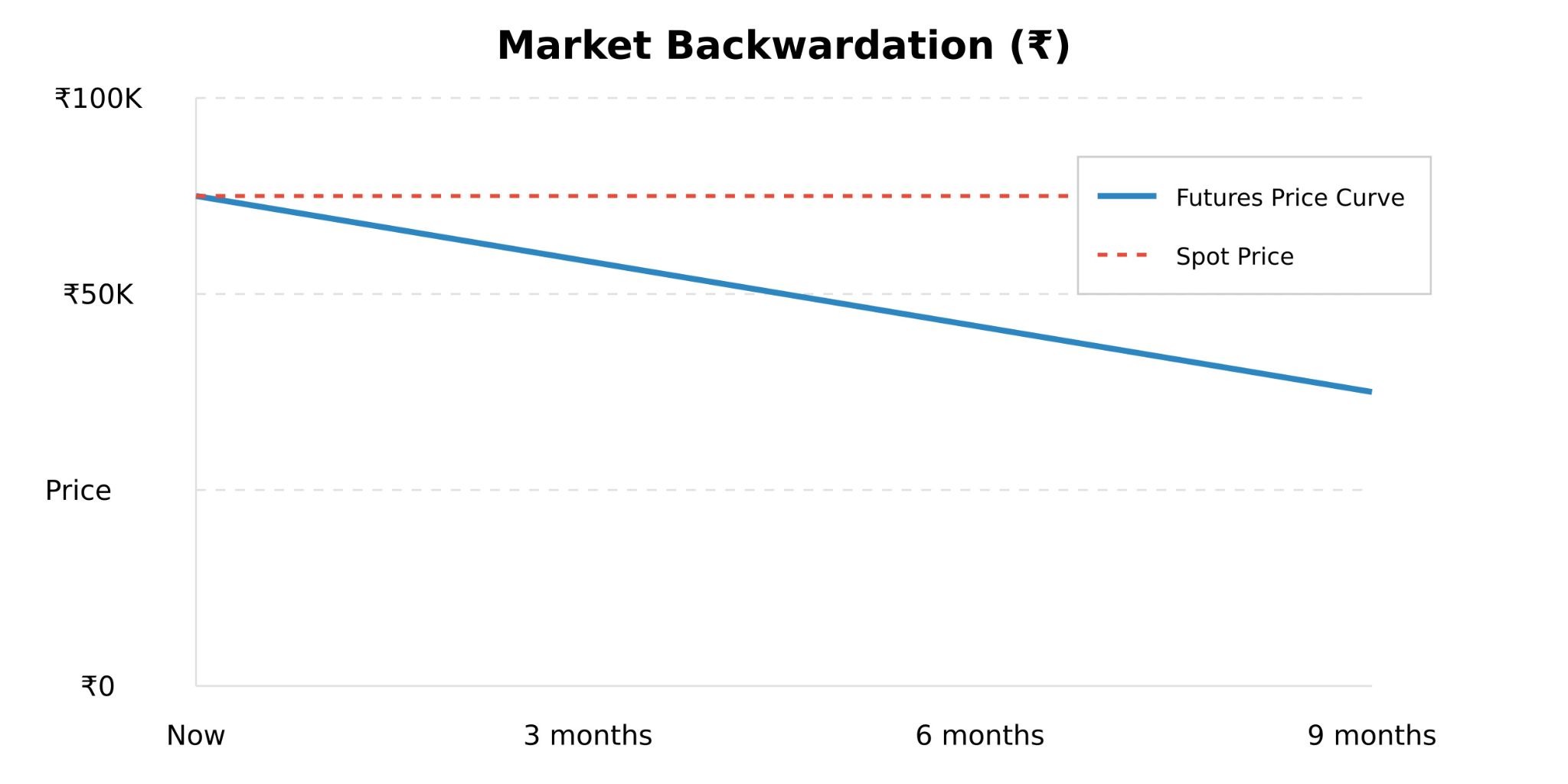
Backwardation is a market condition where the spot price of the underlying asset is higher than its futures price. It typically occurs when there is greater demand for the asset in the present compared to contracts expiring in the future.
Key Takeaways
- Definition: Backwardation occurs when the current (spot) price of a commodity is higher than its future price, indicating stronger demand for immediate delivery.
- Main Cause: It typically happens due to high present demand combined with low supply, often driven by storage issues, seasonal spikes, or supply disruptions.
- Common Markets: Most common in commodities like oil and gas; rare in stock markets, appearing mainly during financial crises when liquidity is prioritised.
- Market Impact: Influences futures trading by encouraging premiums for immediate access, helping investors understand market trends, manage risks, and improve hedging strategies.
What Is Backwardation?
Backwardation in the futures market is a market condition in the commodities futures market where the spot price (the price of a commodity for immediate delivery) is higher than the futures price (the agreed price for future delivery of the commodity).
Backwardation in the market occurs due to immediate demand or supply constraints and is more common in perishable commodities or those with high storage costs.
For example, geopolitical tensions may create supply shortages in the future. Limited storage space can make spot prices higher because traders or companies cannot store large amounts of oil, so there is an increase in trading activity.
Key Causes of Backwardation
Now that we understand how backwardation works, let’s look at the main reasons why this happens in the market.
Higher Demand For The Spot
Backwardation often occurs when the current demand for a commodity is high, but the immediate supply is limited. This drives spot prices up because buyers are willing to pay a premium to secure the commodity for immediate use.
For instance, crude oil during the winter months rises because there is higher demand for oil spikes, especially in colder regions. So, the price of crude oil demand rises, and future prices remain lower because the market expects demand to normalise and supply to catch up in the coming months.
Supply Disruptions Of The Commodity
Unexpected disruptions like natural disasters, geopolitical tensions, or production halts can disrupt the supply of a commodity, creating a scarcity in the immediate market. This often leads to a spike in spot prices while futures prices stay relatively lower due to expectations of future stability.
For example, during the U.S.-Iran standoff in 2020, tensions in the Middle East disrupted oil supply routes, causing spot prices for crude oil in India to spike. Traders importing oil faced higher immediate costs, while futures prices stayed lower, expecting supply to stabilise soon.
Carrying and Transportation Cost
Backwardation often arises when the cost of carrying and transporting a commodity (such as storage, insurance, and logistics) is high or when there is a shortage of immediate supply. Since buyers are willing to pay a premium to secure the asset now rather than later, the spot price exceeds the futures price. In such cases, the futures price reflects the spot price minus the avoided carrying and transportation costs, leading to backwardation.
Differences Between Backwardation in Commodities and the Stock Market
Now that we know what backwardation is, let’s see how it works differently in commodities and the stock market. The reasons and situations where it happens are quite different in both.
|
Backwardation in Commodities |
Backwardation in Stock Markets |
|---|---|
|
Common due to supply-demand imbalances and physical constraints |
Rare, typically during financial crises or unique scenarios |
|
It is driven by storage costs, perishability, immediate demand, and supply shocks | Investor panic, liquidity needs, or high dividend payouts |
|
For example, oil prices spike during geopolitical tensions or winter demand |
Stock indices during the 2008 crisis, when liquidity was prioritised |
|
It affects Physical assets like oil, gas, or metals with immediate utility |
Financial assets like stocks and indices without physical delivery |
|
It often occurs in the short term, driven by immediate scarcity or seasonal factors |
Usually very short-lived, tied to specific market events |
|
Indicates a tight supply or high convenience yield of physical assets |
Reflects fear, uncertainty, or immediate liquidity preference |
How Backwardation Impacts Market Dynamics?
Backwardation affects how prices, demand, and trading behaviour evolve in the market.
Signals Immediate Demand Pressure
Backwardation indicates that current demand is high compared to future demand. Buyers are willing to pay more now to secure supply.
Encourages Immediate Selling
Producers and traders may prefer selling assets in the present at higher prices instead of holding them for the future.
Creates Arbitrage Opportunities
Traders can use reverse cash-and-carry strategies by selling at higher spot prices and buying futures at lower prices.
Read more about Arbitrage.
Supports Positive Roll Yield
Investors in futures contracts may benefit as they roll over positions from lower-priced futures to higher spot prices.
Reflects Market Tightness
It often highlights supply shortages, disruptions, or seasonal demand spikes in commodities like oil or agricultural products.
How Backwardation Affects Traders and Investors?
Backwardation affects traders and investors by creating both opportunities and risks in the futures market. For traders, backwardation allows futures contracts to be purchased at a discount compared to the current spot price, with the potential to profit as the futures price converges upward toward the spot price near expiry. For investors, backwardation may indicate strong near-term demand or supply shortages, signalling attractive short-term gains but also higher market volatility.
Additionally, it reduces the cost of rolling over futures positions, which can benefit long-term investors in commodities. However, reliance on backwardation carries risks, as unexpected shifts in supply, demand, or carrying costs can quickly reverse the pricing structure, leading to potential losses.
Practical Example of Backwardation
A good example of backwardation can be seen in crude oil during supply disruptions.
Suppose crude oil is trading at ₹7,000 per barrel today, but a futures contract for delivery after three months is priced at ₹6,600. This shows backwardation, where the current price is higher than the future price.
This situation usually happens when there is an immediate shortage or high demand, such as during geopolitical tensions or supply cuts by oil-producing countries. Buyers are willing to pay a premium today to secure supply, while future prices remain lower as markets expect the situation to stabilise.
Backwardation vs Contango
While futures markets can move in either direction, two important pricing structures dominate backwardation and contango. Understanding their differences is crucial for traders and investors to make informed decisions.
|
Aspect |
Backwardation |
Contango |
|---|---|---|
|
Definition |
Spot price is higher than the futures price. | The futures price is higher than the spot price in contango. |
|
Market Signal |
Indicates strong current demand or limited supply. |
Suggests abundant supply or low current demand. |
|
Carrying & Transportation Costs |
Avoiding storage and transport costs makes holding the asset now more valuable. |
Futures prices include carrying, storage, and financing costs, making them higher than spot. |
|
Trader Opportunity |
Buy futures at a discount and profit as prices converge upward to spot. |
Risk of paying a premium for futures, which may erode returns if spot prices don’t rise accordingly. |
|
Investor Implication |
Beneficial for short-term traders and reduces roll-over cost for long-term investors. |
Increases roll-over cost for long-term investors and can drag on returns. |
|
Common in |
Commodities with immediate shortages (e.g., crude oil during supply shocks). |
Stable markets with low short-term demand but steady long-term outlook (e.g., gold, oil in surplus). |
Conclusion
Backwardation is a market condition where the spot price of a commodity is higher than its future price, often due to high immediate demand or supply disruptions. It is commonly seen in commodity markets, especially for perishable goods or those with high storage costs. Factors like seasonal demand, geopolitical tensions, and unexpected supply shortages contribute to this situation.
While backwardation is common in commodities, it is rare in the stock market and usually happens during financial crises or panic situations. In commodities, it reflects tight supply or urgency to secure the asset, while in stocks, it signals uncertainty and liquidity concerns.
Understanding backwardation helps traders and investors make informed decisions about market trends, potential risks, and future price movements. It plays a key role in futures trading, impacting hedging strategies and investment approaches. By analysing the causes and effects of backwardation, market participants can better navigate price fluctuations and manage risk effectively.
Frequently Asked Questions (FAQs)
Is backwardation bullish or bearish?
Backwardation is usually bullish because it shows that demand is high in the present, and people are willing to pay more to get the commodity immediately. This can push prices higher in the short term.
Is backwardation good or bad?
It depends on the situation. For traders and businesses needing the commodity now, backwardation can be bad because prices are higher. However, for investors holding the commodity, it can be good because they can sell at a higher price.
What is backwardation and contango?
Backwardation happens when the current price of a commodity is higher than its future price. This means demand is strong now, but the market expects prices to go down later.
Contango is the opposite. It happens when the future price is higher than the current price. This usually means there is plenty of supply now, and prices are expected to rise over time.
How does backwardation affect futures trading?
In backwardation, the spot price of an asset is higher than its futures price. For traders, this creates opportunities to buy futures contracts at a discount compared to the current market price. If spot prices remain high as the contract nears expiry, futures traders can profit from the convergence of futures prices toward the spot price.
Disclaimer: This content is for educational purposes only and does not constitute financial or investment advice. Investments in securities or other financial instruments are subject to market risk, including partial or total loss of capital. Past performance is not indicative of future results. Always consider your financial situation carefully and consult a licensed financial advisor before making investment or trading decisions.
Table of Content
- Key Takeaways
- What Is Backwardation?
- Key Causes of Backwardation
- Differences Between Backwardation in Commodities and the Stock Market
- How Backwardation Impacts Market Dynamics?
- How Backwardation Affects Traders and Investors?
- Practical Example of Backwardation
- Backwardation vs Contango
- Conclusion
- Frequently Asked Questions (FAQs)
Engineered for the obsessed. Built for traders.

Purpose-built terminals.
Zero compromise.
Built for speed.

Plot No 1290, 2nd Floor, 17th Cross, 5th Main, Sector-7, HSR Layout, Bangalore 560102
Follow us on


Mintcap Brokers Private Limited
CIN – U66110KA2023PTC178706 | Registered Address: Plot No 1290, Second Floor, 17th Cross, 5th Main, Sector-7, HSR Layout, Bangalore 560102 | Tel: 080 – 49552310 | Email ID: compliance@capmint.com | SEBI registered Stock Broker: INZ000322732 | NSE Cash/F&O Member ID: 90430 | BSE Cash/F&O Member ID: 6903 | MCX Member ID: 57400 | NCDEX Member ID: 1312 | SEBI registered Depository Participant: IN-DP-806-2025 | CDSL DP ID: 12102300 | NSE Clearing Member code: M70108 | AMFI-Registered Mutual Fund Distributor: ARN-289109 (Valid upto 28-Feb-2027) | Category II Execution Only Platform : E6903
Details of Client Bank Account
Compliance Officer: Ms. Shridevi Vungarala | Email ID: compliance@capmint.com | Tel no. + 91 9035330126 | Grievance Redressal Officer (GRO) – Ms. Shikha Gupta | Email ID: Grievance@capmint.com | Tel no: 9035331595.
Procedure to file a complaint on SEBI SCORES: Register on SCORES portal. Mandatory details for filing complaints on SCORES: Name, PAN, Address, Mobile Number, E-mail ID. Benefits: Effective Communication, Speedy redressal of the grievances. You may refer the website https://scores.sebi.gov.in/ for more information. You may also download the SEBI Scores app to log a complaint Android: https://play.google.com > store > apps > sebiscores iOS: https://apps.apple.com > app > sebiscores
Disclaimer
Investment in the securities market are subject to market risks, read all the related documents carefully before investing. Brokerage will not exceed the SEBI prescribed limit.
Mutual fund investments are subject to market risks, read all scheme related documents carefully before investing. Mutual Funds are not exchange-traded products.
Attention Investor:
- Stock Brokers can accept securities as margin from clients only by way of pledge in the depository system w.e.f. September 1, 2020.
- Update your mobile number & email Id with your stock broker/depository participant and receive OTP directly from depository on your email id and/or mobile number to create pledge.
- Pay 20% as upfront margin of the transaction value to trade in cash market segment.
- Investors may please refer to the Exchange’s Frequently Asked Questions (FAQs) issued vide circular reference NSE/INSP/45191 dated July 31, 2020 and NSE/INSP/45534 dated August 31, 2020 and other guidelines issued from time to time in this regard.
- Check your Securities /MF/ Bonds in the consolidated account statement issued by NSDL/CDSL every month.