

Table of Content
- Key Takeaways
- Understanding Contango: Why It Happens?
- Reasons For Contango In The Market
- Contango Market Curve
- Difference Between Contango and Backwardation
- What Contango Tells About the Market?
- Example: Contango in Gold Prices Before Diwali
- How Contango Affects Traders and Investors?
- Advantages and Disadvantages of Contango
- Conclusion
- Frequently Asked Questions (FAQs)
Link copied!
Contango

Contango is a market condition where the futures price of a commodity is higher than its current spot price. It often happens when traders expect the price of the commodity to rise in the future after factoring in costs like storage, insurance, and interest.
Key Takeaways
- Contango is when the price of a commodity in the futures market is higher than its current spot price. This often happens because of expectations of rising costs, demand, or inflation in the future.
- Contango usually occurs because of extra costs like storage and insurance, and traders expect prices to rise over time. It reflects market confidence that prices will increase over time.
- As the futures contract gets closer to its maturity date, the futures price and the spot price come closer together, a process called convergence. This happens because traders focus more on the actual market value of the asset.
- Contango is very common in commodity markets where traders get future contracts as a hedge against rising prices. This directly affects the commodity ETFs and structured derivatives.
Understanding Contango: Why It Happens?
Contango in the futures market occurs when the futures contract price of an asset is higher than its current spot market price. This occurs because investors are willing to pay more for the asset in the future, often due to expectations of rising carrying costs, insurance, or interest rates.
Contango is considered normal in markets because people generally believe that prices tend to increase due to shifts in demand and supply. Additionally, factors like changes in carrying costs, weather conditions, and other uncertainties can influence commodity prices in the future.
Reasons For Contango In The Market
Here are some main reasons for future prices to be higher than the spot price:
Carrying costs
Storing commodities is expensive, so buyers prefer not to take immediate delivery unless they really need the goods.
Expectations of Future Price
If traders expect prices to increase due to higher demand, inflation, or any economic factors that could affect the future value of the asset, the futures prices tend to be higher than the current spot price.
Market Sentiment
Investors don’t always act logically or focus only on fundamentals. Emotions and market sentiment also influence decisions, and because the future is uncertain, this often leads to poor predictions and quick, impulsive reactions.
Interest rates
Higher interest rates reduce contango by increasing the cost of holding assets, while lower interest rates support contango by making storage and borrowing cheaper.
Contango Market Curve
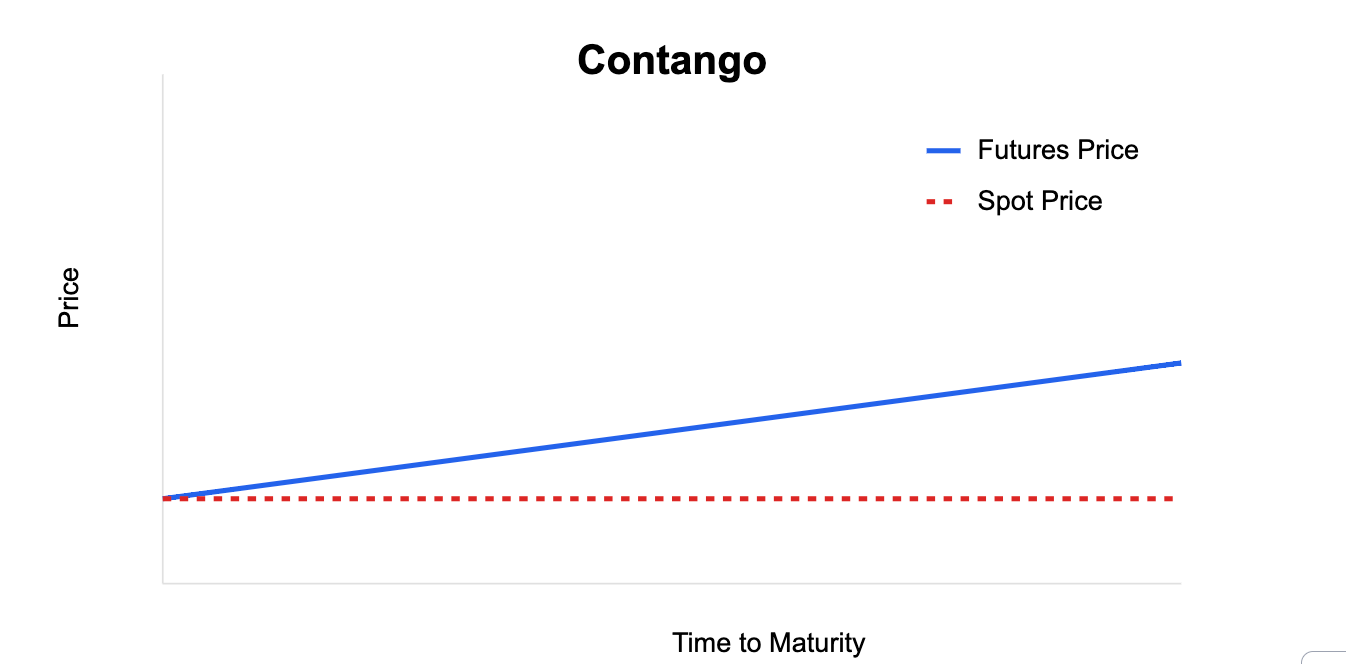
This image represents a contango curve, where the future price of an asset is higher than its current spot price. Contango is common in commodity markets. Companies often buy commodity futures to save on costs like storage and insurance. This strategy can benefit companies by locking in prices and reducing uncertainties.
For example, a company that sells agricultural products can use contango to fix a future price in advance. This helps them avoid sudden price changes in the market and plan their costs better.
As the maturity of the future date approaches in a contango market, the futures price usually starts to move closer to the spot price. This process is called convergence. Convergence happens at the maturity date because traders don’t want to take delivery of the underlying commodities, so there is more trading activity at the maturity date of the future’s underlying assets. Then, both spot prices and futures contract prices converge.
Difference Between Contango and Backwardation
|
Basis |
Contango |
Backwardation |
|---|---|---|
|
Definition |
The futures price is higher than the current spot price. |
The futures price is lower than the current spot price. |
|
Market Expectation |
Prices are expected to rise in the future. |
Prices are expected to fall in the future. |
|
Demand & Supply |
Future demand is expected to be higher. |
Current demand is higher than future demand. |
|
Market Sentiment |
Generally reflects bullish sentiment. |
Often reflects bearish or short-term supply shortage. |
|
Cost Factor |
Includes carrying costs like storage, insurance, and interest. |
Occurs when immediate demand outweighs carrying costs. |
|
Trading Opportunity |
Enables cash-and-carry arbitrage. |
Enables reverse cash-and-carry arbitrage. |
|
Example Scenario |
Gold futures are trading above the current price before the festive demand. |
Oil prices are higher today due to an immediate supply shortage. |
What Contango Tells About the Market?
One of the primary reasons for contango in the market is due to commodity storage. Contango tells us that the market is set to go up in the future. When the futures of the underlying are trading, more traders expect the asset to be worth more as time passes, which is what we see in most markets. Contango also indicates confidence in economic growth and favourable future supply-demand dynamics, the main driver of commodity prices.
Example: Contango in Gold Prices Before Diwali
Buying gold three months before Diwali can be an example of contango. In July 2024, gold was trading at ₹58,000 per 10 grams, a time when the demand for gold was usually low. However, the gold futures contract set to expire in October, during the Diwali season, was trading at ₹59,500 per 10 grams, which is ₹1,500 higher than the current price.
This premium reflects the market’s expectation of higher demand for gold in October due to the festive season. It shows how traders anticipate a rise in prices as Diwali approaches.
How Contango Affects Traders and Investors?
Contango Gives Hedging Opportunities
Businesses use Contango to lock in future prices and protect against rising costs, especially in commodities like oil and metals.
Contango Provides Arbitrage Opportunities
Traders can profit through cash and carry arbitrage, where they buy the asset at the lower spot price, store it, and sell futures at a higher price.
Impact of Contango on ETFs
Commodity ETFs tracking futures may lose value in Contango because they keep rolling over to higher-priced contracts, leading to negative roll yield.
Using Calendar Spreads
Traders can use calendar spreads (buying a near-term contract and selling a far-term contract) to take advantage of price differences in contango markets.
Advantages and Disadvantages of Contango
|
Advantages |
Disadvantages |
|---|---|
|
Provides hedging opportunities for businesses to lock in future prices and manage cost uncertainty. |
Can lead to losses for investors in commodity ETFs due to negative roll yield. |
|
Offers arbitrage opportunities like cash-and-carry, allowing traders to profit from price differences. |
High carrying costs (storage, insurance, interest) reduce overall profitability. |
|
Reflects positive market sentiment and expectations of future price growth. |
Indicates higher future prices, which may increase costs for buyers and businesses. |
|
Helps in better price discovery for future demand and supply conditions. |
Overestimation of future prices can lead to losses if expectations are not met. |
|
Useful for planning and budgeting, especially in commodity-based industries. |
Requires capital and storage capacity to execute strategies effectively. |
Conclusion
Contango is a market condition where the futures price of a commodity is higher than its current spot price. This happens because of expectations about rising costs, demand, or economic factors that influence future prices. Contango is common in commodity markets and is often seen as normal since prices are generally expected to rise over time.
Key factors driving contango include carrying costs like storage and insurance,inflation expectations, and overall market sentiment. It reflects the confidence of traders in future economic growth and supply-demand trends. However, as the futures contract approaches its maturity date, the price usually converges with the spot price due to increased trading activity.
Understanding contango helps traders and investors plan better, as it gives insights into market trends and expectations. It also highlights how both rational and emotional factors influence pricing in financial markets.
Frequently Asked Questions (FAQs)
Is contango bullish or bearish?
Contango is generally considered bullish because it shows that traders expect prices to go up in the future. It reflects confidence in the market and rising demand or costs over time.
What is the difference between contango and backwardation?
Contango happens when the price of a futures contract is higher than the current spot price because traders expect prices to rise in the future.
Backwardation happens when the price of a futures contract is lower than the current spot price because there is more demand for the asset now, and traders expect prices to fall in the future.
Simply put, contango shows expectations of price increases, while backwardation shows expectations of price decreases.
How can traders take advantage of contango?
Traders can profit from contango by buying a commodity or asset at a lower price today and selling a futures contract at a higher price for the future. They can also use a strategy called “cash and carry arbitrage,” where they buy and store the asset, then sell it at a higher price later.
What is an example of a contango?
Imagine crude oil is selling for ₹6,000 per barrel today, but the futures price for delivery in six months is ₹6,500. This means the market is in contango, as future prices are higher than current prices.
What is contango risk?
Contango risk happens when future prices drop instead of rising as expected. If atrader buys a futures contract at a higher price, but the actual market price does not increase, they may face losses.
Disclaimer: This content is for educational purposes only and does not constitute financial or investment advice. Investments in securities or other financial instruments are subject to market risk, including partial or total loss of capital. Past performance is not indicative of future results. Always consider your financial situation carefully and consult a licensed financial advisor before making investment or trading decisions.
Table of Content
- Key Takeaways
- Understanding Contango: Why It Happens?
- Reasons For Contango In The Market
- Contango Market Curve
- Difference Between Contango and Backwardation
- What Contango Tells About the Market?
- Example: Contango in Gold Prices Before Diwali
- How Contango Affects Traders and Investors?
- Advantages and Disadvantages of Contango
- Conclusion
- Frequently Asked Questions (FAQs)
Engineered for the obsessed. Built for traders.

Purpose-built terminals.
Zero compromise.
Built for speed.

Plot No 1290, 2nd Floor, 17th Cross, 5th Main, Sector-7, HSR Layout, Bangalore 560102
Follow us on


Mintcap Brokers Private Limited
CIN – U66110KA2023PTC178706 | Registered Address: Plot No 1290, Second Floor, 17th Cross, 5th Main, Sector-7, HSR Layout, Bangalore 560102 | Tel: 080 – 49552310 | Email ID: compliance@capmint.com | SEBI registered Stock Broker: INZ000322732 | NSE Cash/F&O Member ID: 90430 | BSE Cash/F&O Member ID: 6903 | MCX Member ID: 57400 | NCDEX Member ID: 1312 | SEBI registered Depository Participant: IN-DP-806-2025 | CDSL DP ID: 12102300 | NSE Clearing Member code: M70108 | AMFI-Registered Mutual Fund Distributor: ARN-289109 (Valid upto 28-Feb-2027) | Category II Execution Only Platform : E6903
Details of Client Bank Account
Compliance Officer: Ms. Shridevi Vungarala | Email ID: compliance@capmint.com | Tel no. + 91 9035330126 | Grievance Redressal Officer (GRO) – Ms. Shikha Gupta | Email ID: Grievance@capmint.com | Tel no: 9035331595.
Procedure to file a complaint on SEBI SCORES: Register on SCORES portal. Mandatory details for filing complaints on SCORES: Name, PAN, Address, Mobile Number, E-mail ID. Benefits: Effective Communication, Speedy redressal of the grievances. You may refer the website https://scores.sebi.gov.in/ for more information. You may also download the SEBI Scores app to log a complaint Android: https://play.google.com > store > apps > sebiscores iOS: https://apps.apple.com > app > sebiscores
Disclaimer
Investment in the securities market are subject to market risks, read all the related documents carefully before investing. Brokerage will not exceed the SEBI prescribed limit.
Mutual fund investments are subject to market risks, read all scheme related documents carefully before investing. Mutual Funds are not exchange-traded products.
Attention Investor:
- Stock Brokers can accept securities as margin from clients only by way of pledge in the depository system w.e.f. September 1, 2020.
- Update your mobile number & email Id with your stock broker/depository participant and receive OTP directly from depository on your email id and/or mobile number to create pledge.
- Pay 20% as upfront margin of the transaction value to trade in cash market segment.
- Investors may please refer to the Exchange’s Frequently Asked Questions (FAQs) issued vide circular reference NSE/INSP/45191 dated July 31, 2020 and NSE/INSP/45534 dated August 31, 2020 and other guidelines issued from time to time in this regard.
- Check your Securities /MF/ Bonds in the consolidated account statement issued by NSDL/CDSL every month.