

Link copied!
Hedgers

Market participants who use futures & options to protect their open position in the underlying asset from price fluctuations in the spot market are known as hedgers.
Key Takeaways
- Hedgers use derivatives to protect against price swings in the spot market. Their goal is safety and stability, not making profits from market movements.
- Businesses buy or sell futures depending on whether they want to lock in input costs or selling prices. The hedge offsets any adverse price changes later.
- Hedgers avoid risk and aim for protection, while speculators actively take risks for potential gains. Both are essential to a healthy, functioning futures market.
Who are Hedgers?
Futures & Options are mostly used for speculating in the stock market, but they can also be used to limit the risk an investor/trader faces in the stock/commodity market.
A hedger can be an investor trying to protect their investment in the market or a business trying to protect their business from unpredictable price swings in the commodity.
Hedgers are one of the most important participants in the futures market. They use futures contracts to reduce the risk of price changes in the assets they deal with. These participants are not trying to make a profit from the market; instead, they want to protect their business from unpredictable price swings.
Real-Life Examples of Hedgers
To better understand who the actual hedgers are, let’s take a look at some real-life examples.
Agricultural Producer
A wheat farmer expecting to harvest in three months may worry about falling wheat prices. To protect himself from this uncertainty, the farmer sells wheat futures contracts now. If prices fall at harvest time, the profit on the futures contract offsets the loss from lower market prices.
Note – To lock in selling prices (like selling wheat or copper), a business will sell futures.
Food Manufacturer
A cereal manufacturing company that needs corn for production might hedge by buying corn futures. This allows them to fix their input cost in advance and protect their margins even if corn prices rise later.
Note- To lock in input costs (like buying corn or oil), a business will buy futures.
Importers and Exporters
A company that imports machinery and expects to pay in US dollars may hedge against currency risk by using currency futures. If the domestic currency weakens, the gain on the futures position offsets the higher cost of importing.
Note – Importers hedge by buying futures to lock in the cost of foreign currency or goods. And, exporters hedge by selling futures to lock in the revenue in their local currency
Types of Hedgers
To understand how hedging works in practice, it’s important to look at the different types of hedgers based on their market position and risk exposure.
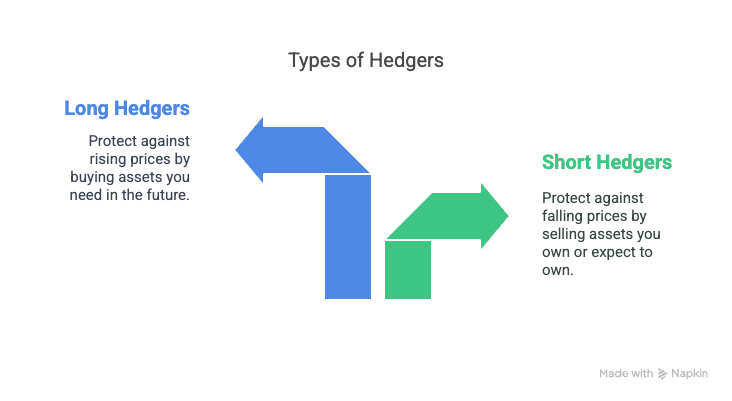
Short Hedgers
These are sellers who already own the asset or expect to own it and want to protect against falling prices. For example, a farmer sells wheat.
Long Hedgers
These are buyers who need to purchase the asset in the future and want to protect against rising prices. For example, a food company needs to buy sugar.
Role of Hedgers in the Stock Market
Hedgers play a crucial role in maintaining stability and reducing uncertainty in financial markets. As per the tone of your article, educational, structured, and beginner-friendly with practical clarity, the explanation should stay simple, factual, and slightly analytical.
Hedgers in financial markets are participants who use derivatives such as futures and options to protect themselves from adverse price movements. Their primary objective is not to make profits, but to reduce risk and ensure predictable outcomes in uncertain market conditions
In the stock market, hedgers contribute in multiple ways. They help stabilise prices by offsetting extreme fluctuations, as their trades are based on real exposure rather than speculation. By locking in prices, they bring real demand and supply into the derivatives market, which improves overall market efficiency.
Hedgers also support liquidity. Since they often take positions to manage risk, speculators can take the opposite side, ensuring smoother trade execution. This interaction between hedgers and speculators is essential for a well-functioning market.
From an investor’s perspective, a hedger investor uses strategies like buying protective puts or selling futures to safeguard their portfolio against downside risk. In derivatives markets, a hedger in derivatives focuses on protecting either the buying price (long hedge) or the selling price (short hedge), depending on their exposure.
Overall, the role of hedgers is to act as risk managers of the market, ensuring stability, reducing volatility impact, and enabling businesses and investors to operate with greater confidence despite price uncertainties.
Hedgers vs Speculators
Hedgers and speculators are two major types of participants in the futures market, each with distinct motives and strategies.
|
Basis |
Hedgers |
Speculators |
|---|---|---|
|
Purpose |
Hedgers enter futures contracts to reduce or eliminate the risk of price volatility in the underlying asset |
Speculators participate in futures markets purely to profit from price movements, without any underlying exposure to the asset. |
|
Market Role |
Hedgers bring real supply and demand into the market. Their trades are based on physical market exposure. |
Speculators provide liquidity by taking the opposite side of hedgers’ trades, helping ensure smoother market functioning. |
|
Risk Appetite |
Hedgers have a low risk appetite. They are risk-averse and prefer certainty over potential gains. |
Speculators have a high risk appetite and willingly accept the possibility of losses in hopes of making a profit. |
|
Outcome Expectation |
Hedgers are generally satisfied with breaking even in the futures market if it offsets their losses or protects margins in the spot market. |
Speculators aim to generate returns directly from the price changes in the futures contracts they trade. |
Conclusion:
Hedgers play an important role in the futures and options market by helping keep prices stable and reducing uncertainty. Whether it’s a farmer securing the selling price of crops, a manufacturer locking in input costs, or an importer managing currency risk, hedging helps them stay focused on their core work without constantly worrying about market ups and downs.
Unlike speculators, hedgers aren’t trying to make profits from price movements. Instead, they use derivatives as a safety net to protect themselves from unexpected changes. Understanding how hedging works can really help anyone manage financial risk more confidently.
Frequently Asked Questions (FAQs)
Why do companies use hedging in futures markets?
Companies use hedging in futures markets to protect themselves from adverse price movements in commodities, currencies, or interest rates. By locking in future prices through futures contracts, they can plan more accurately and avoid unexpected losses.
Is hedging only for large businesses?
No, hedging is not limited to large businesses. Even small farmers, exporters, or manufacturers can use futures contracts to hedge their price risks, provided they understand how these instruments work and can manage the associated costs.
Can a hedger make a profit from futures trading?
While hedgers do not enter futures contracts with the goal of making profits, they can sometimes benefit if market prices move in their favour. However, their primary aim is risk reduction, not speculation.
What’s the difference between a short and a long hedger?
A short hedger is someone who sells futures contracts to protect against falling prices of an asset they own or will produce. A long hedger, on the other hand, buys futures contracts to guard against rising prices of an asset they need to purchase in the future.
Disclaimer: This content is for educational purposes only and does not constitute financial or investment advice. Investments in securities or other financial instruments are subject to market risk, including partial or total loss of capital. Past performance is not indicative of future results. Always consider your financial situation carefully and consult a licensed financial advisor before making investment or trading decisions.
Engineered for the obsessed. Built for traders.

Purpose-built terminals.
Zero compromise.
Built for speed.

Plot No 1290, 2nd Floor, 17th Cross, 5th Main, Sector-7, HSR Layout, Bangalore 560102
Follow us on


Mintcap Brokers Private Limited
CIN – U66110KA2023PTC178706 | Registered Address: Plot No 1290, Second Floor, 17th Cross, 5th Main, Sector-7, HSR Layout, Bangalore 560102 | Tel: 080 – 49552310 | Email ID: compliance@capmint.com | SEBI registered Stock Broker: INZ000322732 | NSE Cash/F&O Member ID: 90430 | BSE Cash/F&O Member ID: 6903 | MCX Member ID: 57400 | NCDEX Member ID: 1312 | SEBI registered Depository Participant: IN-DP-806-2025 | CDSL DP ID: 12102300 | NSE Clearing Member code: M70108 | AMFI-Registered Mutual Fund Distributor: ARN-289109 (Valid upto 28-Feb-2027) | Category II Execution Only Platform : E6903
Details of Client Bank Account
Compliance Officer: Ms. Shridevi Vungarala | Email ID: compliance@capmint.com | Tel no. + 91 9035330126 | Grievance Redressal Officer (GRO) – Ms. Shikha Gupta | Email ID: Grievance@capmint.com | Tel no: 9035331595.
Procedure to file a complaint on SEBI SCORES: Register on SCORES portal. Mandatory details for filing complaints on SCORES: Name, PAN, Address, Mobile Number, E-mail ID. Benefits: Effective Communication, Speedy redressal of the grievances. You may refer the website https://scores.sebi.gov.in/ for more information. You may also download the SEBI Scores app to log a complaint Android: https://play.google.com > store > apps > sebiscores iOS: https://apps.apple.com > app > sebiscores
Disclaimer
Investment in the securities market are subject to market risks, read all the related documents carefully before investing. Brokerage will not exceed the SEBI prescribed limit.
Mutual fund investments are subject to market risks, read all scheme related documents carefully before investing. Mutual Funds are not exchange-traded products.
Attention Investor:
- Stock Brokers can accept securities as margin from clients only by way of pledge in the depository system w.e.f. September 1, 2020.
- Update your mobile number & email Id with your stock broker/depository participant and receive OTP directly from depository on your email id and/or mobile number to create pledge.
- Pay 20% as upfront margin of the transaction value to trade in cash market segment.
- Investors may please refer to the Exchange’s Frequently Asked Questions (FAQs) issued vide circular reference NSE/INSP/45191 dated July 31, 2020 and NSE/INSP/45534 dated August 31, 2020 and other guidelines issued from time to time in this regard.
- Check your Securities /MF/ Bonds in the consolidated account statement issued by NSDL/CDSL every month.