

Table of Content
Link copied!
Bull Calendar Spread

A bull calendar spread is an options trading strategy that involves buying and selling call options with the same strike price but different expiration dates, where the longer-dated option is purchased, and the shorter-dated option is sold.
Key Takeaways
- A bull calendar spread is a limited-risk, moderately bullish strategy designed to exploit time decay and volatility changes in the options market.
- Constructed by selling a near-term call and buying a longer-term call at the same strike price to benefit from time spread dynamics.
- The strategy profits from time decay and increasing implied volatility, especially as the short-term option nears expiration.
- Works best when the underlying price stays near the strike at short-term expiration, maximising the time-value differential.
What Is a Bull Calendar Spread?
A bull calendar spread strategy is an advanced options trading strategy that combines elements of time decay and a mildly bullish market outlook. This strategy involves selling a near-term call option and buying a longer-term call option at the same strike price. The goal is to profit when the underlying asset’s price rises slightly and stays near the strike price as the short-term option nears expiration.
If you are wondering how you will earn a profit if the stock moves slightly above the strike price, then you are on the right track.
Let’s understand this with an example. If you sold a call with a strike price of 20 for a premium of 2, you will earn the premium of 2 only if the stock closes below 20. If the stock closes at 21, you’ll be obligated to sell the stock at 20 (the strike), resulting in a loss of 1 (21 market price – 20 strike). Since you received a premium of 2, your net profit would be 2 – 1 = 1. Similarly, if it closes at 22, your loss on the trade is 2 (22 – 20), which completely offsets the premium you earned. Your net result is breakeven.
Basic Features Of Bull Calendar Spread
Same Strike Price: Both options (buy and sell) have the same strike price but different expiry dates.
1. Different Expiries: A near-term option is sold, and a longer-term option is bought.
2. Net Debit Strategy: The strategy usually requires paying a premium, as the long-term option costs more than the short-term option.
3. Time Decay Advantage: Traders benefit from faster time decay (theta) in the short-term option compared to the long-term option.
4. Neutral to Slightly Bullish View: It works best when the price stays near the strike price or moves slightly upward.
5. Limited Risk: The maximum loss is limited to the net premium paid.
6. Profit from Volatility: An increase in implied volatility can improve the value of the long-term option, benefiting the strategy.
How a Bull Calendar Spread Works?
This strategy is built using call options with the same strike price but different expiration dates. You sell the short-term call and buy the longer-term call, both at the same strike. If the stock price moves slightly upward and hovers around the strike price at the short-term option’s expiration, the short leg expires worthless, and the long leg retains value.
The tent-shaped payoff profile illustrates that maximum profit occurs when the stock stays near the strike, as you can see in the figure below.
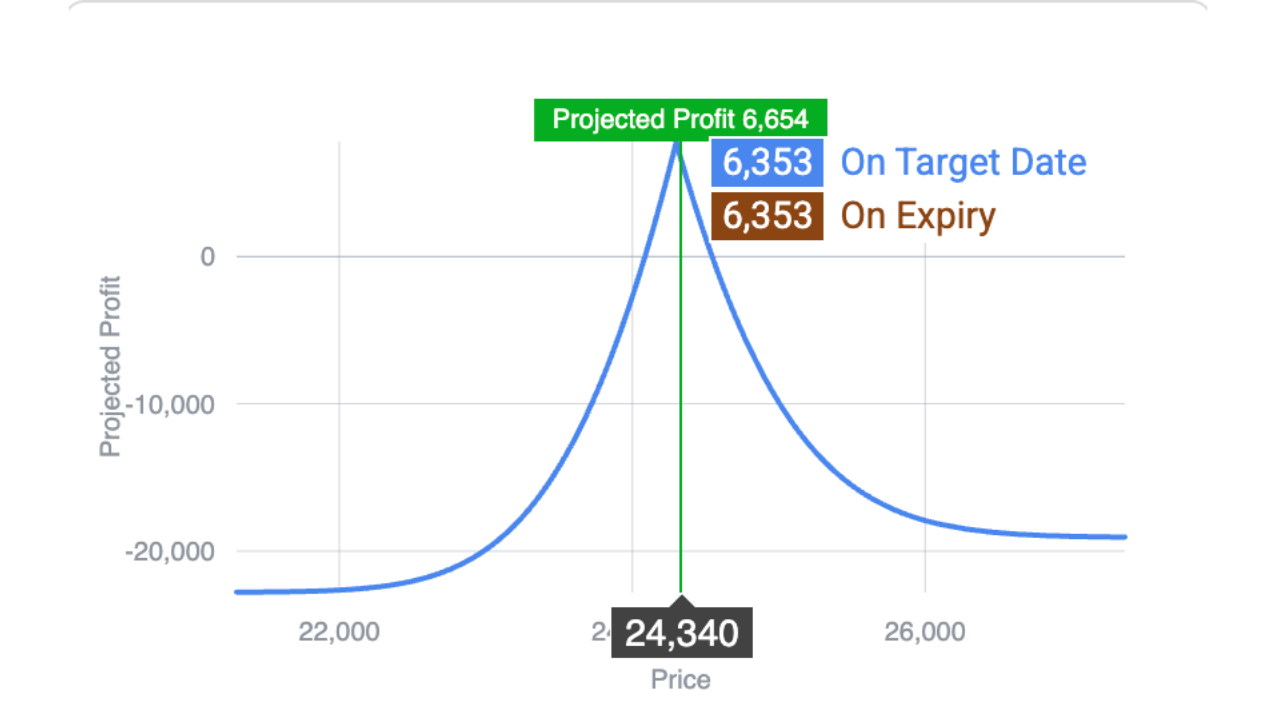
(In the above figure, the strategy was formed by selling 08 May Call of Nifty 24,300 and by buying Nifty Call 24,300 for the expiry date of 15 May, 2025)
Why Use a Bull Calendar Spread?
A bull calendar spread is suitable when:
- You expect the stock to rise slightly over a short period and stay close to the chosen strike price.
- Implied volatility is currently low but expected to increase, which would benefit the longer-term call option.
- You want to limit risk while taking advantage of time decay and volatility changes in a structured trade setup.
When to Use Bull Calendar?
This strategy is mainly used under two expectations, which are:
- When the market outlook is neutral to slightly bullish, and you anticipate limited directional movement in the short term.
- When you are expecting events that may increase volatility (like earnings reports, economic data), where implied volatility is likely to rise and favour the long option (longer-dated option).
Benefits of the Bull Calendar Spread
Defined and Limited Risk
The maximum loss is known upfront and limited to the initial debit paid for the spread. This makes it a safer strategy for traders who want to take a mildly bullish position without exposing themselves to large losses.
Profits from Time Decay and Volatility
The short-term call option decays faster than the long-term call, allowing traders to benefit from the passage of time. Additionally, if implied volatility rises, it increases the value of the long-term call, enhancing profitability.
Cost Efficiency Compared to Long Calls
A bull calendar spread generally costs less than buying a single long call. It provides exposure to upside potential with a smaller capital outlay and more controlled risk-reward dynamics.
Risks and Limitations of Bull Calendar Spread
Limited Profit Zone
The bull calendar spread profits only when the underlying stock stays near the strike price at the expiration of the short-term option. If the price moves significantly in either direction, the strategy becomes less effective, limiting profit potential.
Sensitivity to Volatility Drops
Since the strategy benefits from rising implied volatility, a drop in volatility, especially after entering the trade, can reduce the value of the long-term option and negatively impact the spread’s performance.
Requires Ongoing Management
This strategy is a bit complex as traders need to actively monitor price movements, implied volatility, and time decay to assess whether adjustments are necessary. This adds complexity and requires a solid understanding of option behaviour.
Conclusion
The bull calendar spread is an effective strategy for traders with a slightly bullish view who want to profit from time decay and rising volatility while keeping risk defined. With careful timing and strike selection, it can offer a smart alternative to buying calls outright or other directional strategies.
Frequently Asked Questions (FAQs)
Can I adjust a Bull Calendar Spread Mid-Trade?
Yes, you can roll the short leg or close one leg based on market movements. Adjustments help protect profits or limit further losses in case of unexpected price movements. They also allow traders to adapt to changing volatility or extend the trade’s duration.
When should you use a Bull Calendar Spread?
It is best used when you expect low volatility in the short term and a gradual price increase over time.
What is the maximum profit in a Bull Calendar Spread?
Maximum profit occurs when the underlying price is close to the strike price at the expiry of the short-term option.
What is the risk in a Bull Calendar Spread?
The risk is limited to the net premium paid, and losses occur if the price moves significantly away from the strike price.
Is a Bull Calendar Spread suitable for beginners?
Yes, it is considered a relatively low-risk strategy with limited loss, making it suitable for beginners with basic options knowledge.
Disclaimer: This content is for educational purposes only and does not constitute financial or investment advice. Investments in securities or other financial instruments are subject to market risk, including partial or total loss of capital. Past performance is not indicative of future results. Always consider your financial situation carefully and consult a licensed financial advisor before making investment or trading decisions.
Table of Content
Engineered for the obsessed. Built for traders.

Purpose-built terminals.
Zero compromise.
Built for speed.

Plot No 1290, 2nd Floor, 17th Cross, 5th Main, Sector-7, HSR Layout, Bangalore 560102
Follow us on


Mintcap Brokers Private Limited
CIN – U66110KA2023PTC178706 | Registered Address: Plot No 1290, Second Floor, 17th Cross, 5th Main, Sector-7, HSR Layout, Bangalore 560102 | Tel: 080 – 49552310 | Email ID: compliance@capmint.com | SEBI registered Stock Broker: INZ000322732 | NSE Cash/F&O Member ID: 90430 | BSE Cash/F&O Member ID: 6903 | MCX Member ID: 57400 | NCDEX Member ID: 1312 | SEBI registered Depository Participant: IN-DP-806-2025 | CDSL DP ID: 12102300 | NSE Clearing Member code: M70108 | AMFI-Registered Mutual Fund Distributor: ARN-289109 (Valid upto 28-Feb-2027) | Category II Execution Only Platform : E6903
Details of Client Bank Account
Compliance Officer: Ms. Shridevi Vungarala | Email ID: compliance@capmint.com | Tel no. + 91 9035330126 | Grievance Redressal Officer (GRO) – Ms. Shikha Gupta | Email ID: Grievance@capmint.com | Tel no: 9035331595.
Procedure to file a complaint on SEBI SCORES: Register on SCORES portal. Mandatory details for filing complaints on SCORES: Name, PAN, Address, Mobile Number, E-mail ID. Benefits: Effective Communication, Speedy redressal of the grievances. You may refer the website https://scores.sebi.gov.in/ for more information. You may also download the SEBI Scores app to log a complaint Android: https://play.google.com > store > apps > sebiscores iOS: https://apps.apple.com > app > sebiscores
Disclaimer
Investment in the securities market are subject to market risks, read all the related documents carefully before investing. Brokerage will not exceed the SEBI prescribed limit.
Mutual fund investments are subject to market risks, read all scheme related documents carefully before investing. Mutual Funds are not exchange-traded products.
Attention Investor:
- Stock Brokers can accept securities as margin from clients only by way of pledge in the depository system w.e.f. September 1, 2020.
- Update your mobile number & email Id with your stock broker/depository participant and receive OTP directly from depository on your email id and/or mobile number to create pledge.
- Pay 20% as upfront margin of the transaction value to trade in cash market segment.
- Investors may please refer to the Exchange’s Frequently Asked Questions (FAQs) issued vide circular reference NSE/INSP/45191 dated July 31, 2020 and NSE/INSP/45534 dated August 31, 2020 and other guidelines issued from time to time in this regard.
- Check your Securities /MF/ Bonds in the consolidated account statement issued by NSDL/CDSL every month.