

Link copied!
Speculation in Options

Speculation involves taking calculated risks to profit from anticipated market movements. In options trading, this means using contracts that derive their value from underlying assets to capitalise on expected price changes.
Key Takeaways
- Speculation in options means placing directional or volatility-based bets on where the market will move using call and put options, with the goal of making a profit from price movements.
- Traders use speculation because it offers leverage (larger exposure with less capital), flexibility for any market condition, and limited risk (only the premium paid).
- Common strategies include long calls, long puts, spreads, straddles, and strangles, each designed to profit from different types of market moves or volatility.
- Speculation comes with high risk; time decay can erode value, sudden changes in volatility can impact pricing, and you can lose the full premium if the trade goes wrong.
What Is Speculation in Options?
Speculation in options trading involves buying call or put options based on a prediction about the future direction of a stock or index. Unlike hedging, which is used to reduce risk, speculation is purely aimed at making a profit from expected price movements. Traders use options because they offer leverage, allowing them to take larger positions with a smaller investment compared to buying the underlying asset directly.
This strategy carries a high risk because options have a limited lifespan. If the market does not move in the predicted direction before the option expires, the entire investment can be lost. Speculative trading in options requires a strong understanding of market behaviour, timing, and the characteristics of the options being used.
On Indian exchanges, speculative activity in options is heavily concentrated in Nifty and Bank Nifty weekly expiries, where the low premium cost of short-dated options attracts traders looking for quick, leveraged returns. The weekly expiry cycle means that a significant portion of speculative capital is deployed and resolved within five trading days or less, which compresses both the decision timeline and the margin for error compared to monthly options.
Advantages of Speculation on Options
If you’re not just looking to protect your money but also want to take directional or volatility-based bets for high returns, options can be a practical instrument. Here’s why many traders use them for speculation:
Leverage
Options let you control a large quantity of shares by paying just a small premium instead of the full stock price. This means even a small price movement in the stock can lead to significant percentage returns on the premium invested.
To illustrate: if Nifty is at 22,000 and you buy a 22,200 call option for ₹80, a 200-point move in Nifty might increase the option’s value to ₹180–200, representing a 125–150% return on the premium. Buying Nifty futures for the same 200-point move would have yielded roughly 1.5–2% on the margin deployed. The percentage returns on options are dramatically higher because the capital at risk is a fraction of the notional exposure. But this leverage cuts both ways. If Nifty moves sideways or in the wrong direction, the entire ₹80 premium can go to zero within days.
Flexibility
You can use options no matter what your market view is, whether you think prices will go up, down, or stay flat. There are strategies for every situation. Bullish, bearish, range-bound, or expecting a big move in either direction: options provide a strategy for each scenario. This versatility is not available with simple stock buying, where you can only profit if prices rise.
Risk Management
Even though you’re speculating, the maximum you can lose in most option buying trades is just the premium you paid. This makes it structurally safer than directly short-selling stocks or taking leveraged futures positions, where losses can exceed the initial capital deployed. You know your worst-case outcome before entering the trade, which allows for clearer position sizing.
However, this limited-loss advantage applies specifically to option buying strategies. Option selling strategies, which some speculators also use, carry significantly higher and theoretically unlimited risk, and require a different risk management framework altogether.
Speculation Strategies in Options
Now let’s look at the specific strategies traders use to express their market views through options.
Long Call
This strategy involves buying a call option because you believe the price of a stock or index will rise. You choose a strike price that you think the asset will cross before expiry. If the market moves in your favour, your profit potential is theoretically unlimited. You only risk the premium paid, making it less capital-intensive than directly buying the stock.
The critical decision in a long call is strike price selection. Buying an at-the-money call (strike price close to the current market price) costs more but has a higher probability of becoming profitable. Buying an out-of-the-money call (strike price significantly above the current price) is cheaper, meaning you can buy more contracts for the same capital, but requires a larger move to become profitable. Many retail traders on Indian exchanges gravitate toward deep out-of-the-money calls because the premium is low, sometimes ₹5–15 per lot, but these options require a very large move to generate meaningful returns and expire worthless far more often than they pay off.
A practical consideration: for a long call to be profitable at expiry, the stock needs to move above the strike price by more than the premium paid. If you buy a ₹22,000 Nifty call for ₹150, Nifty needs to close above ₹22,150 at expiry just for you to break even. Anything below that and the trade is a loss, even if Nifty rose from ₹21,800 to ₹22,100, a 300-point move.
Long Put
Here, you buy a put option when you expect the stock to fall. It gives you the right to sell the asset at a fixed price, no matter how low it goes. This strategy profits when the underlying asset drops below the strike price minus the premium paid. Your loss is limited to the premium. It’s a simpler way to speculate on falling prices without borrowing shares or short-selling in the cash market.
Long puts can be particularly useful during earnings season when a trader expects disappointing results from a specific company but doesn’t want the unlimited risk that comes with short-selling the stock. On stocks with liquid F&O contracts, a put option provides a defined-risk way to express a bearish view. One detail to keep in mind: put premiums tend to be slightly more expensive than equivalent call premiums during periods of market nervousness, because demand for downside protection increases. This means a bearish bet through puts can cost more per unit of expected movement than a bullish bet through calls during fearful markets.
Spreads
Spreads involve combining two or more options, typically buying one and selling another at a different strike or expiry. Examples include Bull Call Spread, Bear Put Spread, and Calendar Spreads. They reduce overall cost and risk, but also cap your profits. This makes them a practical middle ground between risk and reward.
Bull Call Spread: Buy a call at a lower strike and sell a call at a higher strike. This reduces the net premium paid because the sold call generates income that partially offsets the bought call’s cost. Your maximum profit is the difference between the two strikes minus the net premium. For example, buying a ₹22,000 Nifty call for ₹200 and selling a ₹22,300 call for ₹80 gives you a net cost of ₹120, a maximum profit of ₹180 (₹300 strike difference minus ₹120 cost), and a maximum loss of ₹120. The risk-reward ratio is 1:1.5, which is more favourable than a naked long call in many scenarios.
Bear Put Spread: The bearish equivalent. Buy a put at a higher strike and sell a put at a lower strike. Same principle: lower cost, capped risk, capped reward.
Calendar Spreads: Involve buying and selling options at the same strike but different expiry dates. These are more complex and profit primarily from differences in time decay between the two expiries.
Spreads are widely used by more experienced options traders on Indian markets because they reduce the breakeven point and allow profitable trades even with moderate price movements. For traders who find that their directional view is often correct but the magnitude of the move is smaller than expected, spreads frequently outperform naked option buys.
Straddles and Strangles
These are non-directional volatility strategies. You use them when you expect a big price move but don’t know the direction.
In a straddle, you buy a call and put at the same strike. In a strangle, you buy a call and put at different strikes (out-of-the-money). If the stock makes a big move either way, you profit. But if it stays flat, both options can lose value or expire worthless.
These strategies are commonly used around events like earnings announcements, RBI policy decisions, union budget, or other scheduled events that are expected to cause sharp moves. The challenge is that the market often anticipates these events too. Implied volatility, which directly affects option premiums, tends to rise in the days leading up to known events. This means by the time you buy the straddle or strangle, you’re paying an elevated premium that already reflects the market’s expectation of a large move. After the event, implied volatility typically collapses (a phenomenon called “IV crush”), which can cause both legs of the position to lose value even if the underlying moves somewhat.
For a straddle to be profitable, the underlying needs to move more than the combined cost of both options. If a Nifty 22,000 straddle costs ₹400 (₹220 for the call and ₹180 for the put), Nifty needs to move above 22,400 or below 21,600 by expiry just to break even. That’s a roughly 1.8% move in each direction, which may or may not materialise depending on the event.
Strangles are cheaper because both options are out-of-the-money, but they require an even larger move to become profitable. The trade-off is always between cost and the magnitude of movement needed.
Risks Associated with Options Speculation
Understanding these risks clearly is what separates informed speculation from uninformed gambling.
Time Decay
As the expiration date gets closer, the value of an option naturally decreases; this is called time decay (technically measured by the Greek “theta”). Even if the stock moves in your direction, the option might lose value just because time is running out. For speculators, this means your timing has to be precise, or you risk losing money even when your directional view is correct.
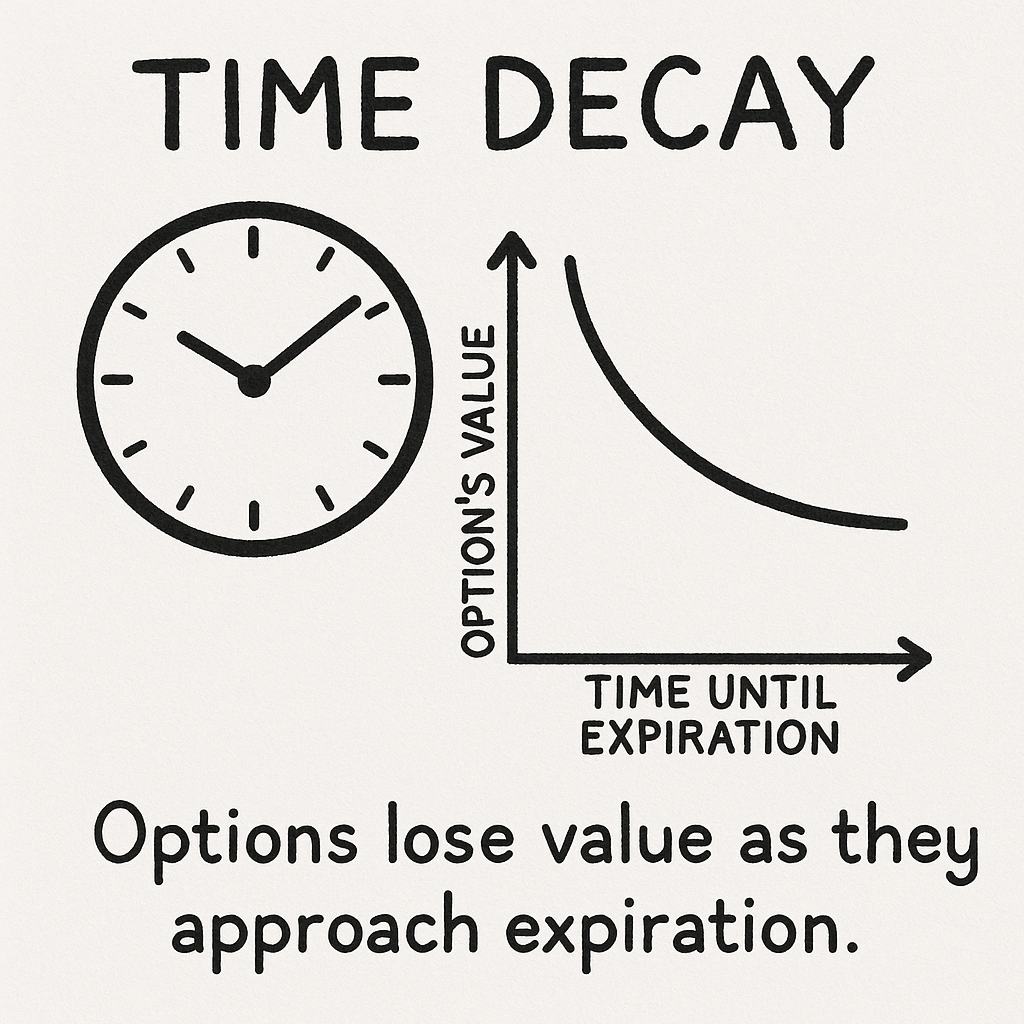
Time decay is not linear. It accelerates sharply in the final week before expiry, with the last two to three days being the most punishing for option buyers. A weekly Nifty option that is ₹30 out of the money on Wednesday morning might be worth ₹15, but by Thursday afternoon, it could be worth ₹2–3 even if Nifty hasn’t moved, simply because expiry is hours away. This is why buying options with very little time to expiry is one of the most common ways retail traders lose money on Indian exchanges. The probability of a large enough move occurring in the remaining time to overcome both the time decay and the distance to the strike price is low.
Volatility
Options prices are heavily influenced by how volatile the market is expected to be. Sudden drops or spikes in implied volatility can impact option premiums significantly. You might see your option losing value even if the stock price doesn’t change much, just because volatility expectations fell.
This risk is most visible in the IV crush after events. A trader who buys a straddle before Nifty quarterly results, paying elevated premiums, can find both legs of the position losing 30–40% of their value the next morning, even if Nifty moved 100–150 points, simply because implied volatility collapsed from 15% to 10% overnight. The price move happened, but it wasn’t large enough to overcome the premium that was already inflated by pre-event volatility expectations.
Conversely, buying options when implied volatility is unusually low, such as during extended periods of market consolidation, means you’re paying relatively cheap premiums. If volatility subsequently expands, the option’s value can increase even without a significant directional move. Awareness of where implied volatility sits relative to its recent range (its “IV percentile”) is a practical edge that many retail speculators overlook.
Potential for Total Loss
Unlike stocks, where you retain ownership and can wait for recovery, options can become completely worthless if the market doesn’t move as you expected within the option’s lifespan. If the price stays below your call strike or above your put strike at expiry, your option expires with zero value. In such cases, you lose the entire premium paid.
On Indian exchanges, data from NSE suggests that a significant majority of options expire worthless, particularly out-of-the-money weekly options. This means the base rate for option buyers is unfavourable: most individual speculative option trades result in a total loss of the premium. Profitability in options speculation comes not from winning on every trade but from ensuring that the wins are large enough to more than compensate for the frequent small losses. This requires discipline in position sizing, ensuring that no single trade represents more than 2–3% of trading capital, and selectivity in choosing only high-conviction setups rather than trading every perceived opportunity.
Liquidity Risk
While Nifty and Bank Nifty options are extremely liquid, options on individual stocks can have wider bid-ask spreads, particularly for strikes that are far out of the money or for expiries beyond the current month. This spread is a hidden cost that directly reduces profitability. On a stock option with a bid of ₹8 and an ask of ₹12, you’re giving up roughly 40% of the midpoint value just to enter and exit the trade. Sticking to liquid contracts and being aware of the bid-ask spread before entering a position is a practical habit that protects against this erosion.
Speculation vs Hedging: Key Differences
While both use the same instruments, the intent and approach are fundamentally different.
| Feature | Speculation | Hedging |
|---|---|---|
| Objective | Profit from anticipated price movements | Protect existing positions from adverse movements |
| Risk Appetite | High; actively taking on risk for potential reward | Conservative; reducing existing risk |
| Capital Deployed | Typically a small premium for leveraged exposure | Premium paid as an insurance cost |
| Outcome if Market Stays Flat | Loss of premium (no profit generated) | Loss of premium, but existing portfolio is unaffected |
| Typical Holding Period | Short-term (days to weeks) | Aligned with the risk event or portfolio holding period |
Understanding which mode you’re operating in is important. Many traders start with a hedging intent but gradually shift to speculation as they become comfortable with options, without adjusting their position sizing or risk management accordingly. This drift is a common source of unexpected losses.
Conclusion
Speculating with options can deliver significant returns, but it demands a clear understanding of how options are priced, how time decay works, and how volatility affects premiums. The main appeal lies in the leverage, flexibility, and the defined-risk nature of option buying strategies. But these advantages come with real risks: time decay works against every option buyer from the moment of purchase, implied volatility can expand or contract in ways that override your directional thesis, and the statistical reality is that most individual options trades, particularly on weekly expiries, result in a total loss of premium.
Successful options speculation is not about predicting direction on every trade. It is about finding setups where the potential payoff justifies the cost, sizing positions so that no single loss is damaging, and maintaining the discipline to avoid trading when the setup isn’t clear. Treating it as a skill that improves with deliberate practice, review, and honest assessment of past trades is what separates those who sustain profitability from those who experience occasional wins followed by steady erosion of capital.
Frequently Asked Questions (FAQs)
What is speculation with an example?
Speculation means taking a calculated risk to make a profit from future price movements. For example, if you think Reliance stock will go up after earnings, you might buy a call option for ₹50. If the stock rises sharply, the option could be worth ₹150–200, giving you a 200–300% return. If the stock doesn’t move or falls, you lose the ₹50 premium. The key distinction from gambling is that speculation is based on a thesis about market direction, informed by analysis, not random chance.
What is hedging and speculation in options?
Hedging is using options to protect your investments from losses, similar to insurance. You already own the stock and buy a put to limit downside. Speculation is using options to profit from expected price changes without necessarily owning the underlying asset. Hedgers start with a risk and use options to reduce it; speculators start with a market view and use options to express it.
What is speculation in derivatives?
Speculation in derivatives (like options or futures) means using these contracts to bet on the price direction of an asset, or on a change in volatility, without owning the underlying asset. Traders do this to earn leveraged returns with limited capital outlay. The risk is that derivatives have expiry dates, and time works against the buyer. Unlike investing in stocks, where you can hold indefinitely and wait for recovery, a speculative options position that doesn’t move in your favour within its lifespan results in a definite loss.
What is the most profitable option strategy?
There’s no universally most profitable strategy, as profitability depends on market conditions and execution. Long calls in a strong bull market or straddles and strangles around high-impact events can produce large returns. However, the strategies with the highest potential returns also have the highest failure rates. Spreads tend to produce smaller but more consistent returns because the cost basis is lower and the breakeven point is closer to the current price. For most traders, matching the strategy to the specific market condition, rather than searching for a single “best” strategy, produces better results over time.
Disclaimer: This content is for educational purposes only and does not constitute financial or investment advice. Investments in securities or other financial instruments are subject to market risk, including partial or total loss of capital. Past performance is not indicative of future results. Always consider your financial situation carefully and consult a licensed financial advisor before making investment or trading decisions.
Engineered for the obsessed. Built for traders.

Purpose-built terminals.
Zero compromise.
Built for speed.

Plot No 1290, 2nd Floor, 17th Cross, 5th Main, Sector-7, HSR Layout, Bangalore 560102
Follow us on


Mintcap Brokers Private Limited
CIN – U66110KA2023PTC178706 | Registered Address: Plot No 1290, Second Floor, 17th Cross, 5th Main, Sector-7, HSR Layout, Bangalore 560102 | Tel: 080 – 49552310 | Email ID: compliance@capmint.com | SEBI registered Stock Broker: INZ000322732 | NSE Cash/F&O Member ID: 90430 | BSE Cash/F&O Member ID: 6903 | MCX Member ID: 57400 | NCDEX Member ID: 1312 | SEBI registered Depository Participant: IN-DP-806-2025 | CDSL DP ID: 12102300 | NSE Clearing Member code: M70108 | AMFI-Registered Mutual Fund Distributor: ARN-289109 (Valid upto 28-Feb-2027) | Category II Execution Only Platform : E6903
Details of Client Bank Account
Compliance Officer: Ms. Shridevi Vungarala | Email ID: compliance@capmint.com | Tel no. + 91 9035330126 | Grievance Redressal Officer (GRO) – Ms. Shikha Gupta | Email ID: Grievance@capmint.com | Tel no: 9035331595.
Procedure to file a complaint on SEBI SCORES: Register on SCORES portal. Mandatory details for filing complaints on SCORES: Name, PAN, Address, Mobile Number, E-mail ID. Benefits: Effective Communication, Speedy redressal of the grievances. You may refer the website https://scores.sebi.gov.in/ for more information. You may also download the SEBI Scores app to log a complaint Android: https://play.google.com > store > apps > sebiscores iOS: https://apps.apple.com > app > sebiscores
Disclaimer
Investment in the securities market are subject to market risks, read all the related documents carefully before investing. Brokerage will not exceed the SEBI prescribed limit.
Mutual fund investments are subject to market risks, read all scheme related documents carefully before investing. Mutual Funds are not exchange-traded products.
Attention Investor:
- Stock Brokers can accept securities as margin from clients only by way of pledge in the depository system w.e.f. September 1, 2020.
- Update your mobile number & email Id with your stock broker/depository participant and receive OTP directly from depository on your email id and/or mobile number to create pledge.
- Pay 20% as upfront margin of the transaction value to trade in cash market segment.
- Investors may please refer to the Exchange’s Frequently Asked Questions (FAQs) issued vide circular reference NSE/INSP/45191 dated July 31, 2020 and NSE/INSP/45534 dated August 31, 2020 and other guidelines issued from time to time in this regard.
- Check your Securities /MF/ Bonds in the consolidated account statement issued by NSDL/CDSL every month.