

Link copied!
Option Hedging Strategies

Hedging with options means using option contracts (like calls or puts) to protect your existing investments from potential losses.
Key Takeaways
- Hedging with options means using call or put contracts to protect your investment from big losses. It works like insurance; you pay a small amount now to avoid bigger problems later.
- Put options can protect your stocks if prices fall, and selling call options can help you earn extra income. These strategies help you reduce risk without selling your stocks.
- Options are flexible and don’t require a lot of money up front. You can choose how much protection you want, how long you want it for, and it costs much less than using futures.
- To hedge properly, you need to plan your strategy, track the market, and adjust your options if needed. You can’t just buy and forget; it needs some attention.
Fundamentals of Options
To really use them well, especially for hedging, you need to understand a few basic building blocks. So, let’s break down the fundamentals of options in the simplest way possible.
Call Option (Right to Buy)
A call option gives you the right (but not the obligation) to buy an asset (like a stock) at a fixed price (strike price) before a certain date. Used in hedging when you think prices might go up and want to lock in today’s price.
Put Option (Right to Sell)
A put option gives you the right (but not the obligation) to sell an asset at a fixed price before a certain date. Used in hedging when you think prices might fall and want protection.
You own stock B (worth ₹200). You’re worried it might fall. You buy a put option with a strike price of ₹190. If the stock crashes to ₹160, the put saves you from a major loss. Your effective loss is limited to the ₹10 gap between the stock price and the strike price, plus the premium you paid for the put, rather than the full ₹40 decline.
One detail worth understanding early: the premium you pay for an option is not just based on how far the strike price is from the current price. It also factors in how much time remains until expiry and how volatile the underlying stock is. A put option on a highly volatile stock like Adani Enterprises will probably cost significantly more than one on a stable stock like HDFC Bank at the same relative distance from the current price, because the probability of a large move is higher.
Why Use Options in Hedging?
There are several advantages of using options for hedging, as they are a practical tool for investors looking to protect their portfolios against market volatility.
Flexibility
One of the biggest advantages of using options is their flexibility. Unlike other hedging tools, options allow you to tailor your strategy based on your specific market outlook and risk tolerance. Whether you want to hedge your entire portfolio or just a part of it, you can choose the strike price, expiration date, and the type of option (call or put) to fit your goals. This makes options highly adaptable for different scenarios and timeframes.
For instance, if you’re concerned about a specific event like an RBI policy announcement or quarterly results, you can buy a put option that expires shortly after the event. This gives you targeted protection for the exact risk window, rather than paying for longer-term coverage you don’t need.
Cost-Effectiveness
Another key benefit is cost-effectiveness. Compared to instruments like futures, options require only a small upfront premium. You don’t need to block large sums of capital in margins, which makes it more accessible for retail investors. This low-cost entry point allows you to gain meaningful protection with minimal investment, especially when the market is uncertain but you still want to stay invested.
To put this in perspective: hedging a ₹5 lakh equity portfolio with Nifty put options typically costs between ₹5,000 and ₹15,000 per month depending on market volatility and how much downside protection you want. That’s roughly 1–3% of the portfolio value for a month of coverage. Futures-based hedging, by contrast, would require margins of ₹80,000–₹1,20,000 to be locked up for the same period.
Risk Limitation
Lastly, options provide risk limitation. They are designed to cap your maximum potential loss while keeping your upside open. For example, a put option ensures that if the underlying asset falls below a certain level, your losses are limited to the premium paid and not beyond. At the same time, if the market moves in your favour, you can still enjoy the gains. This asymmetric risk-reward profile is what makes options a practical choice for risk management.
This is the fundamental difference between hedging with options versus futures. With futures, your hedge works in both directions: you’re protected on the downside but you also give up upside gains. With a put option, you keep the upside fully intact. The premium is the price you pay for this asymmetry.
How to Hedge with Options
These are the most commonly used option strategies for hedging positions:
Protective Put
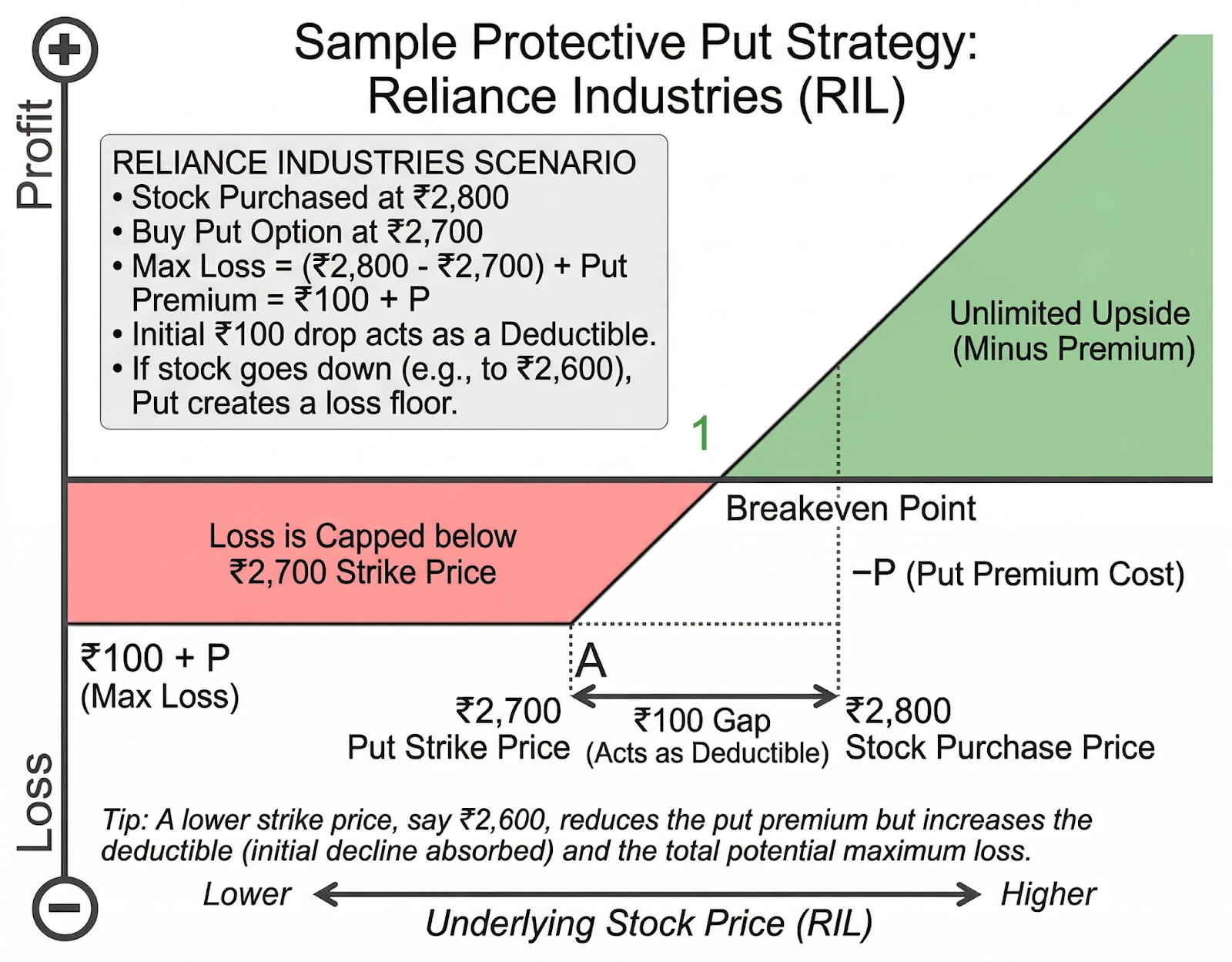
This strategy involves buying a put option for a stock you already own. It acts like insurance; if the stock price drops, the value of the put rises and cushions your loss. You pay a small premium for this protection.
Example Scenario:
You own Reliance Industries at ₹2,800 and are worried about market volatility. You buy a ₹2,700 put option. If the stock falls to ₹2,600, the put gains in value and reduces your loss, while if the stock rises, you still enjoy the upside. The ₹100 gap between the stock price and the strike price acts as a deductible, similar to how insurance policies have a deductible before coverage kicks in. Choosing a lower strike price (say ₹2,600 instead of ₹2,700) reduces the premium but means you absorb a larger initial decline before protection activates.
Do note: protective puts are straightforward on stocks that have liquid options contracts, which typically include Nifty 50 constituents and some of the more active F&O stocks. For stocks outside the F&O list, direct put options are not available, and portfolio-level hedging using Nifty puts becomes the alternative, though this introduces basis risk since individual stock movements don’t always mirror the index.
Covered Call
Here, you sell a call option on a stock you already own. You earn a premium upfront. If the stock stays below the strike price, you keep both the stock and the premium. It’s a way to earn income while offering minor downside protection.
Example Scenario:
You hold TCS shares at ₹3,800. You sell a ₹4,000 call option for a ₹50 premium. If the stock stays below ₹4,000, the option expires worthless, and you keep the ₹50 as profit. If it goes above ₹4,000, you still make a profit (₹200 from stock appreciation plus ₹50 premium) but might have to sell your shares.
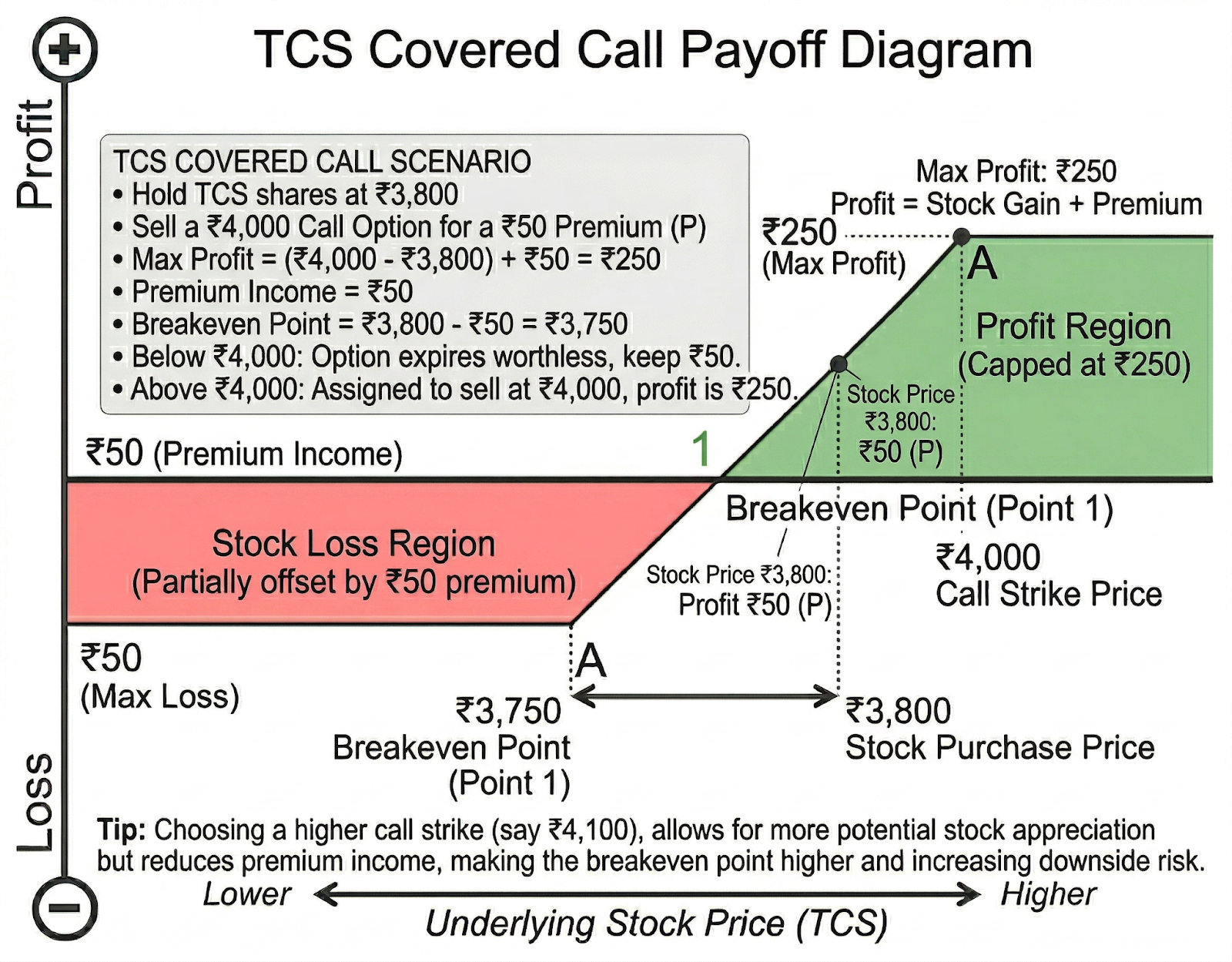
The covered call is not a pure hedge in the traditional sense. It provides limited downside cushion (only to the extent of the premium received) but caps your upside. It works best when you expect the stock to trade sideways or rise modestly. In strongly bullish markets, the regret of capping gains at the strike price can be significant. On the other hand, in a flat or mildly declining market, the premium income from selling calls month after month can meaningfully improve the overall return on a long-term holding.
For most stocks, the strategy works most cleanly when the lot size aligns with your holding. If you own 250 shares of a stock and the options lot size is 250, you can sell exactly one call contract. Mismatches between holding size and lot size require partial hedging or adjustments.
Collar Strategy
This combines both the protective put and the covered call. You buy a put for downside protection and simultaneously sell a call to fund the cost. It limits both losses and gains, useful when you’re okay with a defined range.
Example Scenario:
You own Infosys at ₹1,400. You buy a ₹1,350 put (for protection) and sell a ₹1,500 call (to collect premium). Now, your losses are capped below ₹1,350, and gains are capped above ₹1,500. It’s a cost-effective way to lock in a range.
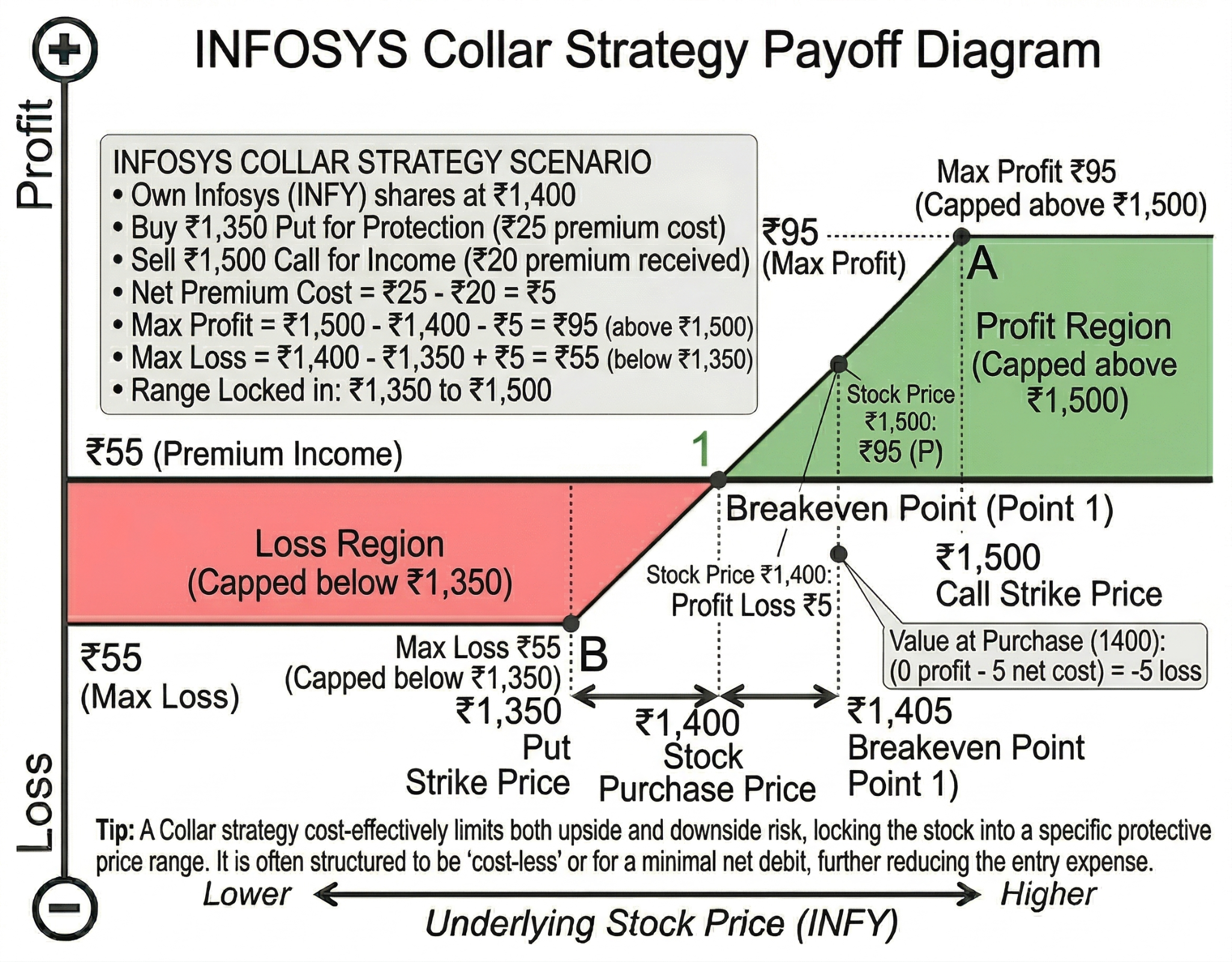
The collar is particularly useful before known risk events, such as quarterly earnings, regulatory decisions, or budget announcements, where you want protection but don’t want to pay the full premium for a standalone put. If the premium received from selling the call roughly offsets the cost of the put, the collar becomes a “zero-cost” hedge, meaning you get downside protection without any net premium outlay, though at the expense of capping your upside.
The width of the collar (the gap between the put strike and the call strike) determines your profit-and-loss range. A narrow collar (say ₹1,380 put and ₹1,420 call) gives you tight protection but very limited room for the stock to move. A wider collar provides more breathing room but either costs more in net premium or provides less downside protection.
Short Straddle
This involves selling both a call and a put option at the same strike price, assuming the stock won’t move much. You earn premiums from both, but the risk is high if the stock moves sharply in either direction. It’s more of a market-neutral income strategy than pure hedging.
Example Scenario:
You sell both a ₹21,000 Nifty call and a put option. If Nifty stays near 21,000 till expiry, both options expire worthless, and you keep the full premium. But if Nifty moves sharply up or down, losses can be significant. This strategy needs strict risk control.
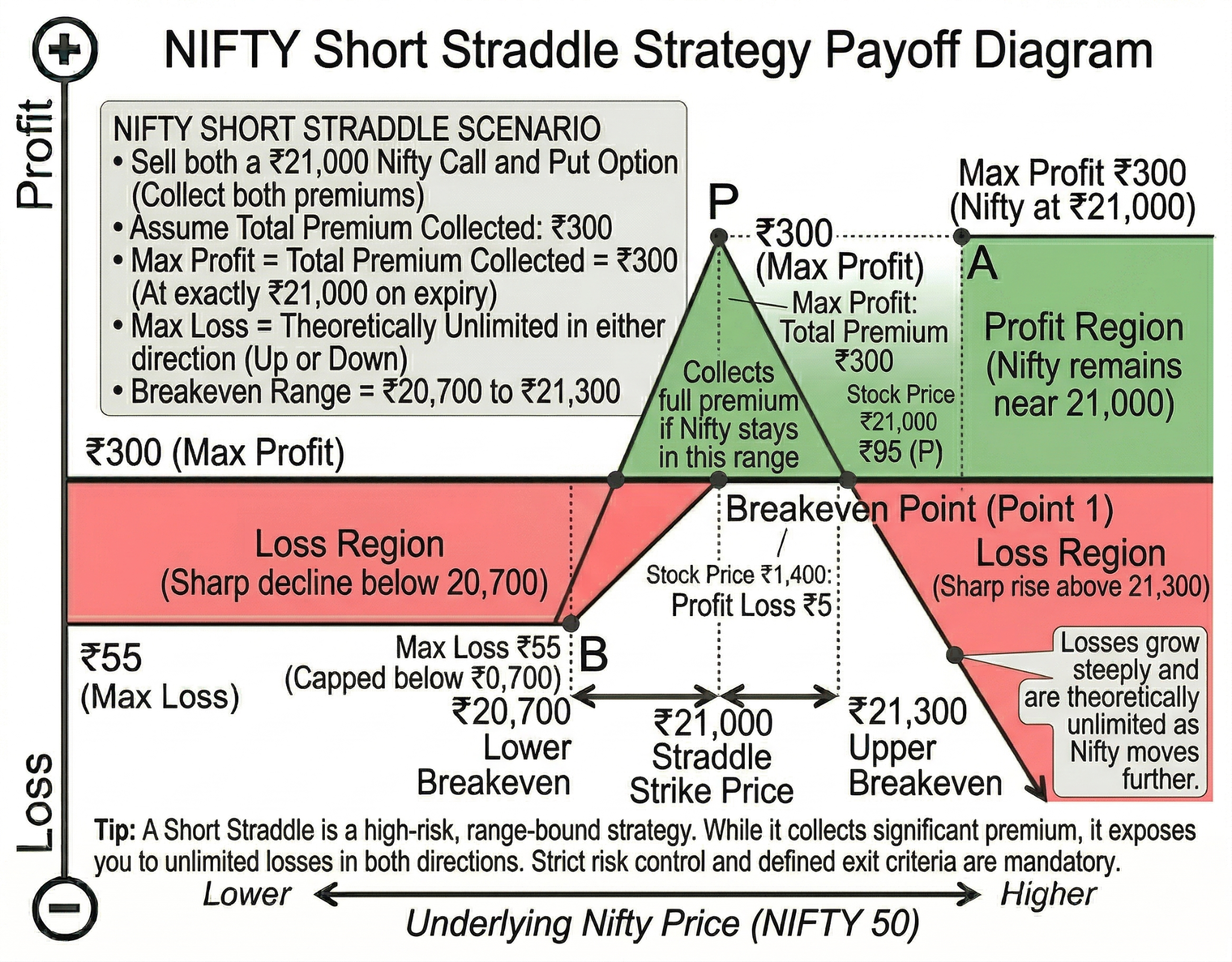
It’s important to be clear that the short straddle is not a hedging strategy in the protective sense. It is an income strategy that benefits from low volatility and time decay. Including it here is useful for completeness, but traders should understand that the risk profile is fundamentally different from a protective put or collar. A short straddle has unlimited risk on both sides, which means a single sharp move, such as the kind that occurs during unexpected events like the March 2020 crash, can produce losses many times larger than the premium collected. Position sizing and having a clear exit plan if the underlying moves beyond a defined range are essential when using this approach.
Steps to Implement Options Hedging
So now that you know why options are useful for hedging, let’s talk about how to actually use them. Here’s a step-by-step process to implement an options hedge.
Step 1: Market Analysis
Start by analysing overall market trends, sector performance, and company-specific risks. This helps identify where the risk is coming from: is it market-wide (Nifty), sectoral (Banking), or specific to the stock? The source of risk determines the hedging instrument. Market-wide risk is best hedged with Nifty or Bank Nifty options. Stock-specific risk requires options on that particular stock, if available.
For example, you observe that banking stocks are under pressure due to rising interest rate concerns. HDFC Bank, despite being fundamentally strong, might see temporary weakness. Based on this, you decide it’s time to hedge.
A useful starting point for deciding when to hedge is assessing the cost of protection relative to the potential loss. If Nifty put options are priced cheaply (low implied volatility), the cost of protection is low, and hedging becomes particularly attractive. If implied volatility is already elevated, as it typically is after a sharp decline has already occurred, the cost of puts may be prohibitively expensive, and alternative strategies like collars become more practical.
Step 2: Strategy Selection
Choose the right options strategy based on your goal. Are you looking for full protection, partial protection, or just extra income? Your risk appetite and investment horizon also matter here.
Since you want downside protection but don’t want to sell your HDFC Bank shares, you decide to go with a Protective Put strategy. This lets you stay invested while covering the potential fall.
A quick reference for strategy selection:
- Worried about a sharp decline and want full protection → Protective Put
- Want some protection at zero or low cost, willing to cap upside → Collar
- Expecting sideways movement, want to earn income on holdings → Covered Call
- Want to hedge an entire equity portfolio against broad market decline → Nifty Put Options
Step 3: Execution
This is where you place your trade. You choose the strike price and expiry date based on how much protection you want and how long you want it for. Higher protection (closer-to-money strikes) means a higher premium.
You buy an HDFC Bank ₹1,450 Put Option, expiring in one month, and pay a premium of ₹20 per share. This means if the price drops below ₹1,450, your losses are capped. If the stock stays above ₹1,450, your maximum loss is just the ₹20 premium.
Strike price selection involves a direct trade-off. An at-the-money put (strike price equal to current stock price) provides the most protection but costs the most. An out-of-the-money put (strike price 5–10% below the current price) is cheaper but only protects against larger declines. For monthly hedging of a long-term portfolio, puts that are 5–7% out of the money typically offer a reasonable balance between cost and meaningful protection. This range absorbs normal market fluctuations without triggering the hedge, while still providing a safety net against more significant corrections.
Expiry selection also matters. Monthly options are the most liquid on Indian exchanges and are the standard choice for most hedging purposes. Weekly options (available on Nifty, Bank Nifty, and select stocks) allow more precise timing around specific events but carry higher time decay costs on a per-day basis.
Step 4: Monitoring and Adjustment
Once the hedge is in place, you can’t just forget about it. You need to track market moves and adjust your hedge if needed, whether that means rolling over to a new expiry, changing the strike price, or exiting early.
Two weeks in, HDFC Bank falls to ₹1,460. The put option is now close to the money and gaining value. You can either hold the position till expiry if the risk still exists, or exit the put option early and book profits on the hedge.
Also, if the stock rebounds quickly, you may not need the hedge anymore and can let the put expire or sell it to recover some of the premium.
A few good-to-have monitoring habits:
Track time decay: Options lose value as expiry approaches, especially in the last week. If the risk event has passed and your stock is stable, holding a put option into the final few days means watching the premium erode rapidly. Exiting or rolling to the next month’s expiry before the last week avoids this unnecessary cost.
Watch implied volatility: If volatility spikes after you’ve bought your put, the option’s value increases even if the stock hasn’t moved much. This can present an opportunity to exit the hedge at a profit and re-enter later when volatility subsides and options become cheaper again.
Roll forward when needed: If the risk you’re hedging against persists beyond the current expiry, you need to roll the position by selling the current month’s put and buying the next month’s. This has a cost (the difference in premiums), but it maintains continuous protection. Rolling a few days before expiry, rather than on the expiry day itself, typically provides better execution prices because liquidity in the next month’s options is stronger at that point.
Common Hedging Mistakes to Avoid
Over-Hedging
Buying more protection than your portfolio needs increases costs without proportional benefit. If you hold ₹10 lakh in equities, buying ₹15 lakh worth of put options means you’re paying for coverage you don’t need and effectively speculating on a decline for the excess amount.
Hedging After the Move
The most common timing mistake is buying puts after a significant decline has already occurred. By that point, implied volatility has spiked, making options expensive. The cost of protection is lowest when markets are calm and complacent, which is precisely when most investors feel they don’t need it. Building a discipline of hedging during low-volatility periods, rather than reacting to declines, significantly reduces the long-term cost of portfolio protection.
Ignoring the Cost of Rolling
Monthly hedging with puts involves recurring premium payments. Over a year, the cumulative cost of 12 monthly puts can amount to 8–15% of the portfolio value, depending on volatility levels. This makes permanent full hedging impractical for most investors. A more sustainable approach is to hedge selectively, increasing protection during periods of elevated risk and reducing it during calmer markets.
Mismatching the Hedge
Using Nifty puts to hedge a portfolio of mid-cap or small-cap stocks introduces basis risk. Nifty may decline 5% during a correction while mid-caps fall 15%, leaving the portfolio significantly under-hedged. The correlation between your holdings and the hedging instrument matters. For portfolios concentrated in a specific sector, sector-specific index options (like Bank Nifty for banking-heavy portfolios) provide a better match than broad Nifty options.
Conclusion
Hedging with options is a practical way to protect your investments without exiting your positions. Strategies like protective puts, covered calls, and collars let you manage risk with defined costs and clear boundaries. Options offer flexibility, limit your downside, and can even generate income when used appropriately. But hedging isn’t a one-time task; you need to monitor positions, track time decay and volatility, and adjust as markets evolve. Think of it as insurance for your portfolio: a manageable cost for meaningful protection. The key is to hedge before you need to, not after the decline has already occurred, and to match the strategy and cost to the specific risk you’re trying to manage.
Frequently Asked Questions (FAQs)
Can you hedge with options?
Yes. Hedging with options means using call or put options to protect your investments. A put option acts as insurance against a decline in your stock or portfolio value. The maximum you can lose on the hedge itself is the premium paid, while the protection against a larger portfolio loss can be substantial.
What is an example of hedging with options?
Imagine you own a stock worth ₹200 and you’re worried it might fall. You buy a put option with a strike price of ₹190 for a premium of ₹5. If the stock drops to ₹160, the put option gains ₹30 in intrinsic value, offsetting most of the ₹40 decline. Your net loss is limited to ₹15 (₹10 gap between stock price and strike + ₹5 premium) instead of the full ₹40.
How do you use F&O for hedging?
In Futures and Options (F&O), you can use put options to protect stocks you already own (protective put), sell call options to generate income on holdings (covered call), or combine both in a collar. Futures can also be used to lock in a selling price, but they require higher margins and eliminate upside potential, which is why options are generally preferred for hedging by retail investors.
Is it better to hedge with options or futures?
Both have their place, but for most retail investors, options are usually the more practical choice. Options limit your maximum loss to the premium paid while preserving upside potential. Futures require larger margin commitments, expose you to unlimited risk if the trade moves against you, and eliminate upside gains on the hedged position. Options also offer more flexibility in choosing how much protection you want and for what duration. The main advantage of futures is that there is no premium cost and no time decay, which makes them more suitable for large institutional hedges where precision and cost efficiency over longer periods matter more.
Disclaimer: This content is for educational purposes only and does not constitute financial or investment advice. Investments in securities or other financial instruments are subject to market risk, including partial or total loss of capital. Past performance is not indicative of future results. Always consider your financial situation carefully and consult a licensed financial advisor before making investment or trading decisions.
Engineered for the obsessed. Built for traders.

Purpose-built terminals.
Zero compromise.
Built for speed.

Plot No 1290, 2nd Floor, 17th Cross, 5th Main, Sector-7, HSR Layout, Bangalore 560102
Follow us on


Mintcap Brokers Private Limited
CIN – U66110KA2023PTC178706 | Registered Address: Plot No 1290, Second Floor, 17th Cross, 5th Main, Sector-7, HSR Layout, Bangalore 560102 | Tel: 080 – 49552310 | Email ID: compliance@capmint.com | SEBI registered Stock Broker: INZ000322732 | NSE Cash/F&O Member ID: 90430 | BSE Cash/F&O Member ID: 6903 | MCX Member ID: 57400 | NCDEX Member ID: 1312 | SEBI registered Depository Participant: IN-DP-806-2025 | CDSL DP ID: 12102300 | NSE Clearing Member code: M70108 | AMFI-Registered Mutual Fund Distributor: ARN-289109 (Valid upto 28-Feb-2027) | Category II Execution Only Platform : E6903
Details of Client Bank Account
Compliance Officer: Ms. Shridevi Vungarala | Email ID: compliance@capmint.com | Tel no. + 91 9035330126 | Grievance Redressal Officer (GRO) – Ms. Shikha Gupta | Email ID: Grievance@capmint.com | Tel no: 9035331595.
Procedure to file a complaint on SEBI SCORES: Register on SCORES portal. Mandatory details for filing complaints on SCORES: Name, PAN, Address, Mobile Number, E-mail ID. Benefits: Effective Communication, Speedy redressal of the grievances. You may refer the website https://scores.sebi.gov.in/ for more information. You may also download the SEBI Scores app to log a complaint Android: https://play.google.com > store > apps > sebiscores iOS: https://apps.apple.com > app > sebiscores
Disclaimer
Investment in the securities market are subject to market risks, read all the related documents carefully before investing. Brokerage will not exceed the SEBI prescribed limit.
Mutual fund investments are subject to market risks, read all scheme related documents carefully before investing. Mutual Funds are not exchange-traded products.
Attention Investor:
- Stock Brokers can accept securities as margin from clients only by way of pledge in the depository system w.e.f. September 1, 2020.
- Update your mobile number & email Id with your stock broker/depository participant and receive OTP directly from depository on your email id and/or mobile number to create pledge.
- Pay 20% as upfront margin of the transaction value to trade in cash market segment.
- Investors may please refer to the Exchange’s Frequently Asked Questions (FAQs) issued vide circular reference NSE/INSP/45191 dated July 31, 2020 and NSE/INSP/45534 dated August 31, 2020 and other guidelines issued from time to time in this regard.
- Check your Securities /MF/ Bonds in the consolidated account statement issued by NSDL/CDSL every month.