

Link copied!
Understanding the Different Types of Stock Trading

When you first step into stock trading, the jargon, strategies, and timeframes can feel overwhelming. It’s like sitting in front of a trading screen for the first time and not knowing where to look. But once you understand the types of trading and match them with your own goals and mindset, the picture becomes clearer. Let us guide you through the main kinds of stock trading, explain what makes each one unique, the skills you need to practice, and how to judge which might suit your trading journey best.
What Is Stock Trading?
At its core, stocktrading is about buying and selling shares of companies through exchanges like the NSE and BSE in India. Unlike long-term investing, where you buy and hold stocks for years, trading is focused on profiting from price movements, whether that’s within minutes, days, or even months. Some traders also look at dividends, but the primary aim is capturing gains from price fluctuations.
There are many styles or “types” of trading, each differentiated by:
- Timeframe – How long you’re willing to hold a stock (seconds, minutes, days, months or even years.
- Approach – Whether you rely on charts, patterns, and indicators, which is a part of technical analysis or focus on business fundamentals.
- Personality & Risk Appetite – This is about you. Do you like checking the market every day and taking quick decisions, or do you prefer a slower style where you don’t have to watch prices all the time? And equally important, how much risk are you okay with if things don’t go your way?
Different Types of Stock Trading
There’s no “one right way” to trade. Each style has its own rhythm, risks, and rewards. The key is to know what suits you.
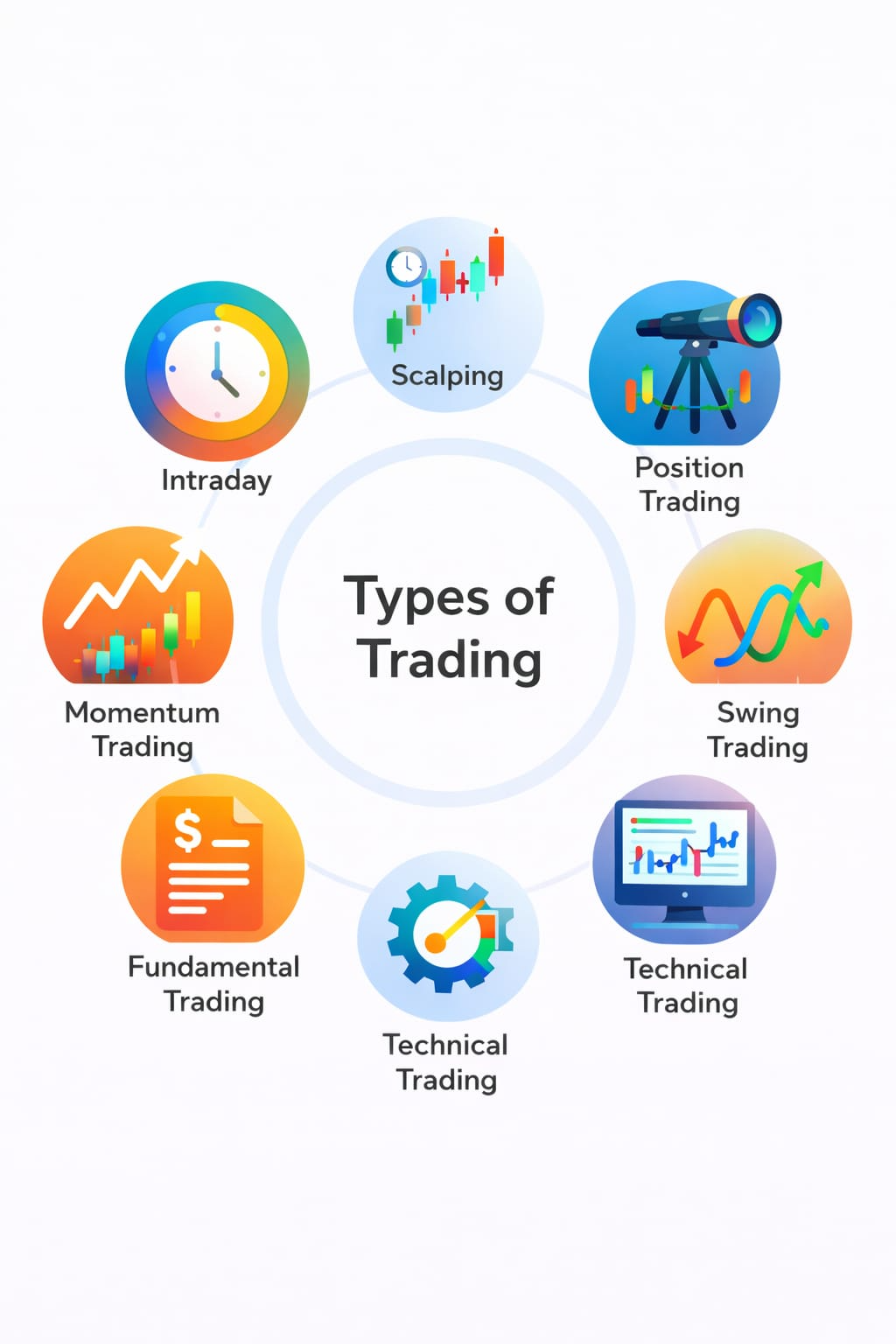
The most common types of trading are:
- Intraday
- Scalping
- Position Trading
- Momentum Trading
- Swing Trading
- Technical Trading
- Fundamental Trading
- Delivery Trading
Intraday Trading (Day Trading)
Intraday trading is all about buying and selling stocks on the same day. You never carry positions overnight; the idea is to capture small price movements during market hours. Think of it as a fast-paced game where timing is everything.
This style works best for people who enjoy quick decision-making, can focus on the screen for hours, and don’t mind a bit of adrenaline. But make no mistake, it’s also one of the riskiest and most stressful forms of trading. If your timing is even slightly off, losses can pile up quickly.
Who does it work for?
Intraday suits traders who love daily action and thrive in a fast-moving environment. If you can stay calm under pressure and follow rules strictly, it can be rewarding.
Who is it not suited for?
If you hate staring at screens, get easily emotional after a loss or even a profit, or don’t have time to actively track the market, intraday will frustrate you. This isn’t the style where you can “set and forget.”
What do you need to learn?
To survive intraday, you need solid technical skills. Start with the basics of candlestick charts, support and resistance, and commonly used indicators like VWAP, RSI, and MACD. Just as important is money management, knowing how much to risk on each trade and always having a stop-loss in place.
Do’s:
- Always decide your entry, exit, and stop-lossbefore taking the trade, as it will help you keep your emotions in check
- Begin small, practice with limited capital until you build confidence.
- Stick to highly liquid stocks with high volume so you can enter and exit easily.
Don’ts:
- Don’t blindly follow tips or trade just because a stock is moving.
- Don’t overtrade; sitting at the screen doesn’t mean you must take 10 trades a day; in fact, not taking a trade is also a trade.
- Never use borrowed money in intraday as the leverage you get in intraday can wipe you out quickly, as it not only increases the profit, but it also increases the magnitude of losses. So I will suggest only going for leverage when you have enough confidence and experience.
Scalping
In simple words, scalping is like intraday trading on steroids. Instead of holding a stock for hours within a day, here you’re targeting tiny price moves that last just seconds or minutes. The goal is to make small profits many times throughout the session, which can add up if done consistently.
This style demands lightning-fast execution, sharp focus, and iron discipline. Scalpers might take 20, 30, or even more trades in a single day. Because the profit per trade is small, you rely on volume and consistency to make it worthwhile. But you must also be aware of the brokerage when you scalp, because when you increase the volume of your trades, your brokerage automatically shoots up.
Who does it work for?
Scalping suits traders who are extremely quick with decision-making and can dedicate their full attention to the screen. If you enjoy high-speed action and have the patience to take small wins repeatedly without getting greedy, scalping might fit your personality.
Who it is not suited for?
If you’re easily distracted, slow at placing orders, or don’t like sitting glued to the market for hours, scalping will quickly burn you out. It’s also not ideal for people who get frustrated with small profits, because here the gains come in tiny chunks. Also, if you are someone who does not like paying too much in brokerage fees, you should avoid it since scalping requires
What you need to learn?
Scalpers must master chart reading at very short timeframes (like 1-minute or 5-minute charts). You’ll need to understand order flow, liquidity, and how to spot quick entry and exit points. Having the right trading platform and super-fast internet is also critical, because even a few seconds of delay can cost you.
Do’s:
- Stick to liquid stocks and indices where spreads are tight, as it will allow you the flexibility to enter and exit easily.
- Use strict stop-losses because, in scalping, even if the stock or index moves against you it could cause big losses as traders use heavy leverage while scalping.
- Focus on quality setups instead of chasing every tick up or down.
Don’ts:
- Don’t over-leverage; as discussed earlier, even small losses add up fast when you take many trades.
- Don’t chase after missed moves; you’ll only end up entering late, and entering late means bigger stop losses and bigger chances of big losses.
- Don’t ignore brokerage and transaction costs, as frequent trades can eat into profits.
Position Trading
Position trading is the slowest and calmest style of trading. Instead of reacting to daily price moves, you hold stocks for months or even years, aiming to ride big trends or back strong companies. Think of it as the middle ground between pure investing and active trading—you’re not chasing daily moves but also not committing to a stock forever.
The focus here is usually on fundamentals and long-term charts. You’re betting on a company’s growth, industry strength, or a larger economic trend, and you let time do the heavy lifting. Because you’re holding longer, you also benefit from compounding returns if the stock performs well.
Who does it work for?
Position trading is perfect for people who don’t want to sit in front of the screen every day but still want to actively participate in the market. If you’re patient, willing to research, and comfortable holding through market noise, this style can reward you with significant gains.
Who it is not suited for?
If you’re someone who panics when prices dip or gets restless waiting months for results, position trading might feel too slow. Also, if you don’t research properly, being stuck in the wrong stock for years can be painful.
What you need to learn?
Position traders should focus on understanding financial statements, company fundamentals, and industry trends. On the technical side, long-term charts (weekly or monthly) are useful for spotting big trends. Risk management is still crucial; you should know when to cut losses if your thesis doesn’t play out.
Do’s:
- Take your time with research. Before putting money into a stock, dig into the company’s business, its financials, and the industry it operates in.
- Spread your bets. Don’t pour all your money into just one company or one sector. Even the best-looking stock can surprise you, so diversifying keeps you safe if one pick goes wrong.
- Trust the process. Once you’ve done your homework and entered a position, give it time. Big trends don’t play out overnight, so avoid the urge to check prices every few minutes.
Don’ts:
- Don’t turn a blind eye to warning signs. If a company is piling up debt, losing market share, or the management looks shaky, don’t ignore it. Hope is not a strategy.
- Don’t get greedy. If your stock has reached the target you set, take your profits. Waiting endlessly for “just a little more” often backfires.
- Don’t expect miracles. Position trading is slow and steady by nature. If you’re looking for excitement and quick wins, this style will frustrate you. Think of it more like a marathon, not a sprint.
Momentum Trading
Momentum trading is about riding the wave of strong price moves. Instead of trying to catch bottoms or tops, you buy when a stock is already showing strength and moving upward, with the belief that the momentum will carry it further. The idea is simple: stocks that are moving tend to keep moving, at least for a while.
This style requires sharp timing and constant awareness of market news. Momentum often comes from fresh triggers, like earnings announcements, government policies, or global events, that create sudden bursts of buying or selling. If you can spot these moves early, momentum trading can deliver quick and impressive returns.
Who does it work for?
Momentum trading is ideal for those who can keep their eyes on the market and react quickly. If you like energy, action, and don’t mind chasing trends instead of predicting them, this style can work for you.
Who it is not suited for?
Momentum can be brutal if you’re late to the party. The very same stock that looks strong can suddenly reverse and trap you at the top. If you’re slow to react or if you struggle with cutting losses fast, momentum trading will feel punishing.
What you need to learn?
Momentum traders need to master volume analysis, breakout patterns, and news tracking. You’ll also need to learn how to set tight stop losses because reversals can be sharp. Tools like moving averages, relative strength index (RSI), and breakout levels often guide momentum entries.
Do’s:
- Jump only into liquid stocks with strong volume; momentum without volume usually fades fast.
- Keep your stop losses tight and predefined. Small controlled losses are part of the game.
- Stay updated with earnings announcements, sector news, and global cues; momentum often comes from fresh triggers.
Don’ts:
- Don’t chase a stock once the move has already stretched too far—it’s usually too late.
- Don’t ignore market mood; momentum thrives when overall sentiment is supportive.
- Don’t forget that not every breakout sustains; be ready to exit quickly if the trend looks weak.
Fundamental Trading
Fundamental trading is about looking beyond the daily ups and downs of stock prices and focusing on the true worth of a company. Instead of relying on charts or short-term signals, you study the business itself, its financial health, management quality, growth prospects, and the industry it operates in. The idea is that if the company is strong and undervalued, its stock price will eventually reflect that strength, even if it takes time.
This style requires patience and the willingness to dig deep into research. You’ll be reading balance sheets, income statements, and annual reports, and tracking how the company performs compared to its competitors. It’s less about excitement and more about conviction, buying into businesses you believe in and holding on while the value unfolds.
When it works well?
Fundamental trading works beautifully for long-term wealth building. If you’re not interested in staring at charts all day and instead prefer making fewer, well-researched decisions, this approach can help you build steady returns over time.
When it doesn’t?
The challenge is that fundamentals don’t change overnight, but stock prices do. A sudden event, like a regulatory change, a bad quarterly result, or management issues, can shake the stock even if your analysis is sound. If you’re impatient or expect quick results, this style might feel too slow.
What you need to learn?
To trade fundamentally, you need to understand how to read financial statements, analyse industries, and track news that impacts businesses. It also helps to learn valuation methods, like price-to-earnings, discounted cash flow, or return on equity, so you can judge whether a stock is cheap or expensive compared to its true worth. And just like with other styles, risk management matters: not every fundamentally strong company will reward you, so diversification is key.
Do’s:
- Do spend time truly understanding the company and the sector it operates in. A strong story on paper means little if you don’t know the risks behind it.
- Do diversify your holdings. Even the best-looking company can face unexpected challenges, and diversification cushions the blow.
- Do give your investments time. Fundamental moves are slow but powerful, and patience often pays off better than constant monitoring.
Don’ts:
- Don’t ignore red flags. If profits are shrinking, debt is piling up, or management quality is questionable, take them seriously.
- Don’t get greedy when your target is reached. It’s better to exit with gains than wait for “just a little more” and risk a reversal.
- Don’t expect overnight results. This style is about steady wealth-building, not quick thrills.
Swing Trading
Swing trading sits between intraday and position trading. Here, you hold stocks for a few days to a few weeks, aiming to capture short- to medium-term price movements. Instead of reacting to every tick, you focus on trends and ride them for a while.
Who does it work for?
Swing trading is ideal for people who can’t monitor the market all day but still want to stay active. If you’re patient enough to hold for a few days and disciplined with your strategy, this style fits well.
Who is it not suited for?
If you’re impatient or constantly worried about overnight price changes, swing trading can feel uncomfortable. It also doesn’t suit those who want instant results like intraday traders.
What do you need to learn?
You need a mix of technical analysis and basic fundamentals. Learn trend identification, support and resistance, moving averages, and indicators like RSI or MACD. Risk management and timing your entry and exit are crucial.
Do’s:
- Follow the trend instead of fighting it.
- Use stop-losses to protect your downside.
- Focus on a few stocks instead of tracking too many.
Don’ts:
- Don’t panic due to short-term fluctuations.
- Don’t ignore broader market trends.
- Don’t overtrade; patience is key here.
Technical Trading
Technical trading is all about reading price charts and using indicators to predict future movements. Instead of focusing on company fundamentals, you rely on patterns, trends, and market behaviour.
Who does it work for?
This style suits traders who enjoy analysing charts and making data-driven decisions. If you like patterns, indicators, and structured systems, technical trading can be highly effective.
Who is it not suited for?
If charts confuse you or you prefer understanding businesses over numbers and patterns, this approach may feel overwhelming.
What do you need to learn?
You need to understand candlestick patterns, chart structures, support and resistance, and indicators like RSI, MACD, and moving averages. Backtesting and discipline are equally important.
Do’s:
- Stick to a defined strategy and tested setups.
- Use indicators as confirmation, not the sole reason to trade.
- Maintain strict risk management.
Don’ts:
- Don’t overload charts with too many indicators.
- Don’t ignore market context and news.
- Don’t assume patterns always work; nothing is guaranteed.
Delivery Trading
Delivery trading involves buying stocks and holding them in your Demat account without a fixed time limit. Unlike intraday trading, there’s no pressure to sell the same day.
Who does it work for?
Delivery trading is suitable for beginners and long-term investors who want to build wealth gradually without constant monitoring.
Who is it not suited for?
If you’re looking for quick profits or enjoy fast-paced trading, this approach may feel too slow.
What do you need to learn?
You should understand basic stock selection, long-term trends, and portfolio diversification. Fundamental analysis plays a bigger role here than technicals.
Do’s:
- Focus on fundamentally strong companies.
- Think long-term and ignore short-term noise.
- Invest consistently and diversify your portfolio.
Don’ts:
- Don’t panic during market corrections.
- Don’t invest all your money in one stock.
- Don’t chase trending stocks without research.
Conclusion
Stock trading isn’t a one-size-fits-all game. Each style, from fast-paced intraday and scalping to patient position, momentum, technical, and fundamental trading, has its own rhythm, risks, and rewards. The key is to understand your goals, personality, and risk tolerance before choosing a style. Some traders thrive on adrenaline and quick decisions, while others prefer research, patience, and letting trends unfold over time.
No matter which path you choose, the fundamentals remain the same: practice consistently, manage your risk, and keep learning. Mistakes will happen, but disciplined trading, combined with the right approach, can turn the market from a confusing maze into a space where you make informed, confident decisions.
Ultimately, the best type of trading is the one that fits you, your schedule, mindset, and comfort with risk. Start small, stick to your plan, and gradually you’ll find your rhythm in the market.
Frequently Asked Questions (FAQs)
What is the best type of trading for beginners?
For beginners, swing trading is often one of the best ways to start. It allows traders to hold positions for a few days to weeks, giving enough time to analyse charts, understand price patterns, and learn risk management without the stress of minute-to-minute decisions. Unlike intraday or scalping, which demand speed and constant monitoring, swing trading offers a balance between active trading and patience, making it easier for beginners to build skills and confidence.
How much money do I need to start trading?
There’s no fixed amount, but it’s best to start with money you can afford to lose. For intraday or scalping, smaller amounts allow you to practice without risking too much. For position or fundamental trading, you can start with modest investments and gradually scale as you gain confidence.
Do I need a trading course or a mentor to start?
Not necessarily, but learning is essential. You can begin with free resources, books, and practice accounts. A mentor or course can speed up your learning, especially for technical skills like chart reading or risk management. The key is consistent practice and disciplined learning.
Can I combine different trading styles?
Yes, many traders use a hybrid approach. For example, you might hold a few stocks long-term (position trading) while taking small intraday trades for practice or extra profits. The important thing is to keep strategies separate, manage risk, and avoid confusing signals across styles.
Disclaimer: This content is for educational purposes only and does not constitute financial or investment advice. Investments in securities or other financial instruments are subject to market risk, including partial or total loss of capital. Past performance is not indicative of future results. Always consider your financial situation carefully and consult a licensed financial advisor before making investment or trading decisions.
Engineered for the obsessed. Built for traders.

Purpose-built terminals.
Zero compromise.
Built for speed.

Plot No 1290, 2nd Floor, 17th Cross, 5th Main, Sector-7, HSR Layout, Bangalore 560102
Follow us on


Mintcap Brokers Private Limited
CIN – U66110KA2023PTC178706 | Registered Address: Plot No 1290, Second Floor, 17th Cross, 5th Main, Sector-7, HSR Layout, Bangalore 560102 | Tel: 080 – 49552310 | Email ID: compliance@capmint.com | SEBI registered Stock Broker: INZ000322732 | NSE Cash/F&O Member ID: 90430 | BSE Cash/F&O Member ID: 6903 | MCX Member ID: 57400 | NCDEX Member ID: 1312 | SEBI registered Depository Participant: IN-DP-806-2025 | CDSL DP ID: 12102300 | NSE Clearing Member code: M70108 | AMFI-Registered Mutual Fund Distributor: ARN-289109 (Valid upto 28-Feb-2027) | Category II Execution Only Platform : E6903
Details of Client Bank Account
Compliance Officer: Ms. Shridevi Vungarala | Email ID: compliance@capmint.com | Tel no. + 91 9035330126 | Grievance Redressal Officer (GRO) – Ms. Shikha Gupta | Email ID: Grievance@capmint.com | Tel no: 9035331595.
Procedure to file a complaint on SEBI SCORES: Register on SCORES portal. Mandatory details for filing complaints on SCORES: Name, PAN, Address, Mobile Number, E-mail ID. Benefits: Effective Communication, Speedy redressal of the grievances. You may refer the website https://scores.sebi.gov.in/ for more information. You may also download the SEBI Scores app to log a complaint Android: https://play.google.com > store > apps > sebiscores iOS: https://apps.apple.com > app > sebiscores
Disclaimer
Investment in the securities market are subject to market risks, read all the related documents carefully before investing. Brokerage will not exceed the SEBI prescribed limit.
Mutual fund investments are subject to market risks, read all scheme related documents carefully before investing. Mutual Funds are not exchange-traded products.
Attention Investor:
- Stock Brokers can accept securities as margin from clients only by way of pledge in the depository system w.e.f. September 1, 2020.
- Update your mobile number & email Id with your stock broker/depository participant and receive OTP directly from depository on your email id and/or mobile number to create pledge.
- Pay 20% as upfront margin of the transaction value to trade in cash market segment.
- Investors may please refer to the Exchange’s Frequently Asked Questions (FAQs) issued vide circular reference NSE/INSP/45191 dated July 31, 2020 and NSE/INSP/45534 dated August 31, 2020 and other guidelines issued from time to time in this regard.
- Check your Securities /MF/ Bonds in the consolidated account statement issued by NSDL/CDSL every month.