

Table of Content
- Key Takeaways
- What is Trading in the Stock Market?
- Trading Participants
- How many Types of Trading in the Stock Market?
- What Assets can you Trade?
- Trading vs. Investing
- Trading or Investing: Which One is Right for You?
- How to Trade In the Stock Market?
- What Are the Advantages of Trading?
- Online Trading vs Offline Trading
- Risks and Challenges in Trading
- Conclusion
- Frequently Asked Questions (FAQs)
Link copied!
Trading

Trading refers to the act of buying and selling financial instruments such as stocks, bonds, commodities, currencies, and derivatives in financial markets. The goal of trading is to profit from price movements by capitalising on short-term or long-term trends.
Key Takeaways
- Trading focuses on short-term price movements, whereas investing aims for long-term wealth accumulation. Both approaches have distinct benefits and risks.
- Risk management is essential for trading success. Using stop-loss orders, proper position sizing, and maintaining a favourable risk-reward ratio helps traders navigate volatile markets.
- Emotions significantly impact trading decisions. Fear and greed often lead to impulsive actions, making psychological discipline and a well-defined strategy crucial for consistent results.
- Markets are constantly evolving, requiring traders to stay informed and adapt. Studying past trends, refining strategies, and keeping up with new tools and technologies are key to long-term success
What is Trading in the Stock Market?
Trading in the Indian Stock Market is all about buying and selling financial assets like stocks, commodities, forex, and cryptocurrencies to make a profit from price movements. Unlike long-term investing, which focuses on steadily building wealth over the years, trading is a more active approach that aims to take advantage of short-term market fluctuations.
Financial markets offer a range of opportunities, allowing traders to choose strategies that match their risk tolerance and time frame. Some prefer quick, high-frequency trades, while others hold positions for days or weeks, looking for the right moment to exit with a profit.
Trading Participants
Trading takes place in financial markets, where buyers and sellers come together to exchange assets. The market is made up of different types of participants, each playing a unique role:
Retail Traders
Individual investors who buy and sell through online brokerage platforms.
Institutional Traders
Big players like hedge funds, banks, and mutual funds trade in large volumes.
Market Makers
Financial firms that keep the market liquid by constantly buying and selling assets.
Trades happen either on formal exchanges like the BSE or NSE or in over-the-counter (OTC) markets (especially for futures and small unlisted companies), where transactions occur directly between parties. To trade, investors use brokerage accounts and trading platforms, relying on research and analysis to make informed decisions.
How many Types of Trading in the Stock Market?
a) Based on Time Horizon
- Intraday Trading: This is the fast-paced world of day trading, where traders buy and sell assets within the same trading session. The goal is to capitalise on small price movements throughout the day using leverage. It requires quick decision-making, strong analytical skills, and a deep understanding of technical charts and indicators.
- Swing Trading: Unlike intraday trading, swing trading involves holding positions for a few days to weeks. Traders identify trends and patterns to predict price movements. This method requires patience and is ideal for those who can’t monitor the market constantly but still want to take advantage of short-term trends.
- Positional Trading: This is a more relaxed trading style where positions are held for months or even years. It focuses on long-term macroeconomic trends, company fundamentals, and industry growth. Positional traders rely more on fundamental analysis than short-term price movements.
- Scalping: Scalping is an ultra-short-term strategy where traders make multiple trades within minutes, profiting from tiny price fluctuations. Scalpers use high-frequency trading techniques and need lightning-fast execution, a deep understanding of market dynamics, and the ability to make split-second decisions.
b) Based on Market Type
- Stock Trading: This is the most well-known form of trading, where individuals buy and sell shares of publicly traded companies. Stock traders analyse company performance, financial reports, and market trends to make decisions.
- Forex Trading: Forex (foreign exchange) trading involves buying and selling currency pairs, such as USD/INR or GBP/JPY. It is the largest and most liquid financial market in the world, operating 24/5. Traders rely on economic data, geopolitical events, and technical indicators to predict currency movements.
- Commodity Trading: In commodity trading, traders buy and sell physical goods like gold, silver, crude oil, natural gas, and agricultural products. Prices fluctuate based on supply-demand dynamics, geopolitical factors, and global economic conditions.
- Derivatives Trading: This involves trading contracts like futures and options, where the value is derived from underlying assets such as stocks, commodities, or indices. Traders use derivatives for speculation or hedging against price movements.
- Crypto Trading: The rise of digital currencies has created a new market where traders buy and sell cryptocurrencies like Bitcoin, Ethereum, and other altcoins. Crypto markets are highly volatile, and traders use both technical and fundamental analysis to make decisions.
What Assets can you Trade?
Financial markets offer a wide range of assets that traders can buy and sell, depending on their strategy, risk tolerance, and market understanding. Some of the most commonly traded assets include:
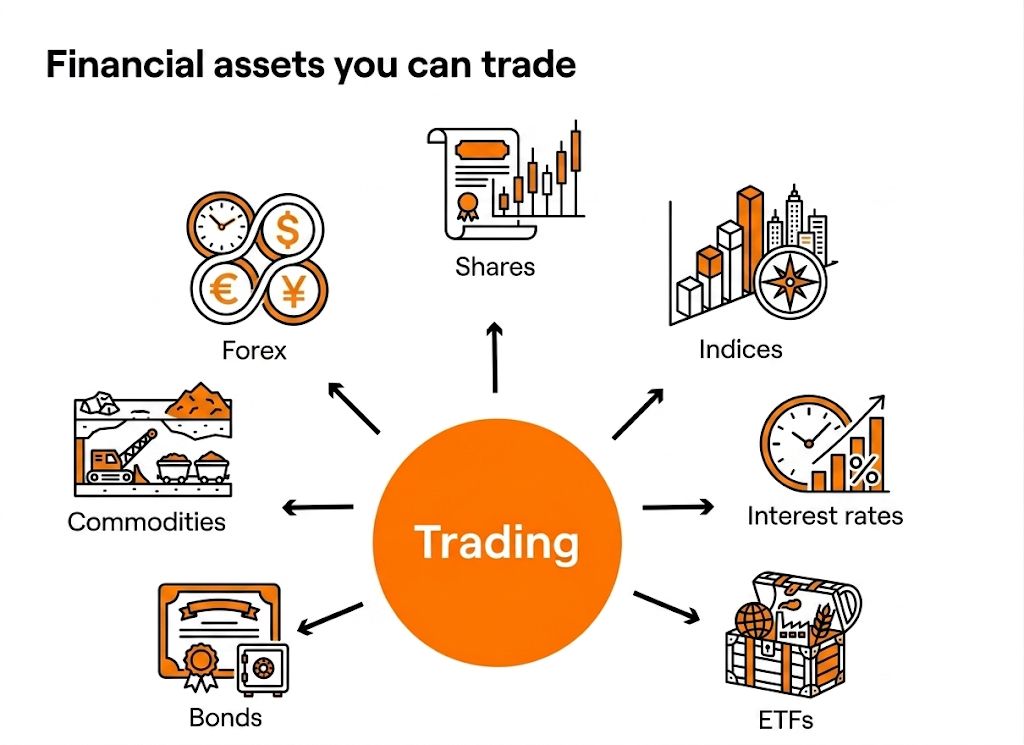
Shares
Shares represent ownership in a company. Trading shares involves buying and selling stocks of individual companies to benefit from price movements.
Indices
Indices track the performance of a group of stocks or assets. Trading indices allows you to take exposure to the overall performance of a market or sector rather than a single company.
Forex
Forex, or the foreign exchange market, involves trading currency pairs. Traders aim to profit from changes in the relative value of one currency against another.
ETFs (Exchange-Traded Funds)
ETFs are investment funds that hold a basket of assets such as stocks, bonds, or commodities. They provide diversification and can be traded like individual stocks on an exchange.
Bonds
Bonds are debt instruments issued by governments or corporations. Trading bonds allows participants to earn returns through interest payments and price movements.
Commodities
Commodities include raw materials like gold, crude oil, and agricultural products. Their prices are influenced by supply and demand, geopolitical events, and economic conditions.
IPOs (Initial Public Offerings)
IPOs refer to the process by which a company offers its shares to the public for the first time. Traders may participate to take advantage of early price movements after listing.
Trading vs. Investing
Trading and investing are two distinct approaches to participating in financial markets, each with its own set of goals, strategies, and risk factors. While both involve buying and selling assets, the key differences lie in the time horizon, risk appetite, and analytical approach
|
Feature |
Trading |
Investing |
|---|---|---|
|
Time Horizon |
Short-term (minutes to weeks) |
Long-term (years to decades) |
|
Objective |
Quick profits from price fluctuations |
Gradual wealth accumulation |
|
Risk Level |
High due to frequent transactions and leverage |
Lower due to long-term market trends |
|
Frequency |
Multiple trades daily or weekly |
Fewer trades over long periods |
|
Analysis Type |
Primarily technical analysis |
Primarily fundamental analysis |
|
Capital Requirement |
Often requires more active capital management |
Can start with smaller, consistent investments |
Trading or Investing: Which One is Right for You?
The choice between trading and investing depends on your financial goals, risk tolerance, and time commitment. If you prefer an active, high-risk approach with the potential for quick profits, trading might be suitable. However, if you’re looking for steady, long-term growth with a more passive strategy, investing is likely the better option.
Many successful market participants combine both approaches, trading a portion of their capital for short-term gains while investing the majority in stable, long-term assets for future security.
How to Trade In the Stock Market?
Trading is not just about buying and selling assets; it requires a unique set of skills to navigate the complexities of financial markets. Legendary traders featured in Market Wizards and Unknown Market Wizards by Jack Schwager emphasise that success in trading is less about predicting the market and more about mastering risk, psychology, and strategy. Here are some essential skills every trader should develop:
Risk Management – The Key to Survival
One of the most common lessons shared by top traders in Schwager’s books is the importance of risk management. According to them, even a trader with an average strategy can succeed if they control their losses. Key risk management techniques include:
- Position Sizing: Never risk more than a small percentage of your capital on a single trade.
- Stop-Loss Orders: Predefine your exit points to minimise losses.
- Risk-Reward Ratio: Ensuring that potential profits justify the risks taken (e.g., risking Rs 1 to make Rs 3).
As trader Bruce Kovner put it in Market Wizards, “If you personalise losses, you can’t trade.” Managing risk ensures that no single trade can wipe out your account.
Psychological Discipline – Controlling Emotions Under Pressure
Many of the greatest traders in history agree that emotional discipline is what separates professionals from amateurs. Mark Minervini, a featured trader in Unknown Market Wizards, highlights that trading is more of a mental game than a technical one.
Common psychological pitfalls include:
- Overconfidence after wins leads to reckless trades.
- Fear of missing out (FOMO) pushes traders into bad entries.
- Revenge trading after a loss often results in bigger mistakes.
Paul Tudor Jones, another legendary trader, famously said, “The most important rule of trading is to play great defence, not great offence.” Keeping emotions in check ensures traders stick to their strategies instead of making impulsive decisions.
Strategy Development – Finding a Repeatable Edge
Every successful trader in Schwager’s books has a well-defined strategy. Whether it’s trend-following, breakout trading, or mean reversion, they all have a structured approach.
Developing a trading strategy involves:
- Backtest historical data to see if the strategy holds up over time.
- Understanding market conditions where the strategy works best.
- Adapting to changing market dynamics, as no single strategy works forever.
As Ed Seykota, another Market Wizard, put it, “Win or lose, everybody gets what they want out of the market.” Successful traders have a method they trust and follow consistently.
Continuous Learning – Adapting to Market Changes
The best traders never stop learning. Many in Market Wizards emphasise that markets evolve, and traders must keep up. This includes:
- Studying past market cycles to recognise patterns.
- Learning from losses and improving execution.
- Keeping up with new trading technologies and tools.
Jack Schwager himself noted that successful traders have a deep passion for the game and a willingness to adapt.
What Are the Advantages of Trading?
Trading in stocks and other financial instruments offers several benefits that make it an attractive option for investors:
Profit Potential
Trading provides the opportunity to achieve significant profits within a relatively short time frame. When executed with the right strategy at the right time, traders can capitalise on market movements to generate substantial returns.
Flexibility in Nature
Trading is inherently flexible. Investors have the freedom to buy and sell securities whenever market conditions seem favourable, allowing them to adapt quickly and capitalise on opportunities.
Access to a Growing Economy
Active participation in trading, especially in sizeable trades, provides direct exposure to the economic growth of a country. When market indices rise, it reflects broader economic expansion, allowing traders to benefit from this growth through strategic investments.
Ability to Leverage Economic Growth
Trading enables investors to benefit from economic expansion. A growing economy often leads to higher corporate earnings, increased employment, and rising consumer spending, all of which can positively impact asset prices.
Ease of Buying and Selling
The process of trading shares is straightforward and accessible. It begins with opening a Demat account through a broker or online platform. Once set up, investors can conveniently place buy and sell orders and participate in the market.
Flexibility for Small Investments
Trading allows individuals to start with relatively small amounts by investing in smaller units or companies, such as small-cap and mid-cap stocks. This makes it accessible for beginners testing the market with limited capital.
Liquidity
Stocks are highly liquid assets and can be easily converted into cash. Investors can sell their holdings quickly when needed, making trading a convenient option for those requiring fast access to funds.
Online Trading vs Offline Trading
Trading can be conducted through online or offline modes, each offering distinct advantages depending on the investor’s preferences:
Convenience
Online trading allows investors to trade from virtually anywhere. In contrast, offline trading requires visiting a broker’s office or placing trades through phone calls.
Ease of Trading
In online trading, investors can make decisions independently without external intervention. In offline trading, transactions are typically executed through a broker.
Access to Information and Insights
Online trading platforms provide access to detailed reports, charts, patterns, and trend-based recommendations, helping investors make more informed decisions.
Risks and Challenges in Trading
Trading may seem like an exciting way to make money, but it comes with significant risks and challenges. To be successful, traders must be aware of these risks and learn how to manage them effectively.
Market Volatility – The Double-Edged Sword
One of the biggest challenges in trading is dealing with market volatility. Prices of assets can fluctuate rapidly due to economic events, company news, political developments, or even global crises. While volatility creates opportunities for profits, it also increases the chances of unexpected losses. Traders need to develop strategies to handle these fluctuations, such as setting stop-loss orders and diversifying their portfolios.
Leverage – Amplified Gains and Losses
Leverage allows traders to control larger positions with a smaller amount of capital, but it also amplifies risks. A small adverse movement in price can result in substantial losses. For example, using 10x leverage means that a 10% price drop can wipe out your entire investment. It’s essential for traders to use leverage cautiously and manage risk effectively.
Emotional Trading – The Danger of Fear and Greed
Psychology plays a crucial role in trading. Many traders let emotions like fear and greed drive their decisions, leading to impulsive actions. Fear can cause traders to exit positions too early, missing out on potential gains, while greed may push them to take excessive risks. Developing discipline, following a well-defined trading plan, and maintaining emotional control are critical for long-term success.
Lack of Proper Risk Management
Many traders fail because they do not prioritise risk management. Successful traders focus not just on making profits but also on minimising losses. Proper risk management strategies include:
- Setting stop-loss orders to limit potential losses.
- Using position sizing to avoid overexposure to a single trade.
- Maintaining a risk-reward ratio that ensures potential rewards justify the risks taken.
Regulatory and Legal Risks
Financial markets are regulated differently across regions, and traders must comply with the rules of their respective markets. Some countries impose restrictions on short selling, derivatives trading, or cryptocurrency transactions. Not being aware of regulatory requirements can lead to legal complications or unexpected trading limitations.
Conclusion
Trading is a dynamic and rewarding approach to financial markets, but it comes with its own challenges and risks. Success in trading requires a combination of skill, discipline, and risk management. While different strategies cater to different time horizons and risk appetites, the key to long-term success lies in continuous learning and adaptability. Whether one chooses to trade actively or invest for the long term, understanding the principles of market behaviour and personal financial goals is crucial for making informed decisions.
Frequently Asked Questions (FAQs)
What is the difference between trading and investing?
Trading involves buying and selling financial instruments over short periods to capitalise on market fluctuations, whereas investing focuses on long-term growth, often holding assets for years to benefit from appreciation and dividends.
How much money do I need to start trading?
The required capital varies depending on the market and broker. Some platforms allow you to start with as little as Rs 100, but it’s advisable to have sufficient funds to manage risks effectively and cover potential losses.
Is trading the same as Gambling?
While both involve risk and uncertainty, trading differs from gambling in that it relies on analysis, strategy, and informed decision-making to increase the likelihood of success, whereas gambling outcomes are predominantly based on chance.
Can Trading replace my Day Job?
Trading has the potential to become a full-time occupation, but it requires substantial knowledge, experience, and a consistent track record of profitability. Many traders start part-time before considering it as a primary income source.
What are the Risks Involved in Trading?
Trading carries several risks, including market volatility, liquidity issues, and the potential for significant financial losses. Effective risk management strategies are essential to mitigate these risks.
Disclaimer: This content is for educational purposes only and does not constitute financial or investment advice. Investments in securities or other financial instruments are subject to market risk, including partial or total loss of capital. Past performance is not indicative of future results. Always consider your financial situation carefully and consult a licensed financial advisor before making investment or trading decisions.
Table of Content
- Key Takeaways
- What is Trading in the Stock Market?
- Trading Participants
- How many Types of Trading in the Stock Market?
- What Assets can you Trade?
- Trading vs. Investing
- Trading or Investing: Which One is Right for You?
- How to Trade In the Stock Market?
- What Are the Advantages of Trading?
- Online Trading vs Offline Trading
- Risks and Challenges in Trading
- Conclusion
- Frequently Asked Questions (FAQs)
Engineered for the obsessed. Built for traders.

Purpose-built terminals.
Zero compromise.
Built for speed.

Plot No 1290, 2nd Floor, 17th Cross, 5th Main, Sector-7, HSR Layout, Bangalore 560102
Follow us on


Mintcap Brokers Private Limited
CIN – U66110KA2023PTC178706 | Registered Address: Plot No 1290, Second Floor, 17th Cross, 5th Main, Sector-7, HSR Layout, Bangalore 560102 | Tel: 080 – 49552310 | Email ID: compliance@capmint.com | SEBI registered Stock Broker: INZ000322732 | NSE Cash/F&O Member ID: 90430 | BSE Cash/F&O Member ID: 6903 | MCX Member ID: 57400 | NCDEX Member ID: 1312 | SEBI registered Depository Participant: IN-DP-806-2025 | CDSL DP ID: 12102300 | NSE Clearing Member code: M70108 | AMFI-Registered Mutual Fund Distributor: ARN-289109 (Valid upto 28-Feb-2027) | Category II Execution Only Platform : E6903
Details of Client Bank Account
Compliance Officer: Ms. Shridevi Vungarala | Email ID: compliance@capmint.com | Tel no. + 91 9035330126 | Grievance Redressal Officer (GRO) – Ms. Shikha Gupta | Email ID: Grievance@capmint.com | Tel no: 9035331595.
Procedure to file a complaint on SEBI SCORES: Register on SCORES portal. Mandatory details for filing complaints on SCORES: Name, PAN, Address, Mobile Number, E-mail ID. Benefits: Effective Communication, Speedy redressal of the grievances. You may refer the website https://scores.sebi.gov.in/ for more information. You may also download the SEBI Scores app to log a complaint Android: https://play.google.com > store > apps > sebiscores iOS: https://apps.apple.com > app > sebiscores
Disclaimer
Investment in the securities market are subject to market risks, read all the related documents carefully before investing. Brokerage will not exceed the SEBI prescribed limit.
Mutual fund investments are subject to market risks, read all scheme related documents carefully before investing. Mutual Funds are not exchange-traded products.
Attention Investor:
- Stock Brokers can accept securities as margin from clients only by way of pledge in the depository system w.e.f. September 1, 2020.
- Update your mobile number & email Id with your stock broker/depository participant and receive OTP directly from depository on your email id and/or mobile number to create pledge.
- Pay 20% as upfront margin of the transaction value to trade in cash market segment.
- Investors may please refer to the Exchange’s Frequently Asked Questions (FAQs) issued vide circular reference NSE/INSP/45191 dated July 31, 2020 and NSE/INSP/45534 dated August 31, 2020 and other guidelines issued from time to time in this regard.
- Check your Securities /MF/ Bonds in the consolidated account statement issued by NSDL/CDSL every month.