

Link copied!
Market Order

A market order in the stock market is an instruction given by the investor or trader to their broker to buy or sell a stock at the best possible price.
Key Takeaways
- A market order is executed immediately at the best available price, prioritising speed over price control to ensure quick trade completion.
- Market orders work best with highly liquid stocks because the tight bid-ask spread reduces the risk of significant price slippage.
- Market orders carry the risk of unexpected execution prices in volatile or low-volume markets where prices can change rapidly.
- Large trades or illiquid stocks are not ideal for market orders because they can cause unfavourable price movements and increased execution risks.
Understanding Market Order
When you’re placing a trade in the stock market, timing and price are everything. One of the most straightforward ways to get your trade done quickly is by using what’s known as a “market order.” It’s the simplest type of order out there, basically telling your broker, “Buy (or sell) this now at the best available price.”
Unlike other types of orders, a market order prioritises execution speed over price. This means the order will be fulfilled as quickly as possible.
For example, suppose you want to buy 50 shares of Reliance Industries. The current best available ask price in the market is ₹2,500 per share. If you place a market order, your broker will immediately buy those shares for you at around ₹2,500. But if only 30 shares are available at ₹2,500 and the rest at ₹2,505, your order will get executed partly at ₹2,500 and the remaining at ₹2,505. The key is that your order gets completed instantly, even if it means paying slightly more. This partial fill at different prices is more common than many new traders expect, particularly in mid-cap stocks where the order book depth at each price level can be thin.
Key Features of Market Orders
Market orders are the most basic way to trade, designed for speed and ease rather than price precision.
Immediate Execution
Market orders are executed almost instantly during regular market hours. On liquid large-cap stocks listed on the NSE, execution typically happens within a fraction of a second during normal trading conditions.
No Price Guarantee
Since the focus is on speed, the final transaction price may differ from the last quoted price. The gap between the quoted price and the actual fill price tends to widen during the opening and closing minutes of the session, when order flow is most uneven.
Liquidity Dependent
Market orders work best with highly liquid securities, where price changes between order placement and execution are minimal.
Market Order vs Limit Order
Understanding the difference between market and limit orders is crucial for choosing the right execution method based on your trading goals, speed, and risk tolerance.
| Feature | Market Order | Limit Order |
|---|---|---|
| Price Control | Offers little to no control over the execution price, which can vary due to market conditions. | Provides full control over the price at which you buy or sell. The order only executes at your specified price or better. |
| Execution Speed | Executes immediately at the best available market price. Ideal for speed. | Might take a long time to execute or may not execute at all if the set price is not met. |
| Use Case | Suitable for high-liquidity stocks when immediate buying or selling is the priority. | Best suited for trading in volatile or illiquid markets where prices fluctuate widely and precision is needed. |
| Risk | Higher risk of slippage, especially during fast-moving markets or with low liquidity. | Reduces the risk of slippage but carries the risk of non-execution if the market doesn’t meet your price. |
In practice, the choice often comes down to context rather than a blanket preference. On a Nifty 50 stock with tight spreads, a market order and a limit order placed at the current ask will produce nearly identical results. The difference becomes meaningful on less liquid counters or during event-driven volatility, where a market order can slip noticeably while a limit order keeps you within a defined range.
Pros and Cons of Market Orders
Every trading tool has its strengths and weaknesses, and market orders are no exception. Here’s a breakdown of the key benefits and potential drawbacks to help you decide when a market order might be right for you.
Pros
Fast execution: One of the biggest advantages of a market order is speed. The order goes through almost instantly, which is useful if you’re looking to enter or exit a position quickly.
Useful in fast-moving markets: In volatile markets where prices are changing rapidly, a market order can ensure that your trade gets filled without delay, avoiding missed opportunities. When a stock is moving 1–2% in a matter of minutes on breaking news, waiting for a limit order to fill can mean missing the move entirely.
Best for high-volume stocks: Market orders are ideal for stocks with high liquidity, where the difference between bid and ask prices is minimal. This helps in reducing price slippage. On stocks like HDFC Bank, Infosys, or Reliance, the bid-ask spread during regular hours is often just ₹0.05 to ₹0.20, making market orders functionally equivalent to limit orders in most situations.
Cons
No control over price: When you place a market order, you agree to buy or sell at the current market rate, whatever that may be. If prices shift suddenly, you could end up paying more or receiving less than expected.
Risk of slippage in volatile markets: If the stock is highly volatile, the price at the moment you place the order might differ significantly from the price at execution, especially for large orders. During quarterly results announcements, for instance, slippage of 0.5–1.5% on a market order is not unusual on mid-cap stocks, even with moderate order sizes of a few hundred shares.
Not ideal for illiquid securities: For stocks with low trading volume, a market order could get filled at an unfavourable price due to the wide spread between bid and ask prices. Some small-cap stocks on the BSE can have bid-ask spreads of ₹5–10 or more, which means a market order immediately costs you that spread before the stock even moves in your favour.
When Should You Use a Market Order?
Knowing the right context for using a market order can make a meaningful difference in your trading outcomes. Here’s when a market order works best and when it might work against you.
Best Situations
Trading highly liquid stocks: If you’re buying or selling large-cap stocks with heavy trading volume, market orders are generally safe. The high volume means there’s a tight spread between bid and ask prices, so you’re likely to get a fair deal without significant slippage.
When speed is more important than price: Sometimes, the priority is just to get in or out of a position fast, perhaps due to breaking news or a fast-moving trend. In these cases, sacrificing price control for execution speed makes sense. A common scenario is exiting a position when a stop-loss level has been breached and the price is falling quickly. Waiting for a limit fill while the stock drops further often results in a worse outcome than accepting the slippage on a market order.
During regular trading hours: Liquidity is highest when markets are open. Executing market orders during these hours reduces the risk of large price swings and ensures quicker fills. On the NSE, liquidity tends to be deepest between 10:00 AM and 2:30 PM, making this window the most predictable for market order execution.
Avoid Market Orders
In low-volume or volatile markets: If you’re trading lesser-known stocks or during earnings reports or major news events, prices can move fast. A market order in these scenarios might get executed at a significantly worse price than expected.
For large orders that might impact the stock price: When placing a large order in a stock that doesn’t trade heavily, your own trade could push the price up or down, which could increase your average buying price. As a rough guideline, if your order size exceeds 10–15% of the stock’s average five-minute traded volume, a market order is likely to cause visible price impact.
How to Place a Market Order on CapMint
- Log into your account.

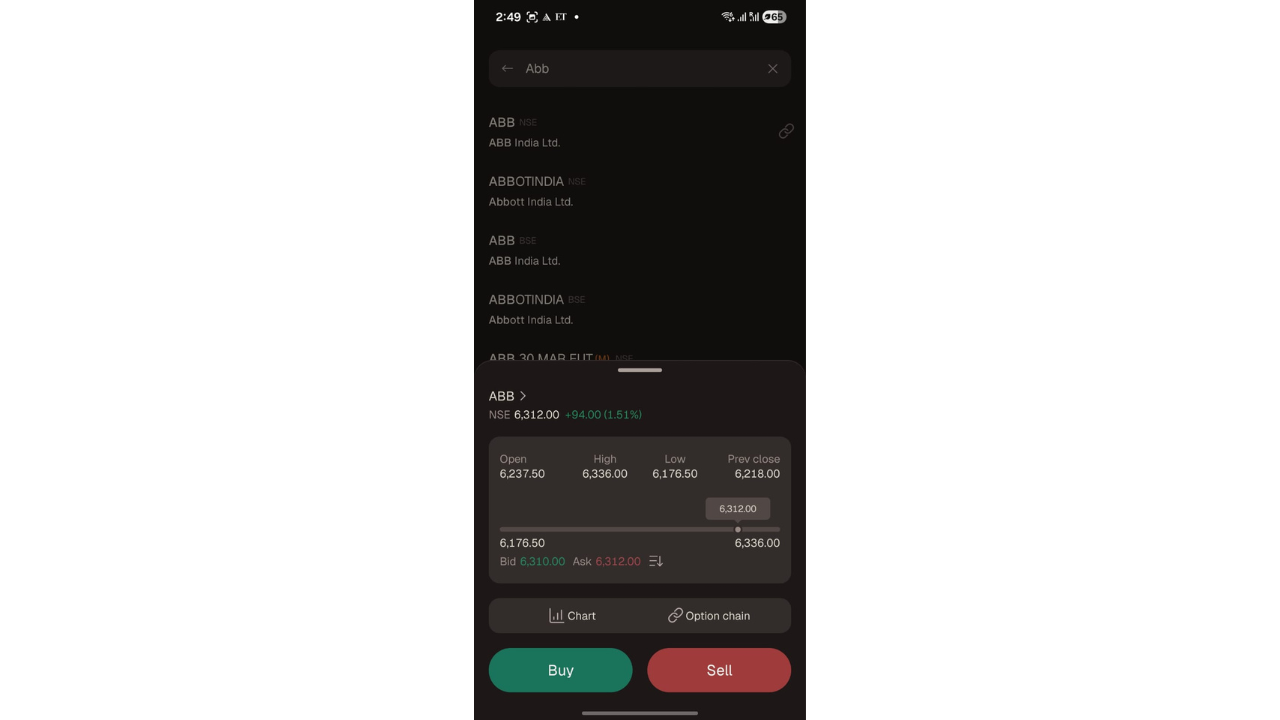
- Search for the stock you want to trade, and then click buy or sell depending on whether you want to go long or short.
- Choose “Market” under order type.
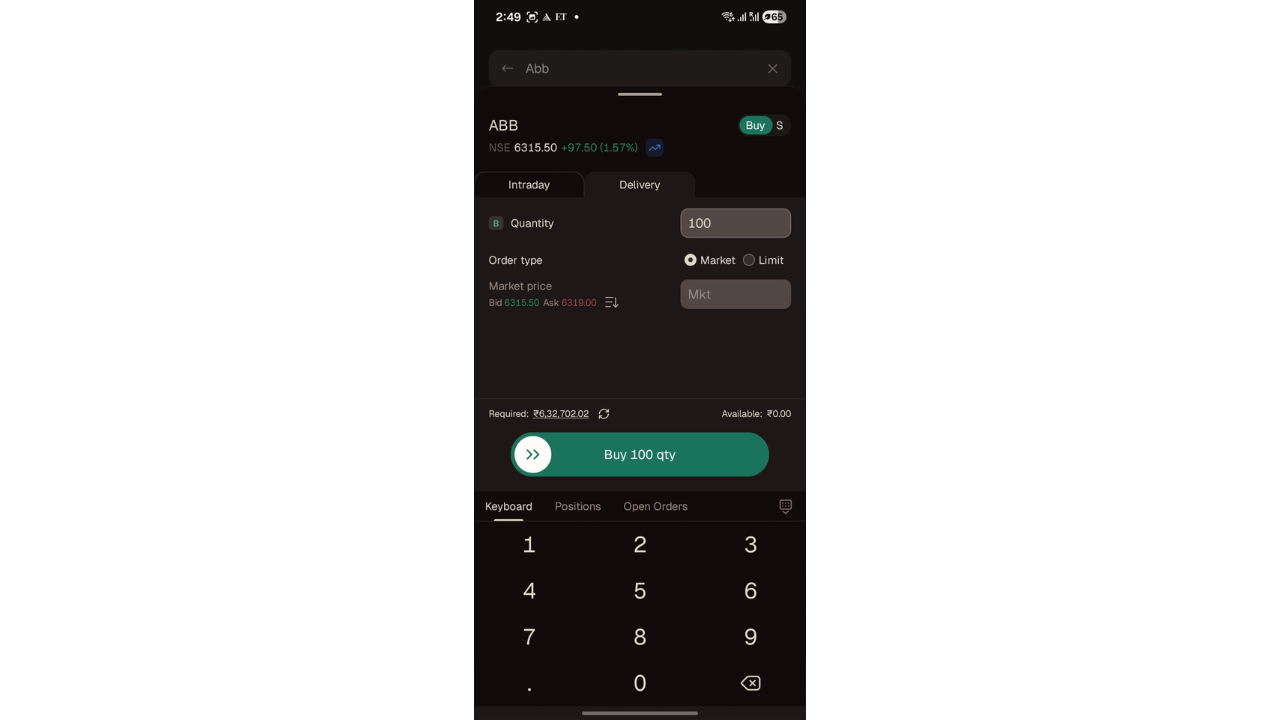
- Enter the quantity and then place the order.
Conclusion
Market orders are the simplest and fastest way to execute a trade, making them a go-to choice for many traders, especially in time-sensitive situations. While they don’t offer price control, their ease of use and instant execution make them well-suited when market conditions are stable and liquidity is high. Still, they should be used with caution in volatile or low-volume environments where price swings can be more pronounced. Understanding when to use a market order and when to opt for a limit order instead can help you trade more effectively and avoid paying unnecessary slippage on routine transactions.
Frequently Asked Questions (FAQs)
What is a market order in trading?
A market order is a buy or sell instruction to a broker to execute the trade immediately at the best available price in the market. It’s suited for traders who want fast execution and are less concerned about the exact price point. Market orders prioritise speed over price precision, which can be helpful in fast-moving markets but risky in volatile or low-volume conditions.
Is a market order executed immediately?
Yes, during standard market hours, market orders are usually filled almost instantly. Since these orders don’t have any price limitations, they get matched with the best available bid or ask price. However, the final execution price may differ slightly from the last traded price due to rapid price fluctuations, particularly during the opening auction or in the minutes following a major news event.
Is a market order better than a limit order?
That depends on your trading goals. Market orders are well-suited for quick entry or exit, especially when timing is critical. On the other hand, limit orders give you more control by allowing you to specify the exact price at which you want to buy or sell. While market orders offer speed, limit orders offer precision, so the better choice depends on your priorities in a given trade. For highly liquid large-caps during normal hours, the difference is often negligible. For anything less liquid or during volatile sessions, a limit order is generally the safer default.
Disclaimer: This content is for educational purposes only and does not constitute financial or investment advice. Investments in securities or other financial instruments are subject to market risk, including partial or total loss of capital. Past performance is not indicative of future results. Always consider your financial situation carefully and consult a licensed financial advisor before making investment or trading decisions.
Engineered for the obsessed. Built for traders.

Purpose-built terminals.
Zero compromise.
Built for speed.

Plot No 1290, 2nd Floor, 17th Cross, 5th Main, Sector-7, HSR Layout, Bangalore 560102
Follow us on


Mintcap Brokers Private Limited
CIN – U66110KA2023PTC178706 | Registered Address: Plot No 1290, Second Floor, 17th Cross, 5th Main, Sector-7, HSR Layout, Bangalore 560102 | Tel: 080 – 49552310 | Email ID: compliance@capmint.com | SEBI registered Stock Broker: INZ000322732 | NSE Cash/F&O Member ID: 90430 | BSE Cash/F&O Member ID: 6903 | MCX Member ID: 57400 | NCDEX Member ID: 1312 | SEBI registered Depository Participant: IN-DP-806-2025 | CDSL DP ID: 12102300 | NSE Clearing Member code: M70108 | AMFI-Registered Mutual Fund Distributor: ARN-289109 (Valid upto 28-Feb-2027) | Category II Execution Only Platform : E6903
Details of Client Bank Account
Compliance Officer: Ms. Shridevi Vungarala | Email ID: compliance@capmint.com | Tel no. + 91 9035330126 | Grievance Redressal Officer (GRO) – Ms. Shikha Gupta | Email ID: Grievance@capmint.com | Tel no: 9035331595.
Procedure to file a complaint on SEBI SCORES: Register on SCORES portal. Mandatory details for filing complaints on SCORES: Name, PAN, Address, Mobile Number, E-mail ID. Benefits: Effective Communication, Speedy redressal of the grievances. You may refer the website https://scores.sebi.gov.in/ for more information. You may also download the SEBI Scores app to log a complaint Android: https://play.google.com > store > apps > sebiscores iOS: https://apps.apple.com > app > sebiscores
Disclaimer
Investment in the securities market are subject to market risks, read all the related documents carefully before investing. Brokerage will not exceed the SEBI prescribed limit.
Mutual fund investments are subject to market risks, read all scheme related documents carefully before investing. Mutual Funds are not exchange-traded products.
Attention Investor:
- Stock Brokers can accept securities as margin from clients only by way of pledge in the depository system w.e.f. September 1, 2020.
- Update your mobile number & email Id with your stock broker/depository participant and receive OTP directly from depository on your email id and/or mobile number to create pledge.
- Pay 20% as upfront margin of the transaction value to trade in cash market segment.
- Investors may please refer to the Exchange’s Frequently Asked Questions (FAQs) issued vide circular reference NSE/INSP/45191 dated July 31, 2020 and NSE/INSP/45534 dated August 31, 2020 and other guidelines issued from time to time in this regard.
- Check your Securities /MF/ Bonds in the consolidated account statement issued by NSDL/CDSL every month.