

Link copied!
Option Chain

An option chain is a comprehensive listing of all available options contracts for a specific underlying asset, such as a stock, index, or commodity. It provides traders and investors with detailed information to make informed decisions in options trading.
Key Takeaways
- An option chain is a table listing call and put options with details like strike price, expiry, price, volume, and open interest.
- High volume means active trading, and open interest shows market positions. Put OI = Support, Call OI = Resistance.
- High put OI suggests a price floor (support), and high call OI suggests a ceiling (resistance), guiding option strategies.
- ITM options have value and are safer, but cost more. OTM options are cheaper but riskier and have no intrinsic value.
Understanding Option Chain
An option chain is a detailed listing of all available option contracts with different strike prices for a particular underlying asset, such as a stock, commodity, or currency. It is an important tool as it provides key details like option premium, strike price, and open interest, helping traders understand market trends and trading opportunities.
An option chain mainly consists of two types of options: call options and put options. It is widely used by retail and institutional investors, traders, and market analysts to assess market sentiment, predict potential price movements of the underlying asset, and make better trading decisions based on the available data.
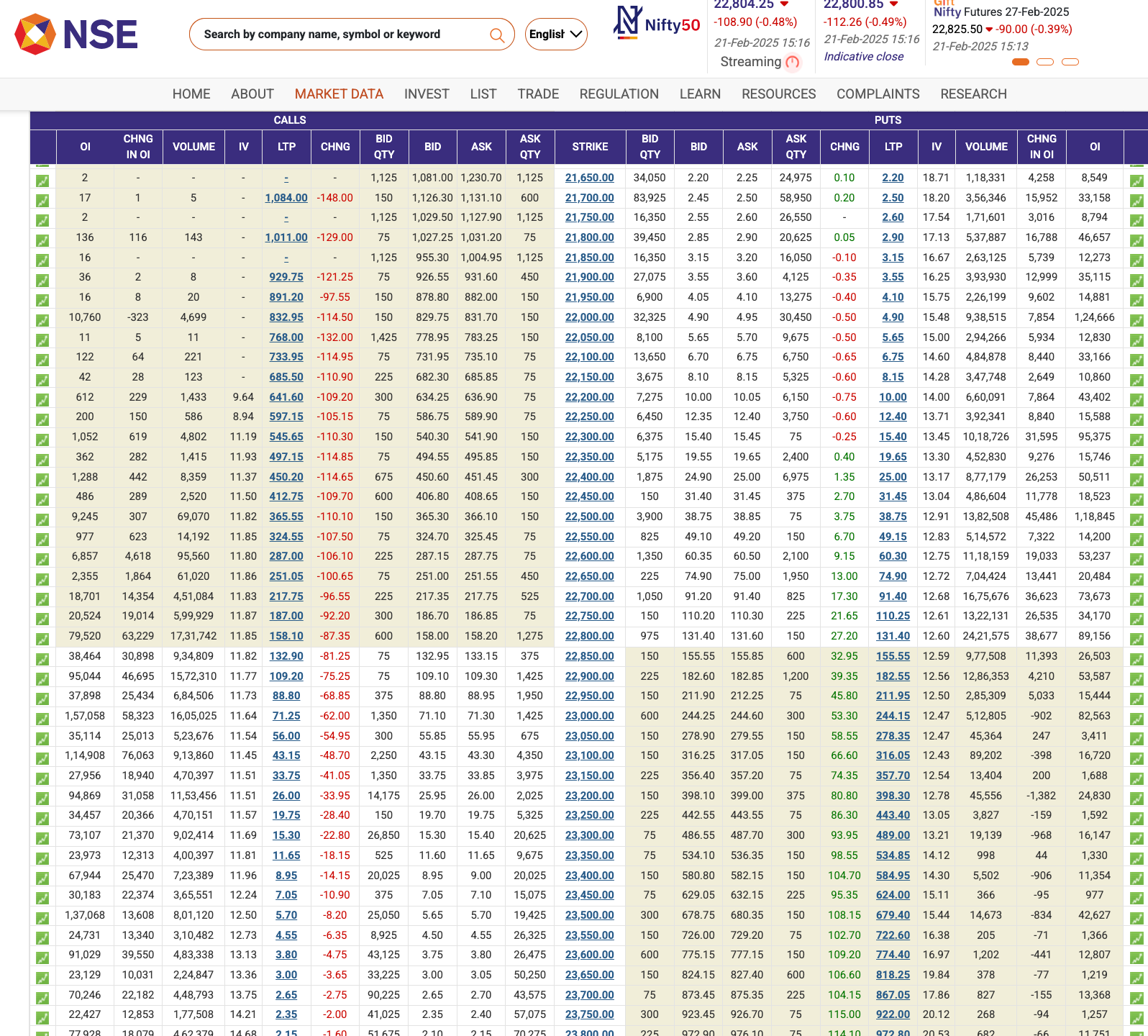
Here is an example of an option chain from NSE.
Components of an Option Chain:
To make the most of an option chain, it’s important to understand the key details it provides. Each contract comes with specific numbers that help traders decide when to buy or sell. Let’s break down the main components of an option chain and what they mean.
Underlying Asset
The financial instrument on which the options are based. These can be assets like stocks, indexes, or commodities in the above example. Nifty50 is the underlying asset, and different options contracts are built on it.
Expiration Dates:
The dates on which the options contracts expire. Option contracts have multiple expiration dates. For instance, Nifty has a weekly expiration every Thursday, and Bank Nifty on Wednesday.
Strike Prices:
The predetermined prices at which the underlying asset can be bought (call option) or sold (put option) upon exercise. Nifty has a 50-point difference between two consecutive strike prices.
Option Types:
Two primary types exist:
- Call Options: Grant the holder the right to buy the underlying asset at the strike price before expiration.
- Put Options: Grant the holder the right to sell the underlying asset at the strike price before expiration.
Bid and Ask Prices
The bid price represents the highest price a buyer is willing to pay for the option, while the asking price is the lowest price a seller is willing to accept. The difference between these prices is known as the bid-ask spread.
By examining bids and asking prices, a trader can gauge the ease of trading, assess demand levels, and determine whether the market is stable or volatile.
Volume
The number of option contracts traded during a specific period indicates the level of activity for that option. Higher volume means strong interest and active trading, while lower volume suggests less interest and lower market participation.
Open Interest
The total number of outstanding option contracts that have not been settled, provides insight into market liquidity and sentiment.
How To Read an Option Chain?
In an option chain, there are different components like strike price, expiry, volume, open interest, and bid-ask spread. Among these, traders pay the most attention to volume and open interest for a particular strike price. By analysing these two factors, traders can understand how much interest the market has in that strike price and make better trading decisions.
Analysing Volume in an Option Chain
A higher volume in an option contract means that the option is actively traded, showing strong interest from both buyers and sellers. On the other hand, low volume means fewer traders are participating, which can make it difficult to buy or sell the option at a fair price. Higher volume generally indicates better liquidity and smoother transactions, while lower volume may lead to wider bid-ask spreads and difficulty in exiting a trade.
In the above Nifty option chain, the 22,800 strike price has a high trading volume for both call and put options. These high-volume contracts show strong market interest and liquidity at this level. However, since the volume is higher on the put side, adding more put contracts could indicate a shift in market sentiment toward a bearish outlook.
Interpretation Of Open Interest
Open interest means the total number of outstanding option contracts that have not been settled. Open interest is created by selling of option contracts by selling different types of option contracts. Support and resistance of the particular underlying can be found by analysing the open interest because a higher open interest at a particular strike price indicates strong positions being built by option sellers.
- High open interest in put options means many put sellers believe the price won’t fall below that level, making it a strong support.
- High open interest in call options shows call sellers expect the price to stay below that level, creating resistance.
After marking down support and resistance with the option chain, it is advisable to sell puts if the support breaks, and if resistance breaks, it is better to buy call options.
Uses of Option Chain
An option chain helps traders analyse market sentiment and identify potential trading opportunities.
Traders use option chains for:
- Identifying support and resistance levels
- Analysing market sentiment
- Selecting strike prices
- Monitoring liquidity and volatility
- Planning intraday and positional option strategies
Option chain data is widely used in both directional trading and volatility-based strategies.
Significance of NSE Option Chain
The National Stock Exchange of India option chain is one of the most widely used tools among Indian traders because it provides real-time data on option contracts for stocks and indices like NIFTY 50 and BANK NIFTY.
Traders use the NSE option chain to:
- Track market positioning
- Analyse open interest shifts
- Identify support and resistance
- Understand market volatility
- Plan option buying and selling strategies
The NSE option chain is especially useful for intraday traders and option sellers who rely heavily on real-time market data.
Conclusion
An option chain is a valuable tool that helps traders understand market trends, liquidity, and price movements. By analysing key components like strike prices, expiration dates, volume, open interest, and bid-ask spreads, traders can make informed trading decisions.
Among these, volume and open interest are the most important indicators. High volume suggests strong trading activity, while open interest helps identify support and resistance levels. A high put open interest indicates strong support, while a high call open interest suggests resistance.
Once traders identify these key levels, they can plan their trades accordingly. If support holds, selling puts or buying calls can be profitable. If resistance holds, selling calls or buying puts can work well. Understanding how to read an option chain effectively allows traders to improve their strategies, minimise risk, and maximise profits in options trading.
Frequently Answered Questions (FAQs)
What is an option chain?
An option chain is a table that shows all the available call and put options for a particular stock, index, or commodity. It includes details like strike prices, expiry dates, option premiums, volume, and open interest. Traders use this to decide which option to buy or sell based on market trends.
What is the NSE option chain strategy for volatility trading?
Traders use the NSE option chain to identify periods of high and low volatility by analysing changes in option premiums, volume, and open interest.
During high volatility:
- Option premiums generally increase
- Traders may prefer option-selling strategies
- ATM and OTM options become more expensive
During low volatility:
- Option premiums decrease
- Traders may prefer option-buying strategies before expected breakouts
Monitoring changes in open interest and implied volatility helps traders build better volatility-based option strategies.
How to use the NSE option chain for intraday trading?
Intraday traders use the NSE option chain to identify short-term support, resistance, momentum, and market sentiment.
Some common approaches include:
- Tracking sudden increases in call or put open interest
- Monitoring volume spikes near important strike prices
- Watching changes in ATM option premiums
- Identifying support and resistance zones using OI buildup
Many traders combine option chain analysis with price action and technical indicators for better intraday decision-making.
How often Option chain updated?
Option chain data is updated continuously during market hours in near real-time.
On exchanges like NSE, option chain values such as:
- Option premium
- Open interest
- Volume
- Bid-ask prices
keep changing as traders place new buy and sell orders in the market.
What is NSE option analysis?
NSE option analysis refers to studying option chain data, open interest, volume, premiums, and implied volatility to understand market sentiment and potential price movement.
Traders use this analysis to identify:
- Bullish and bearish sentiment
- Support and resistance levels
- Volatility trends
- Trading opportunities in options contracts
What are Calls and Puts?
A call option gives the buyer the right to buy an underlying asset at a predetermined strike price before expiry, while a put option gives the buyer the right to sell the underlying asset at a predetermined strike price before expiry.
Call options are generally used when traders expect prices to rise, while put options are commonly used when traders expect prices to fall.
How to read an option chain?
To read an option chain, traders mainly analyse strike price, open interest (OI), volume, option premium, and expiry date. High Put OI often acts as support, while high Call OI usually acts as resistance, helping traders understand market sentiment and trading opportunities.
Disclaimer: This content is for educational purposes only and does not constitute financial or investment advice. Investments in securities or other financial instruments are subject to market risk, including partial or total loss of capital. Past performance is not indicative of future results. Always consider your financial situation carefully and consult a licensed financial advisor before making investment or trading decisions.
Engineered for the obsessed. Built for traders.

Purpose-built terminals.
Zero compromise.
Built for speed.

Plot No 1290, 2nd Floor, 17th Cross, 5th Main, Sector-7, HSR Layout, Bangalore 560102
Follow us on


Mintcap Brokers Private Limited
CIN – U66110KA2023PTC178706 | Registered Address: Plot No 1290, Second Floor, 17th Cross, 5th Main, Sector-7, HSR Layout, Bangalore 560102 | Tel: 080 – 49552310 | Email ID: compliance@capmint.com | SEBI registered Stock Broker: INZ000322732 | NSE Cash/F&O Member ID: 90430 | BSE Cash/F&O Member ID: 6903 | MCX Member ID: 57400 | NCDEX Member ID: 1312 | SEBI registered Depository Participant: IN-DP-806-2025 | CDSL DP ID: 12102300 | NSE Clearing Member code: M70108 | AMFI-Registered Mutual Fund Distributor: ARN-289109 (Valid upto 28-Feb-2027) | Category II Execution Only Platform : E6903
Details of Client Bank Account
Compliance Officer: Ms. Shridevi Vungarala | Email ID: compliance@capmint.com | Tel no. + 91 9035330126 | Grievance Redressal Officer (GRO) – Ms. Shikha Gupta | Email ID: Grievance@capmint.com | Tel no: 9035331595.
Procedure to file a complaint on SEBI SCORES: Register on SCORES portal. Mandatory details for filing complaints on SCORES: Name, PAN, Address, Mobile Number, E-mail ID. Benefits: Effective Communication, Speedy redressal of the grievances. You may refer the website https://scores.sebi.gov.in/ for more information. You may also download the SEBI Scores app to log a complaint Android: https://play.google.com > store > apps > sebiscores iOS: https://apps.apple.com > app > sebiscores
Disclaimer
Investment in the securities market are subject to market risks, read all the related documents carefully before investing. Brokerage will not exceed the SEBI prescribed limit.
Mutual fund investments are subject to market risks, read all scheme related documents carefully before investing. Mutual Funds are not exchange-traded products.
Attention Investor:
- Stock Brokers can accept securities as margin from clients only by way of pledge in the depository system w.e.f. September 1, 2020.
- Update your mobile number & email Id with your stock broker/depository participant and receive OTP directly from depository on your email id and/or mobile number to create pledge.
- Pay 20% as upfront margin of the transaction value to trade in cash market segment.
- Investors may please refer to the Exchange’s Frequently Asked Questions (FAQs) issued vide circular reference NSE/INSP/45191 dated July 31, 2020 and NSE/INSP/45534 dated August 31, 2020 and other guidelines issued from time to time in this regard.
- Check your Securities /MF/ Bonds in the consolidated account statement issued by NSDL/CDSL every month.