

Link copied!
Options Contract

An options contract is a deal between two people where one gets the right (but not the obligation) to buy or sell something (like a stock) at a fixed price (strike price) before a certain date (expiration date).
Key Takeaways
- An option contract gives traders the right (but not the obligation) to buy or sell an asset at a fixed price before a certain date. Call options allow buying, and put options allow selling.
- There are call options (used when expecting prices to go up) and put options (used when expecting prices to go down). Options can be used for trading, hedging, or speculation.
- Investors use options to hedge risks by protecting their investments from losses. Traders also speculate with options to make profits by predicting market movements.
- Options offer leverage, meaning traders can control large positions with less money. However, they can also be risky because if the price doesn’t move as expected before expiry, the option can become worthless.
Understanding Option Contracts
An option contract is a financial agreement between two parties that gives one of them the right but not the obligation to buy or sell an asset (such as stock) at a predetermined price, known as the strike price, before or on a specific date, called the expiration date.
There are two types of option contracts: call options, which give the right to buy the asset, and put options, the right to sell the asset; option contracts are often used for trading, hedging risks, or speculating on price movements in the stock market. However, if the option is not exercised before it expires, it becomes worthless.
What Are The Types Of Option Contracts?
Options work in different ways based on how and when they can be used. Let’s explore their types.
Call Option Contract
A call option is bought by the traders when they anticipate the price to go up in the future. A call option buyer pays a premium to the seller, and a call covers a position and this position. A call option buyer becomes profitable if the price moves above the strike price and sells it at a higher market price.
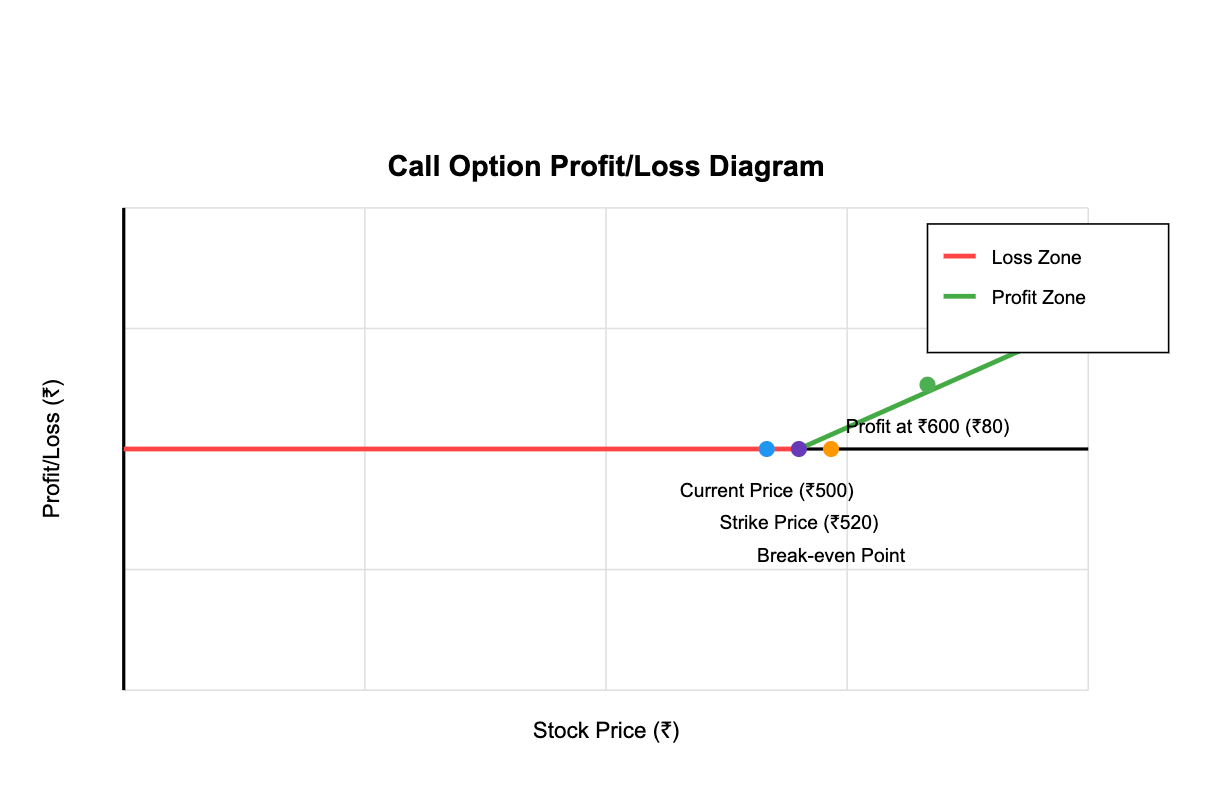
Suppose a stock is currently trading at ₹500, and you buy a call option with a strike price of ₹520. If the stock price rises to ₹600 before the expiry date, you can buy it at ₹520 and sell at ₹600, making a profit of ₹80 per share (excluding premiums and fees). Here is the pictorial representation of it:
Put Option Contract
Traders buy put option contracts when they expect the price of an asset to fall. A put option gives the holder the right to sell the asset at the strike price on or before the expiration date. Put options are generally preferred in a low-volatility market, as they tend to gain value when the underlying asset declines steadily.
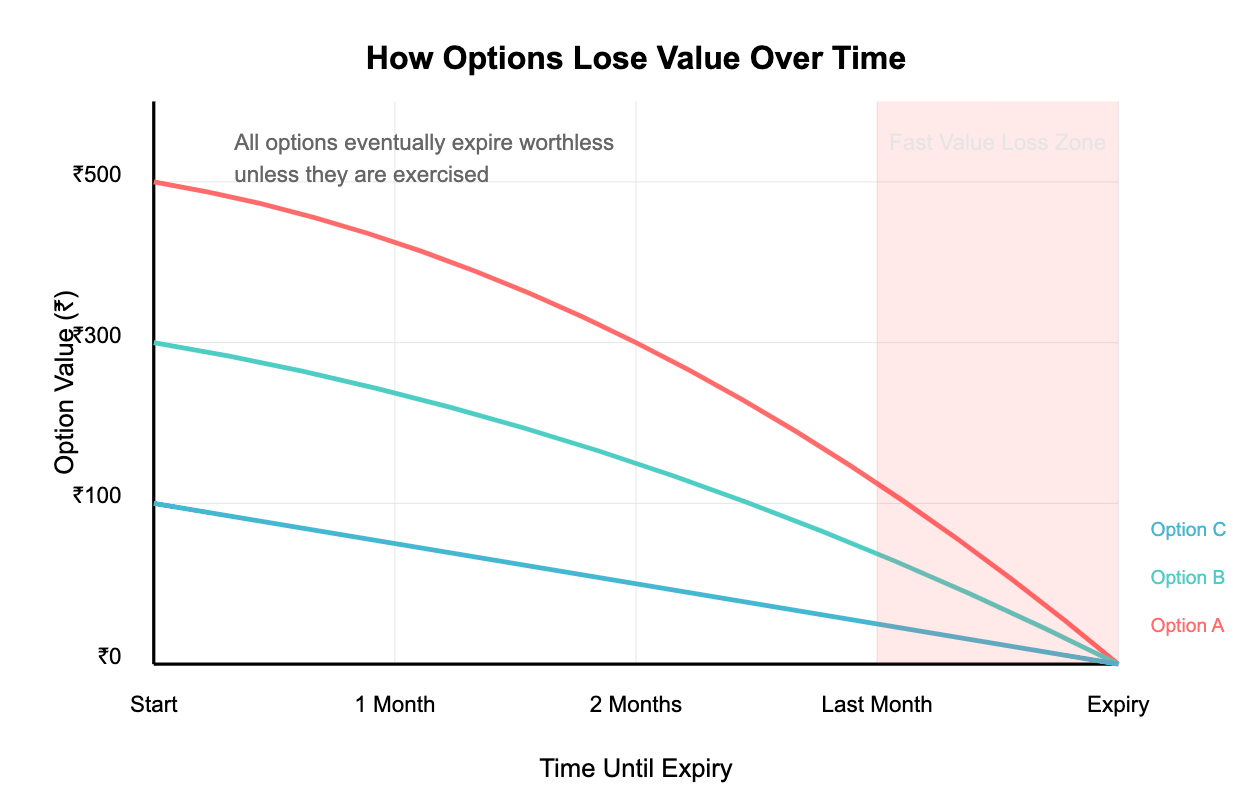
Traders can also benefit from time decay (theta decay) if the price moves in their favour. However, if the option is not exercised before expiry, it becomes worthless, as all options lose their time value at the end.
Hedging And Speculation With Option Strategies
Traders and investors use different option strategies for two main purposes: hedging to protect against losses and speculation to profit from market movements. Let’s explore how these strategies work.
Hedging With Option Contracts
Investors use option contracts to hedge their positions because they help reduce the downside risk of a portfolio. Hedging with options involves taking an offsetting position in the same or a different strike price to limit potential losses. The goal is not to make a profit but to protect the existing investment from unfavourable price movements, ensuring that a gain in the other balances any loss in one position.
Imagine you own 100 shares of a company, and the stock is currently at ₹500. You’re excited about your investment, but there’s a worry: what if the price drops?
To protect yourself, you buy a put option with a strike price of ₹480. Now, if the stock crashes to ₹450, you don’t panic because your put option allows you to sell at ₹480, limiting your loss.
Suppose the stock price goes up instead; great! You let the option expire and enjoy your gains. This way, the put option works like an insurance policy it costs a little, but it saves you from big losses.
Also read about Hedging with futures.
Speculation With Option Contracts
Options contracts are widely traded because they offer leverage, allowing traders to control a significant position with a relatively small amount of capital. If a trader buys a covered call and the option price rises beyond the stock price, the premium can increase significantly, sometimes multiplying in value.
Similarly, if a trader buys a put option and the stock price falls, the put option gains value, allowing the trader to profit from the premium increase.
Read more about speculation.
Features of an Options Contract
Options contracts have several unique features that make them widely used in trading, hedging, and speculative strategies. Understanding these features helps traders manage risk and make informed trading decisions.
Strike Price
The strike price is the predetermined price at which the buyer can buy or sell the underlying asset before the option expires. It is one of the most important components of an option contract because profitability depends on how the market price moves relative to the strike price.
Expiration Date
Every option contract has an expiry date. If the option is not exercised before or on this date, the contract becomes worthless. Traders often monitor expiry closely because time decay increases as expiration approaches.
Premium
The premium is the price paid by the option buyer to the seller for acquiring the contract. This amount represents the maximum possible loss for the buyer of the option.
Underlying Asset
Options derive their value from an underlying asset such as stocks, indices, commodities, or currencies. The movement of the underlying asset directly impacts the option’s value.
Leverage
Options provide leverage, allowing traders to control larger positions with a relatively smaller amount of capital. This can amplify profits, but it also increases risk exposure.
Time Decay (Theta Decay)
Options lose value as they approach expiry due to time decay. If the market price does not move favourably before expiration, the option premium may decline significantly.
Example Of Option Contracts
To understand how option contracts work in real life, let’s look at some simple examples.
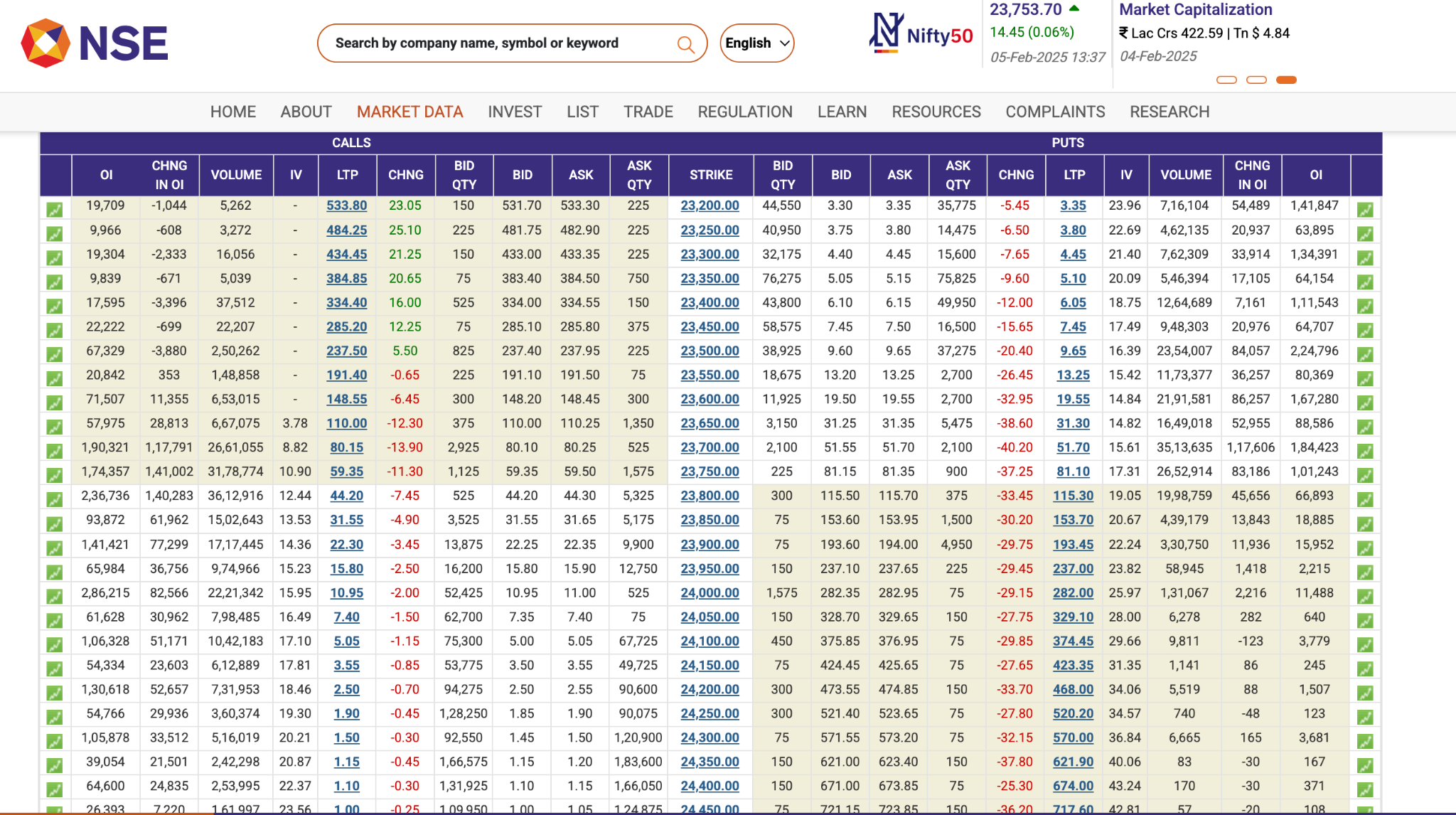
The Nifty option chain displays both call and put option contracts, with the LTP indicating the premium for each contract. For example, if a trader buys a call option with a strike price of 23,750 while Nifty is also trading at 23,750, and the index moves up to 23,800, the call option buyer would gain 50 points. This increase in price adds to the option’s premium, allowing the trader to make a profit.
Pros and Cons of Put Options
|
Pros of Option Contracts |
Cons of Option Contracts |
|---|---|
|
Options provide leverage, allowing traders to control larger positions with less capital. |
Options can expire worthless if the market does not move as expected before expiry. |
|
Traders can profit from both rising and falling markets using calls and puts. |
High leverage can increase losses if trades move against the position. |
|
Options are widely used for hedging and portfolio protection. |
Time decay reduces the value of options as expiry approaches. |
|
Risk for option buyers is generally limited to the premium paid. |
Options trading can be complex for beginners to understand. |
|
Options offer flexibility through different trading and hedging strategies. |
Market volatility can significantly impact option pricing. |
Risks of Put Options
While option contracts offer profit opportunities and risk management benefits, they also carry several risks that traders should understand before trading.
Time Decay Risk
Options lose value as they approach expiry. Even if the market moves slowly in the expected direction, time decay can reduce profitability.
Volatility Risk
Changes in market volatility can significantly affect option premiums. Sudden drops in volatility may reduce the value of options even when price movements appear favourable.
Leverage Risk
Options provide leverage, which can magnify both profits and losses. Small price movements in the underlying asset can lead to large percentage changes in option value.
Liquidity Risk
Some option contracts may have low trading volumes, making it difficult for traders to enter or exit positions at desired prices.
Expiry Risk
If the market price does not move beyond the strike price before expiry, the option may expire worthless, resulting in a complete loss of the premium paid by the buyer.
Conclusion
Options contracts are powerful financial tools that provide traders and investors with flexibility in managing risk and maximising returns. They allow market participants to either hedge their positions to protect against potential losses or speculate on price movements to generate profits.
Call options help traders benefit from rising prices, while put options provide protection or profit opportunities when prices fall. These contracts also offer leverage, enabling traders to control larger positions with a smaller amount of capital. However, while options can be highly rewarding, they also carry risks, especially if not managed properly.
Understanding how options work, their different types and the strategies involved is essential for making informed trading decisions. Whether used for hedging or speculation, options can be a valuable part of an investment strategy when used with proper knowledge and risk management. By learning and applying the right strategies, traders can make better decisions and navigate the market more effectively.
Frequently Asked Questions (FAQs)
What is an option contract?
An option contract is a financial agreement that gives a trader the right (but not the obligation) to buy or sell a stock at a fixed price before a certain date. There are two types: call options (to buy) and put options (to sell).
What Are Some Options Trading Strategies?
Some common options trading strategies include covered calls, protective puts, long calls, long puts, and straddles. Traders use these strategies for different purposes, such as hedging against market risk, generating income, or speculating on price movements and market volatility.
Is it Possible for Beginners to trade in Options Trading?
Yes, beginners can trade in options, but they should first understand the basics of option contracts, strike prices, premiums, expiry dates, and risk management. Since options trading involves leverage and volatility, beginners often start with simple strategies such as buying call or put options before moving to advanced strategies.
Is Options Trading a Profit-Making Strategy?
Options trading can be profitable if traders correctly predict market direction, volatility, and timing. Traders use options for speculation, hedging, and income generation. However, because options are highly sensitive to market movements and time decay, they also carry significant risks and require proper strategy and risk management.
Is an option contract risky?
Yes, option contracts can be risky because their value depends on market price movements and time decay. If the price doesn’t move as expected before expiry, the option can become worthless, leading to a loss of the premium paid. However, with proper strategies, the risk can be managed.
Is one option contract for 100 shares?
Yes, in most markets, one options contract represents 100 shares of the underlying stock. This means when you buy one option, you control 100 shares, allowing for bigger potential profits or losses with a smaller investment.
Disclaimer: This content is for educational purposes only and does not constitute financial or investment advice. Investments in securities or other financial instruments are subject to market risk, including partial or total loss of capital. Past performance is not indicative of future results. Always consider your financial situation carefully and consult a licensed financial advisor before making investment or trading decisions.
Engineered for the obsessed. Built for traders.

Purpose-built terminals.
Zero compromise.
Built for speed.

Plot No 1290, 2nd Floor, 17th Cross, 5th Main, Sector-7, HSR Layout, Bangalore 560102
Follow us on


Mintcap Brokers Private Limited
CIN – U66110KA2023PTC178706 | Registered Address: Plot No 1290, Second Floor, 17th Cross, 5th Main, Sector-7, HSR Layout, Bangalore 560102 | Tel: 080 – 49552310 | Email ID: compliance@capmint.com | SEBI registered Stock Broker: INZ000322732 | NSE Cash/F&O Member ID: 90430 | BSE Cash/F&O Member ID: 6903 | MCX Member ID: 57400 | NCDEX Member ID: 1312 | SEBI registered Depository Participant: IN-DP-806-2025 | CDSL DP ID: 12102300 | NSE Clearing Member code: M70108 | AMFI-Registered Mutual Fund Distributor: ARN-289109 (Valid upto 28-Feb-2027) | Category II Execution Only Platform : E6903
Details of Client Bank Account
Compliance Officer: Ms. Shridevi Vungarala | Email ID: compliance@capmint.com | Tel no. + 91 9035330126 | Grievance Redressal Officer (GRO) – Ms. Shikha Gupta | Email ID: Grievance@capmint.com | Tel no: 9035331595.
Procedure to file a complaint on SEBI SCORES: Register on SCORES portal. Mandatory details for filing complaints on SCORES: Name, PAN, Address, Mobile Number, E-mail ID. Benefits: Effective Communication, Speedy redressal of the grievances. You may refer the website https://scores.sebi.gov.in/ for more information. You may also download the SEBI Scores app to log a complaint Android: https://play.google.com > store > apps > sebiscores iOS: https://apps.apple.com > app > sebiscores
Disclaimer
Investment in the securities market are subject to market risks, read all the related documents carefully before investing. Brokerage will not exceed the SEBI prescribed limit.
Mutual fund investments are subject to market risks, read all scheme related documents carefully before investing. Mutual Funds are not exchange-traded products.
Attention Investor:
- Stock Brokers can accept securities as margin from clients only by way of pledge in the depository system w.e.f. September 1, 2020.
- Update your mobile number & email Id with your stock broker/depository participant and receive OTP directly from depository on your email id and/or mobile number to create pledge.
- Pay 20% as upfront margin of the transaction value to trade in cash market segment.
- Investors may please refer to the Exchange’s Frequently Asked Questions (FAQs) issued vide circular reference NSE/INSP/45191 dated July 31, 2020 and NSE/INSP/45534 dated August 31, 2020 and other guidelines issued from time to time in this regard.
- Check your Securities /MF/ Bonds in the consolidated account statement issued by NSDL/CDSL every month.