

Link copied!
NSE (National Stock Exchange) of India

The National Stock Exchange of India Limited (NSE), established in 1992 and headquartered in Mumbai, is the fourth-largest stock exchange globally by market capitalisation.
Key Takeaways
- NSE is India’s leading stock exchange, established in 1992 in Mumbai.
- It pioneered India’s first fully automated electronic trading system, replacing the opaque open outcry method with transparent, efficient screen-based trading.
- NSE facilitates trading across equities, derivatives, ETFs, debt, and currency instruments, operating on a T+1 settlement cycle via the NEAT matching engine.
Introduction to NSE
Regulated by the Securities and Exchange Board of India (SEBI), NSE revolutionised Indian financial markets by introducing screen-based trading. Today, it serves as the default exchange for most retail investors and active traders in India.
The sheer depth of liquidity on NSE, particularly in index derivatives, ensures tighter bid-ask spreads and faster order execution than most comparable global exchanges. This unparalleled liquidity drives NSE’s options volume, ranking it among the highest globally by contract count.
History of NSE
Incorporated in 1992, NSE commenced operations in 1994 by launching the wholesale debt and cash market segments. It successfully dismantled the fragmented, opaque, and settlement-delayed open outcry system dominated by regional exchanges.
The 1994 shift to screen-based trading proved transformative. For the first time, a retail investor in Chennai or Kolkata accessed the exact same prices as a trader in a Mumbai brokerage at the exact same moment. This nationwide price parity fundamentally democratised Indian capital markets.
NSE continually introduced market firsts: index futures (2000), index options (2001), single-stock options and futures (2001), and currency derivatives (2008). These innovations elevated India’s market infrastructure to global standards. By 2023-24, NSE’s average daily equity derivatives turnover scaled to several Lakh Crore Rupees, cementing its status as a dominant global derivatives market.
Key Functions of NSE
The core functions of NSE include:
Facilitating Trading
NSE executes millions of orders daily through its NEAT system, maintaining a continuous, fair auction market for equities and derivatives.
Providing Market Data
NSE distributes real-time feeds, order book depth, and historical analytics directly to brokers and third-party platforms.
Risk Management & Clearing
NSE Clearing Limited acts as the central counterparty to every trade. Through real-time margin monitoring and auto-square-off mechanisms, it guarantees settlement, insulating participants from counterparty default risk.
Promoting Financial Literacy
NSE educates investors and professionals through webinars and the NSE Certification in Financial Markets (NCFM) programme, building structured market knowledge.
Major Indices Under NSE
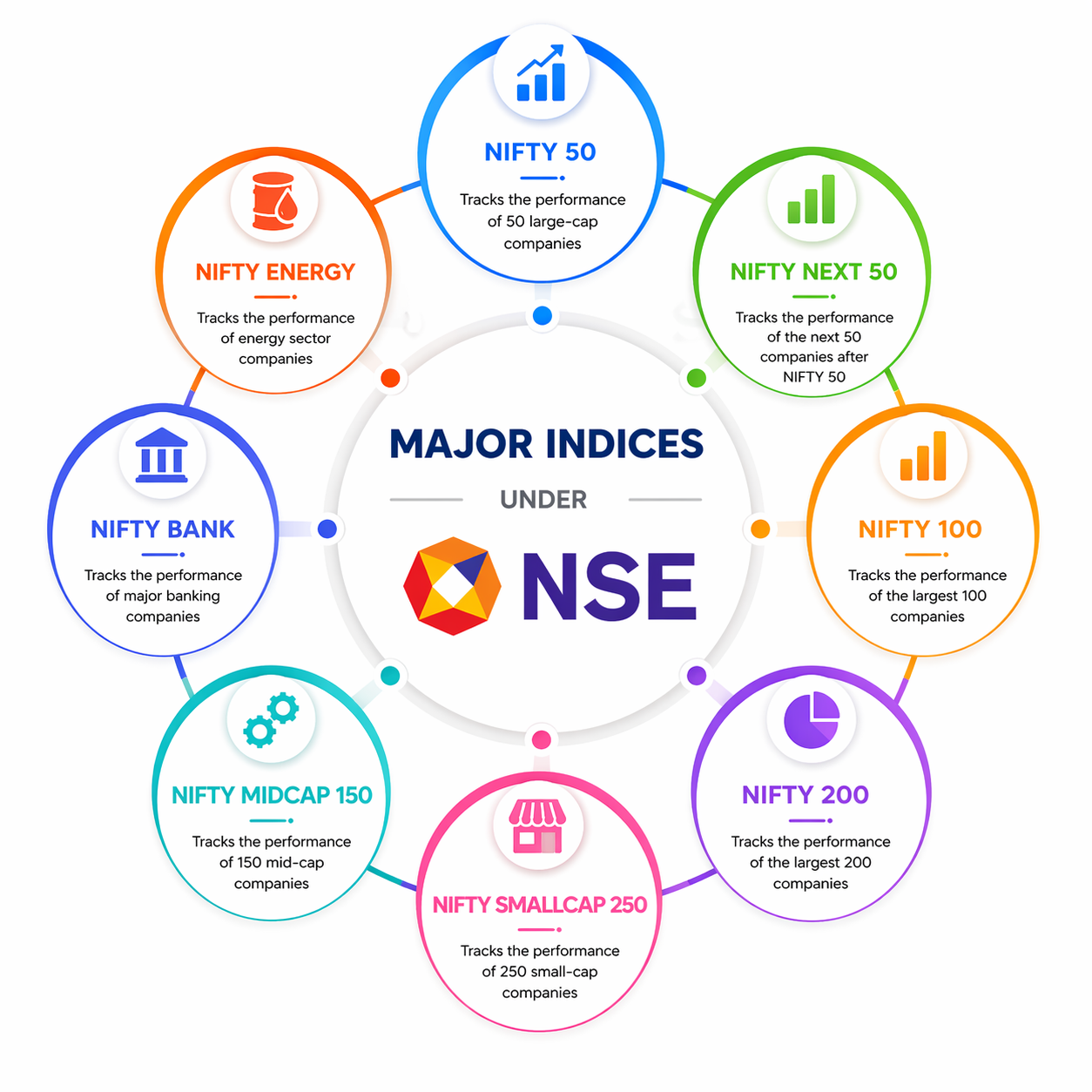
The Nifty 50 acts as the primary barometer of the Indian equity market, tracking the top 50 large-cap stocks. NSE’s Index Maintenance Sub-Committee reviews its composition semi-annually; additions or deletions trigger significant price reactions due to passive index fund flows.
Other key indices include:
- Nifty Next 50: Tracks companies ranked 51-100 by market capitalisation.
- Nifty Midcap 150 & Smallcap 250: Captures mid-cap and small-cap performance for index funds and ETFs.
- Nifty Bank: Tracks liquid banking stocks; serves as the underlying index for heavily traded Bank Nifty derivatives.
- Sectoral & Thematic Indices: Tracks specific industries (Nifty IT, Nifty Auto) or themes (Nifty India Defence, Nifty PSU Bank) for targeted ETF and mutual fund investments.
How Does the NSE Work?
NSE operates a sophisticated electronic limit order book. An advanced trading engine automatically matches buy and sell orders based strictly on price-time priority, ensuring unbiased execution without human intervention.
Trading Hours
Stock market timings are from Monday to Friday, 9:15 AM to 3:30 PM. A pre-opening call auction session runs from 9:00 AM to 9:15 AM to discover opening prices. A post-closing session runs from 3:40 PM to 4:00 PM.
Trading System (NEAT)
The National Exchange for Automated Trading handles millions of concurrent orders. It enforces strict price-time priority, eliminating the preferential treatment historically seen in floor trading.
Settlement Cycle
NSE mandates a T+1 settlement cycle for equities. Shares sold on Monday generate proceeds by Tuesday, drastically reducing counterparty risk.
Note: SEBI is actively rolling out optional T+0 settlement for select securities.
Products Traded on NSE
NSE offers a wide range of financial instruments for trading.
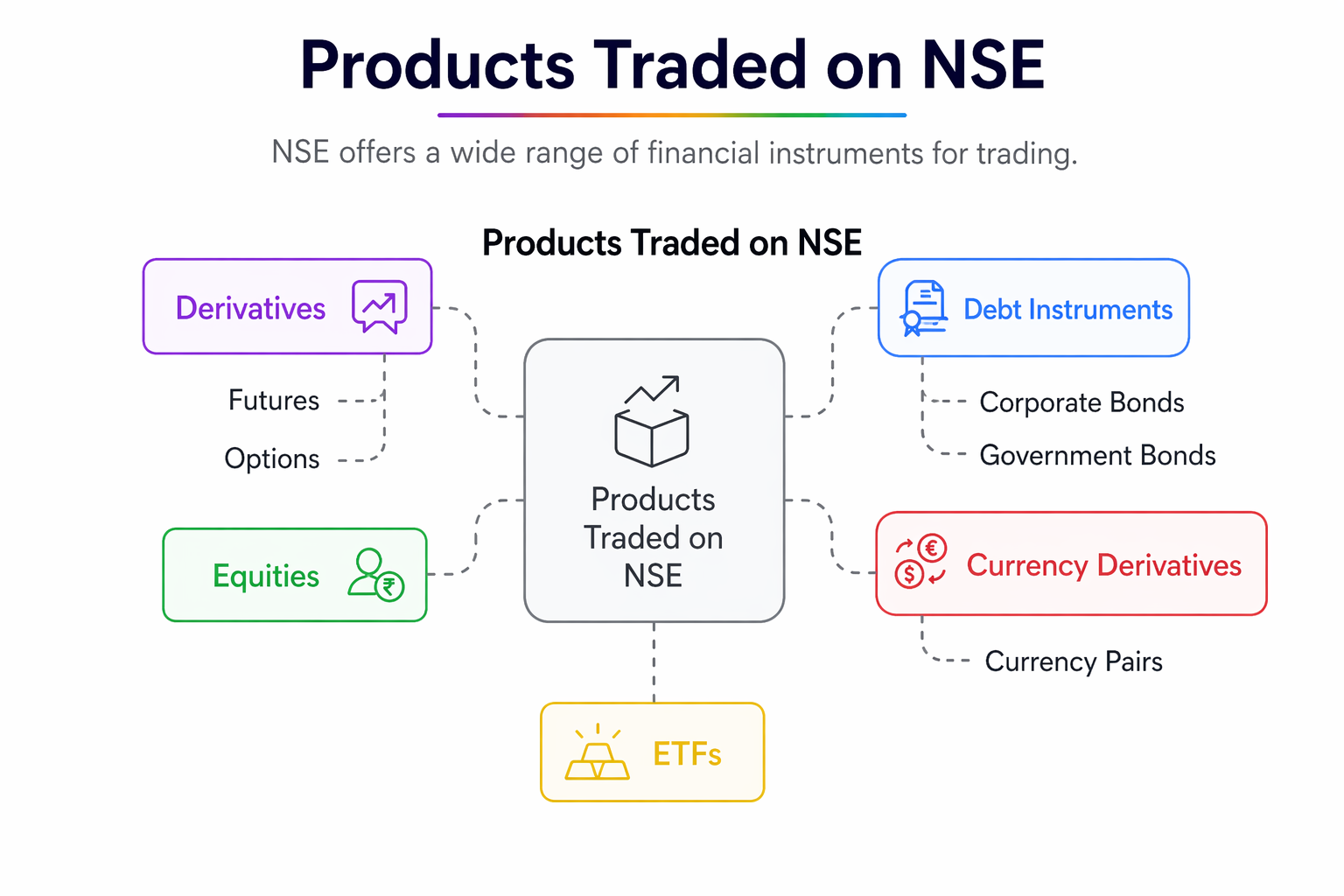
- Equities: Shares of over 2,000 publicly listed large, mid, and small-cap companies.
- Equity Derivatives: Futures and options on stocks and indices. Following SEBI’s mandate limiting exchanges to a single weekly index derivative expiry, the Nifty 50 (Thursday) remains the primary short-duration options contract for retail traders.
- Currency Derivatives: Hedging instruments for currency pairs (USD/INR, EUR/INR). (Note: RBI mandates require traders to possess a valid underlying contracted exposure to trade these).
- Debt Instruments: Government bonds and debentures, accessible directly to retail investors.
- ETFs & Index Funds: Funds tracking broader indices, sectoral themes, or commodities like gold.
- Sovereign Gold Bonds (SGBs): Government-backed, interest-bearing securities offering exposure to gold prices without physical ownership.
Difference Between NSE and BSE
|
Feature |
BSE (Bombay Stock Exchange) |
NSE (National Stock Exchange) |
|---|---|---|
|
Establishment |
1875 (Asia’s oldest exchange). |
1992 (Pioneered electronic trading). |
|
Benchmark Index |
Sensex (30 large-cap companies). |
Nifty 50 (50 diversified large-cap companies). |
|
Listed Companies |
5,000+ (Includes many micro/small-caps). |
2,000+ (Weighted toward liquid, larger stocks). |
|
Derivatives Market |
Lower volume and liquidity. |
Dominates India’s F&O segment. |
|
Trading Volume |
Generally lower. |
Highest liquidity; preferred by active traders. |
Arbitrageurs keep Nifty 50 equity prices identical across both exchanges. However, NSE’s vastly superior liquidity makes it the only practical choice for derivatives (F&O) trading.
Conclusion
The NSE forms the infrastructure backbone of India’s capital markets. By pioneering screen-based trading and consistently upgrading settlement cycles, NSE aligns Indian markets with global best practices.
Understanding NSE’s mechanics (from NEAT’s price-time priority to the clearing corporation’s settlement guarantees) equips traders and investors to execute market decisions with confidence.
Frequently Asked Questions (FAQs)
What is the difference between NSE and BSE?
NSE offers significantly higher liquidity, tighter spreads, and dominates the derivatives market. BSE is Asia’s oldest exchange with more listed companies. Both are functionally identical for equity delivery, but NSE is essential for F&O trading.
Can I buy stocks directly from NSE?
No. You must open a trading or demat account with a SEBI-registered broker like CapMint. The broker routes your orders to NSE’s trading engine.
What is the minimum amount required to invest in NSE?
There is no minimum limit; you can purchase a single share (often costing under ₹100). Derivatives trading, however, requires specific capital to meet exchange-mandated margin requirements.
Is NSE safe for beginners?
Yes. SEBI strictly regulates NSE, and its clearing corporation guarantees all trade settlements. However, while the exchange infrastructure is secure, the securities you purchase still carry inherent market risk.
What is NEAT and how does it affect my trades?
NEAT (National Exchange for Automated Trading) is NSE’s matching engine. It automatically pairs buy and sell orders based on price-time priority, guaranteeing fair, transparent, and immediate execution at the best available market price.
Disclaimer: This content is for educational purposes only and does not constitute financial or investment advice. Investments in securities or other financial instruments are subject to market risk, including partial or total loss of capital. Past performance is not indicative of future results. Always consider your financial situation carefully and consult a licensed financial advisor before making investment or trading decisions.
Engineered for the obsessed. Built for traders.

Purpose-built terminals.
Zero compromise.
Built for speed.

Plot No 1290, 2nd Floor, 17th Cross, 5th Main, Sector-7, HSR Layout, Bangalore 560102
Follow us on


Mintcap Brokers Private Limited
CIN – U66110KA2023PTC178706 | Registered Address: Plot No 1290, Second Floor, 17th Cross, 5th Main, Sector-7, HSR Layout, Bangalore 560102 | Tel: 080 – 49552310 | Email ID: compliance@capmint.com | SEBI registered Stock Broker: INZ000322732 | NSE Cash/F&O Member ID: 90430 | BSE Cash/F&O Member ID: 6903 | MCX Member ID: 57400 | NCDEX Member ID: 1312 | SEBI registered Depository Participant: IN-DP-806-2025 | CDSL DP ID: 12102300 | NSE Clearing Member code: M70108 | AMFI-Registered Mutual Fund Distributor: ARN-289109 (Valid upto 28-Feb-2027) | Category II Execution Only Platform : E6903
Details of Client Bank Account
Compliance Officer: Ms. Shridevi Vungarala | Email ID: compliance@capmint.com | Tel no. + 91 9035330126 | Grievance Redressal Officer (GRO) – Ms. Shikha Gupta | Email ID: Grievance@capmint.com | Tel no: 9035331595.
Procedure to file a complaint on SEBI SCORES: Register on SCORES portal. Mandatory details for filing complaints on SCORES: Name, PAN, Address, Mobile Number, E-mail ID. Benefits: Effective Communication, Speedy redressal of the grievances. You may refer the website https://scores.sebi.gov.in/ for more information. You may also download the SEBI Scores app to log a complaint Android: https://play.google.com > store > apps > sebiscores iOS: https://apps.apple.com > app > sebiscores
Disclaimer
Investment in the securities market are subject to market risks, read all the related documents carefully before investing. Brokerage will not exceed the SEBI prescribed limit.
Mutual fund investments are subject to market risks, read all scheme related documents carefully before investing. Mutual Funds are not exchange-traded products.
Attention Investor:
- Stock Brokers can accept securities as margin from clients only by way of pledge in the depository system w.e.f. September 1, 2020.
- Update your mobile number & email Id with your stock broker/depository participant and receive OTP directly from depository on your email id and/or mobile number to create pledge.
- Pay 20% as upfront margin of the transaction value to trade in cash market segment.
- Investors may please refer to the Exchange’s Frequently Asked Questions (FAQs) issued vide circular reference NSE/INSP/45191 dated July 31, 2020 and NSE/INSP/45534 dated August 31, 2020 and other guidelines issued from time to time in this regard.
- Check your Securities /MF/ Bonds in the consolidated account statement issued by NSDL/CDSL every month.