

Table of Content
- Key Takeaways
- What Is Rho In Options Trading?
- How to Calculate Rho?
- Rho Values Interpretation
- Interpretation of RHO in different Options
- What Is The Rho's Impact on Call and Put Options?
- How to use RHO for Option Trading?
- Factors Affecting Rho Option Greek
- Understanding the role of rho in volatility trading
- Conclusion
- Frequently Asked Questions (FAQs)
Link copied!
Rho in Option Trading

Rho is one of the Greeks in options trading that measures the sensitivity of the option price with respect to interest rates. Rho represents the expected change in premium for a 1% change in interest rates. The rho effect is more pronounced with long-term options.
Key Takeaways
- Rho is one of the Greeks in options trading who shows how much an option’s price will change if interest rates go up or down by 1%. It is more important for long-term options.
- When interest rates rise, call option prices increase because investors prefer buying options instead of stocks. On the other hand, option prices fall because holding cash becomes more attractive.
- Options with a longer time until expiration are more affected by interest rate changes, while short-term options have little impact from rho.
- Deep in-the-money options have a higher rho because they behave more like stocks, while at-the-money and out-of-the-money options have a lower rho impact.
What Is Rho In Options Trading?
Rho is one crucial option Greeks that traders watch while carrying option contracts. These measure how much the premium changes for a 1% change in interest rates. Interest rates refer to the risk-free interest rate, which is usually represented by the yield on government securities like Treasury bills (T-bills) or bonds.
Rho is higher for long-term option contracts because the longer the duration, the more time interest rates have to influence the pricing. Since rho measures the sensitivity of interest rates, long-term options change more with interest rates because they last longer.
How to Calculate Rho?
Rho is calculated by measuring how much the option premium changes when interest rates move by 1%, while all other factors remain constant.
Rho = Change in Option Premium / Change in Interest Rate
For example, suppose a call option premium rises from ₹12 to ₹15 after interest rates increase by 1%.
- Change in Option Premium = ₹3
- Change in Interest Rate = 1%
So, the rho of the option will be 3. This means the option premium is expected to increase by approximately ₹3 for every 1% rise in interest rates.
Rho Values Interpretation
The value of Rho helps traders understand the sensitivity of an option to interest rate fluctuations. Here’s how to interpret it:
Example:
- Suppose a stock is trading at ₹1,000.
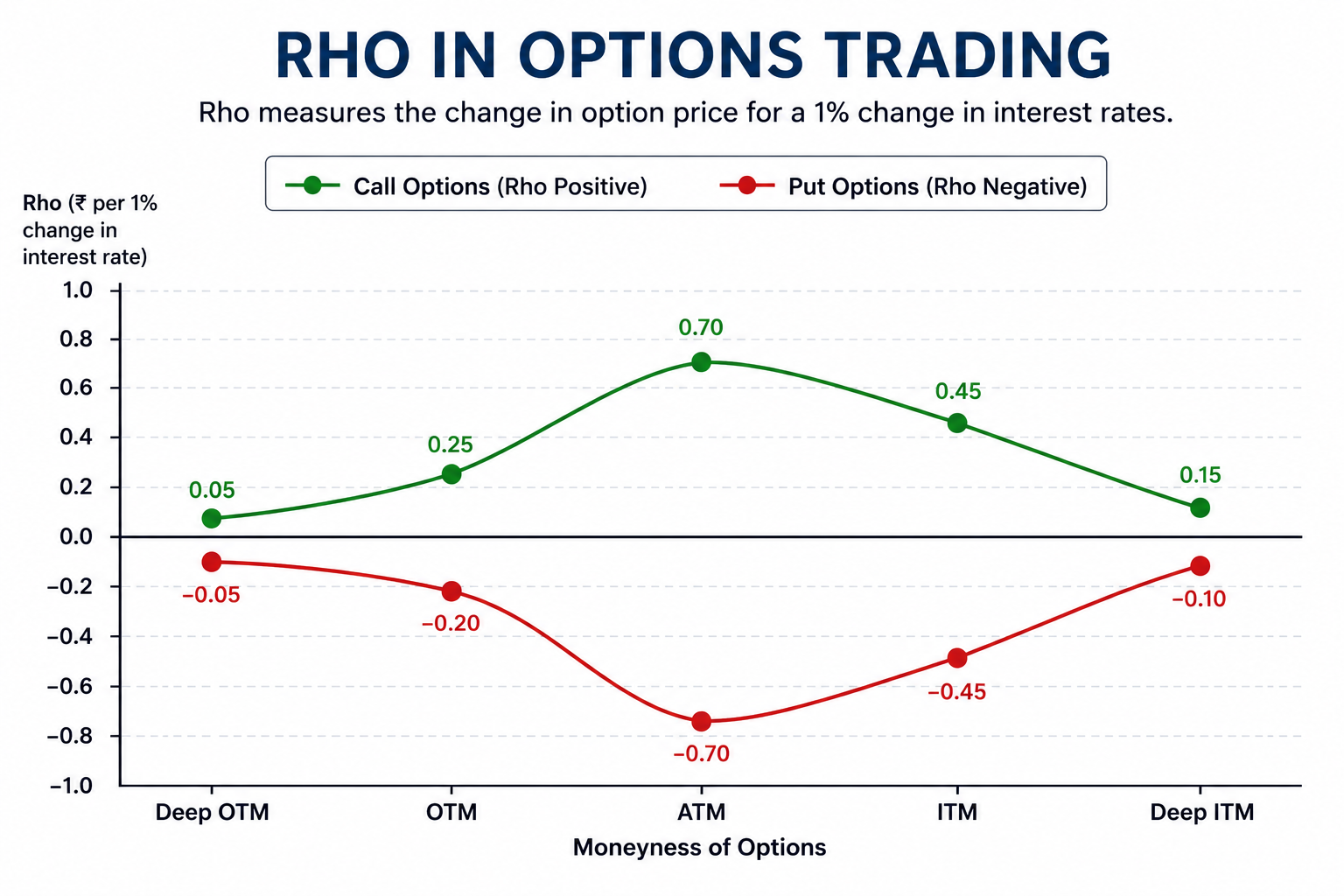
- A call option with a strike price of ₹1,100 has a Rho of 0.25.
- If interest rates increase by 1%, the call option price will increase by ₹0.25 per contract.
Positive And Negative Values Of Rho
Call options have a positive row because an increase in interest rates will ultimately increase the price of a call option contract. For Instance, if a call option has a Rho of +0.40, a 1% rise in interest rates will increase the option price by ₹0.40 per unit.
For put options, the effect is the opposite. To exercise a put option, traders need cash. When interest rates rise, holding cash becomes more attractive because it earns more in bank deposits or government bonds. As a result, investors prefer to keep their money instead of buying put options, reducing demand and lowering their prices.
Interpretation of RHO in different Options
Rho behaves differently depending on whether the option is In-the-Money (ITM), At-the-Money (ATM), or Out-of-the-Money (OTM).
Deep ITM Options:
Usually have higher rho because they behave more like the underlying stock.
ATM Options:
ATM Options have moderate rho sensitivity because their value mainly comes from the time value.
OTM Options:
OTM Options generally have lower rho because their pricing depends more on volatility and time value rather than interest rates.
What Is The Rho’s Impact on Call and Put Options?
Rho affects call and put options differently because of the way interest rates influence the cost of carrying stocks and the time value of money. Here’s why:
Higher Interest rates Increase Call Option Prices
Call options allow traders to control a stock without actually buying it. When interest rates increase, borrowing money becomes more expensive, making outright stock purchases less attractive. This increases the demand for call options, raising their price.
The reason for higher call option prices is that if an investor buys a stock, their money gets locked in, and they miss out on earning interest elsewhere. But buying a call option needs less money, so it’s a better choice when interest rates are high.
When the Reserve Bank of India increases interest rates after its MPC decisions, borrowing money becomes more expensive for investors. As a result, they find it difficult to take loans and invest directly in Nifty 50 stocks. Instead, they prefer buying Nifty 50 call options because they require less capital. This increases the demand for call options, which in turn raises their prices, ultimately pushing up the Nifty 50 index.
Rising Interest Rates Weaken Put Option Value
Rising interest rates make bank deposits and bonds more rewarding, so investors prefer to keep cash instead of buying put options. Since put options need cash to work, fewer people buy them, causing their prices to drop.
How to use RHO for Option Trading?
Rho helps traders understand how changes in interest rates may affect option premiums, especially in long-term contracts.
Traders often monitor rho:
- During central bank policy announcements
- In high-interest-rate environments
- While trading long-dated options
- When analysing the cost of carrying positions
Rho becomes more important for institutional traders and long-term options strategies where interest rate changes can significantly affect pricing.
Factors Affecting Rho Option Greek
Rho doesn’t affect all options the same way. Its impact depends on factors like whether it’s a call or put, how much time is left until expiry, and how deep the option is in the money. Let’s break down the key factors that influence Rho.
Long-Term Options Feel the Interest Rate Impact More
Options with longer expiration periods are more affected by interest rate changes. This is because the impact of interest rates builds up over time, making long-term options more sensitive to rate fluctuations.
Moneyness of Option: How It Affects Rho
This is a general trend observed that deep In-The-Money contracts have higher row because these ITM contracts almost behave like underlying stocks since stock prices get affected by interest rates (higher rates make borrowing costlier, affecting stock demand); ITM options are also more sensitive to rate changes. ITM options have a higher probability of expiring in profit, so their future value is more affected by interest rate changes.
As ATM and OTM options don’t have intrinsic value, they only derive their value from time value; since Rho affects the intrinsic value more than time value, ATM and OTM options have a much lower Rho impact.OTM options are more speculative, and their value depends more on volatility (Vega) than interest rates (Rho).
Understanding the role of rho in volatility trading
Although Volatility mainly affects option pricing through Vega, rho can still influence trading decisions during periods of changing interest rates.
In volatile markets with rising interest rates, option premiums may increase further for call options because both volatility and borrowing costs affect demand. Traders often analyse rho together with volatility to better understand long-term option pricing behaviour.
Conclusion
Rho is an important yet often overlooked Greek letter in options trading that measures the impact of interest rate changes on option prices. It plays a crucial role in long-term options, where interest rate fluctuations have a more pronounced effect.
Call options have a positive rho, meaning their prices rise with increasing interest rates, while put options have a negative rho, meaning their prices fall. Factors like time to expiration and moneyness influence rho’s impact. While not the most critical factor in short-term trading, rho becomes significant in high-interest rate environments, helping traders make informed decisions on their options strategies.
Frequently Asked Questions (FAQs)
What is the definition of rho in options trading?
Rho measures how much an option’s premium is expected to change when interest rates rise or fall by 1%. It is one of the Option Greeks used to analyse option pricing sensitivity.
What is the impact of rho on option prices?
Rho affects call and put options differently.
- Rising interest rates generally increase call option prices.
- Rising interest rates usually reduce put option prices.
The impact of rho is stronger in long-term options because interest rates have more time to influence option pricing.
What is the rho equation in finance?
Rho in finance is a formula used to measure how much the price of an option will change when interest rates go up or down by 1%. It helps traders understand the impact of interest rates on options pricing, especially for long-term options.
How to use rho?
Traders use rho to estimate how interest rate changes may affect long-term option positions. It is especially useful when trading long-dated contracts or during periods of changing monetary policy and bond yields.
What is the rho formula?
Rho measures the expected change in an option’s premium for a 1% change in interest rates.
Rho = Change in Option Price / Change in Interest Rate
For example, if a call option premium increases by ₹2 after a 1% rise in interest rates, the rho of the option will be 2.
Disclaimer: This content is for educational purposes only and does not constitute financial or investment advice. Investments in securities or other financial instruments are subject to market risk, including partial or total loss of capital. Past performance is not indicative of future results. Always consider your financial situation carefully and consult a licensed financial advisor before making investment or trading decisions.
Table of Content
- Key Takeaways
- What Is Rho In Options Trading?
- How to Calculate Rho?
- Rho Values Interpretation
- Interpretation of RHO in different Options
- What Is The Rho's Impact on Call and Put Options?
- How to use RHO for Option Trading?
- Factors Affecting Rho Option Greek
- Understanding the role of rho in volatility trading
- Conclusion
- Frequently Asked Questions (FAQs)
Engineered for the obsessed. Built for traders.
Purpose-built terminals.
Zero compromise.
Built for speed.

Plot No 1290, 2nd Floor, 17th Cross, 5th Main, Sector-7, HSR Layout, Bangalore 560102
Follow us on


Mintcap Brokers Private Limited
CIN – U66110KA2023PTC178706 | Registered Address: Plot No 1290, Second Floor, 17th Cross, 5th Main, Sector-7, HSR Layout, Bangalore 560102 | Tel: 080 – 49552310 | Email ID: compliance@capmint.com | SEBI registered Stock Broker: INZ000322732 | NSE Cash/F&O Member ID: 90430 | BSE Cash/F&O Member ID: 6903 | MCX Member ID: 57400 | NCDEX Member ID: 1312 | SEBI registered Depository Participant: IN-DP-806-2025 | CDSL DP ID: 12102300 | NSE Clearing Member code: M70108 | AMFI-Registered Mutual Fund Distributor: ARN-289109 (Valid upto 28-Feb-2027) | Category II Execution Only Platform : E6903
Details of Client Bank Account
Compliance Officer: Ms. Shridevi Vungarala | Email ID: compliance@capmint.com | Tel no. + 91 9035330126 | Grievance Redressal Officer (GRO) – Ms. Shikha Gupta | Email ID: Grievance@capmint.com | Tel no: 9035331595.
Procedure to file a complaint on SEBI SCORES: Register on SCORES portal. Mandatory details for filing complaints on SCORES: Name, PAN, Address, Mobile Number, E-mail ID. Benefits: Effective Communication, Speedy redressal of the grievances. You may refer the website https://scores.sebi.gov.in/ for more information. You may also download the SEBI Scores app to log a complaint Android: https://play.google.com > store > apps > sebiscores iOS: https://apps.apple.com > app > sebiscores
Disclaimer
Investment in the securities market are subject to market risks, read all the related documents carefully before investing. Brokerage will not exceed the SEBI prescribed limit.
Mutual fund investments are subject to market risks, read all scheme related documents carefully before investing. Mutual Funds are not exchange-traded products.
Attention Investor:
- Stock Brokers can accept securities as margin from clients only by way of pledge in the depository system w.e.f. September 1, 2020.
- Update your mobile number & email Id with your stock broker/depository participant and receive OTP directly from depository on your email id and/or mobile number to create pledge.
- Pay 20% as upfront margin of the transaction value to trade in cash market segment.
- Investors may please refer to the Exchange’s Frequently Asked Questions (FAQs) issued vide circular reference NSE/INSP/45191 dated July 31, 2020 and NSE/INSP/45534 dated August 31, 2020 and other guidelines issued from time to time in this regard.
- Check your Securities /MF/ Bonds in the consolidated account statement issued by NSDL/CDSL every month.