

Table of Content
Link copied!
Long Put

A long put is when a trader buys a put option, expecting a stock’s price to fall. It can be used to make a profit if the price drops or to protect existing investments from losses.
Key Takeaways
- A long put is when a trader buys a put option expecting the stock price to fall. It allows profit from a price drop while limiting the loss to the premium paid.
- A long put makes money when the stock price falls below the strike price, but if the price stays high, the trader only loses the premium. It is a safer alternative to short selling.
- Investors use long puts as protection against falling stock prices, known as a protective put strategy, which helps reduce losses without selling the stock.
What is a Long Put?
Long put is a trading strategy that involves buying a put option contract, expecting the price of the underlying asset (stock, index, or commodity) to fall. A long put strategy has the potential of limited loss, that is, the option premium paid and unlimited profit as the underlying declines further.
A long put option strategy helps protect an existing stock from losses and is also used by traders to profit when stock prices fall. It is commonly used when traders expect a company’s stock to drop, especially after weak earnings results.
Long Put Option Payoff
A long put option gains as the stock price falls, but the loss is limited to the premium paid if the price stays high. Let’s understand its payoff.
The payoff of a long put option depends on how far the price of the underlying asset moves below the strike price.
The formula below explains the potential profit or loss.
Profit/Loss = max (Strike Price − Market Price,0) − Premium Paid
- Maximum Profit: Max Profit = Strike Price − Premium Paid
- Maximum Loss:Premium Paid (occurs if the stock price stays above the strike price)
- Breakeven Point: Breakeven Price = Strike Price − Premium Paid (The price at which the trader neither makes a profit nor a loss)
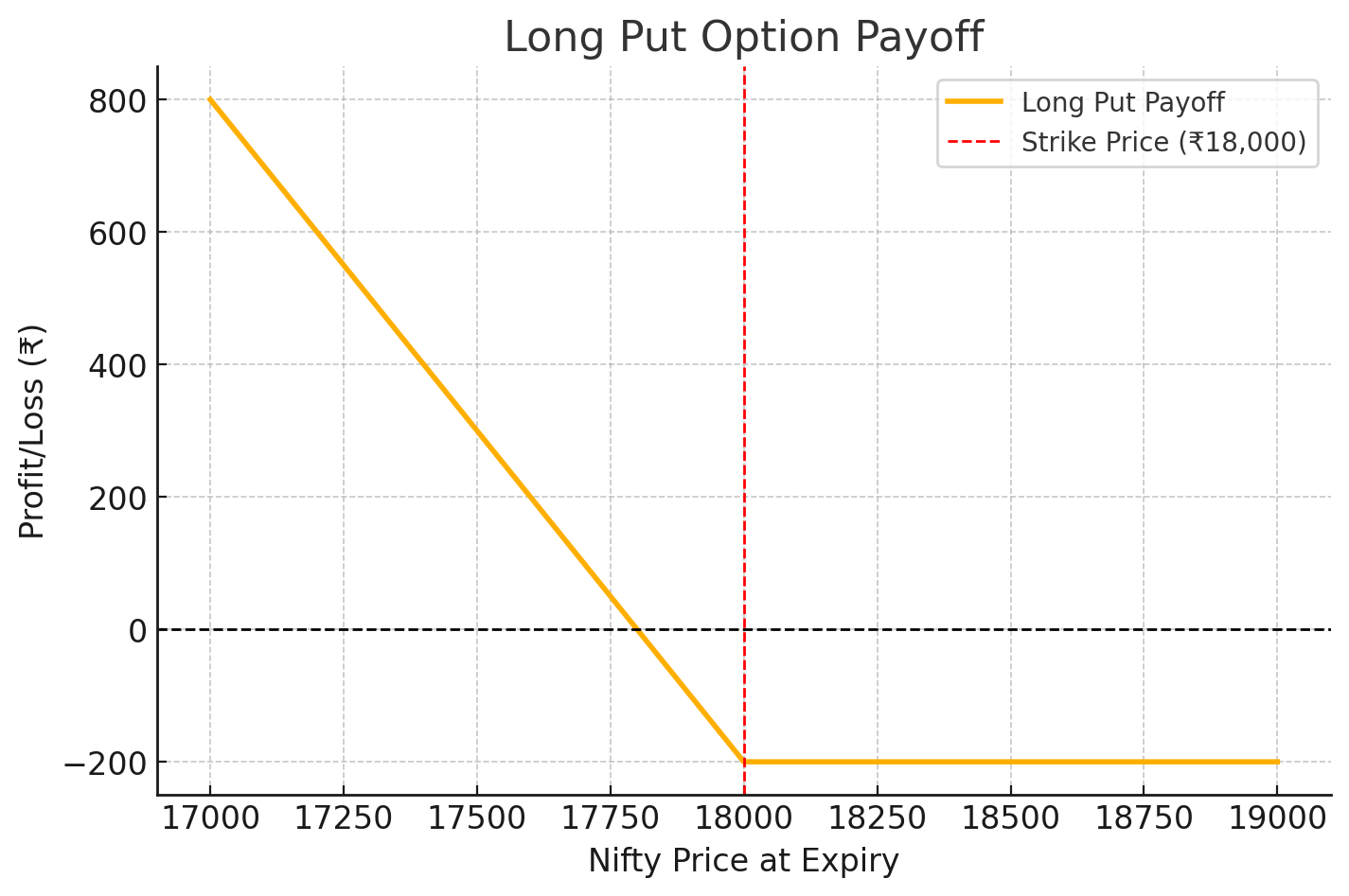
A simple example of Nifty’s long-put strategy: Nifty 50 is currently at 18,000 and is expected to fall. A Nifty 18,000 put option is bought at a ₹200 premium, expiring in a month. Here’s what profit and loss look like
- Scenario 1: Nifty Falls to 17,500
Your put option allows you to sell at 18,000 while the market is at 17,500.
- Profit = (18,000 – 17,500) – 200 = ₹300 per lot
Nifty Stays at 18,000 or Rises
- The option expires worthless, and your loss is limited to the ₹200 premium paid.
Given below Long Put Option Graph:
Using Long Put Options for Hedging Strategies
Investors commonly buy the option contract to hedge against market fluctuations. This strategy is known married put or protective put.
Example of Long Put Strategy
Amit owns 100 shares of HDFC Bank, currently trading at ₹1,600 per share. He is worried that the stock might fall in the next few months due to stock market uncertainty, but he doesn’t want to sell his shares.
To protect his investment, he buys a HDFC Bank 1,550 Put Option at a premium of ₹20 per share.
If HDFC Bank falls to ₹1,500, Amit’s stock loses ₹100 per share, but his put option gains ₹50, reducing his overall loss. If the stock rises to ₹1,700, the put option expires worthless (₹20 loss), but his stock gains ₹100 per share, leading to an overall profit.
Long Put Strategy vs Shorting Stock
A long put strategy is often more convenient for bearish investors compared to shorting stocks. When shorting a stock, losses can be unlimited if the stock price keeps rising, while the profit is limited since the stock price can only drop to zero.
The same applies to a long put strategy, where the trade is profitable only if the underlying asset’s price falls below the strike price, with the maximum profit occurring if the asset price drops to zero.
One disadvantage of a put option is that the underlying asset must fall below the strike price for the trade to be profitable. If this doesn’t happen, the trader loses the entire premium paid for the option.
Both shorting stocks and buying put options are ways to profit from a falling stock market. In short selling, a trader sells the stock first and hopes to buy it back at a lower price.
Put options work similarly; if the underlying stock falls, the put option’s value increases, and the trader can sell it for a profit. However, unlike short selling, a long put has a limited loss (premium paid), making it a safer way to bet against a stock.
Advantages of Long Put Option
A long put strategy offers several benefits for traders and investors who expect the market to decline or want to protect their existing investments from downside risk.
Limited Risk
One of the biggest advantages of a long put is that the maximum loss is limited to the premium paid for the option contract. Unlike short selling, traders do not face unlimited loss potential if the market moves against them.
Profit Potential in Falling Markets
Long put options allow traders to potentially profit when stock or index prices decline. As the price of the underlying asset falls below the strike price, the value of the put option generally increases.
Useful for Hedging
Investors often use long put options as a hedging strategy to protect existing stock holdings from market corrections or sudden price declines. This protective strategy helps reduce overall portfolio risk.
Lower Capital Requirement
Compared to directly short-selling stocks, buying a put option generally requires less capital because traders only pay the premium instead of the full value of the stock position.
Risks of Long Put Option
Although a long put strategy limits risk compared to short selling, traders should still understand the potential drawbacks before using this strategy.
Premium Loss
If the stock price does not fall below the strike price before expiry, the option may expire worthless. In this case, the trader loses the entire premium paid for the contract.
Time Decay Risk
Options lose value as they approach expiration due to time decay. Even if the stock price moves slightly lower, the option may still lose value if the move happens too slowly.
Requires Correct Market Timing
A long put strategy depends not only on predicting the market direction correctly but also on timing the move before the option expires.
Volatility Impact
Changes in market volatility can affect option prices significantly. Falling volatility may reduce the value of the put option even if the market moves slightly downward.
Also read about: Risk Management of Options Trading.
Profit and loss potential of a long put
A long put strategy offers limited loss and significant profit potential in bearish market conditions. The maximum loss is restricted to the premium paid for the put option, while profits increase as the underlying asset price continues to decline.
For example, if a trader buys a put option with a strike price of ₹1,800 by paying a premium of ₹50, and the stock falls to ₹1,600, the trader can potentially profit from the difference between the strike price and market price after adjusting for the premium paid.
However, if the stock price remains above the strike price until expiry, the option may expire worthless, and the trader loses only the premium amount.
Long Put Strategy To Hedge
Investors commonly buy the option contract to hedge against market fluctuations. This strategy is known married put or protective put.
Amit owns 100 shares of HDFC Bank, currently trading at ₹1,600 per share. He is worried that the stock might fall in the next few months due to market uncertainty, but he doesn’t want to sell his shares.
To protect his investment, he buys a HDFC Bank 1,550 Put Option at a premium of ₹20 per share.
If HDFC Bank falls to ₹1,500, Amit’s stock loses ₹100 per share, but his put option gains ₹50, reducing his overall loss. If the stock rises to ₹1,700, the put option expires worthless (₹20 loss), but his stock gains ₹100 per share, leading to an overall profit.
Conclusion
A long put strategy helps traders make money when stock prices fall while keeping losses limited to the premium paid. It is a safer option compared to short selling, which has unlimited risk.
This strategy is also useful for hedging, where investors use a protective put to protect their stocks from losses. However, for a long put to be profitable, the stock price must fall below the strike price; otherwise, the premium paid is lost.
Overall, a long put is a simple and low-risk way to bet against a stock or protect investments from market downturns.
Frequently Asked Questions (FAQs)
What is the Definition of a Long Put Option?
A long put is when a trader buys a put option, expecting the stock price to fall. If the price drops, the trader can sell at a higher strike price and make a profit. If the price doesn’t fall, the trader only loses the premium paid for the option.
When to use a long put?
Traders usually use a long put strategy when they expect the price of a stock, index, or other underlying asset to decline significantly within a specific time period.
It is commonly used during bearish market conditions, weak earnings expectations, economic uncertainty, or when traders anticipate short-term downside movement in a stock. Investors also use long puts to hedge existing portfolios against sudden market corrections.
When to sell a long put option?
Traders may sell a long put option before expiration if the option has gained value due to a fall in the underlying asset’s price. Selling early allows traders to lock in profits without waiting until expiry.
Some traders also exit long put positions to reduce losses if market conditions change and the expected downward movement no longer seems likely.
How to profit from long put options?
A trader profits from a long put option when the price of the underlying asset falls below the strike price by more than the premium paid. As the market price declines, the value of the put option generally increases.
Traders can either exercise the option or sell the option contract in the market at a higher premium to book profits.
How to calculate profit from long put options?
The profit or loss from a long put option depends on the difference between the strike price, market price, and premium paid.
Formula of Long Put Options:
Profit/Loss = max (Strike Price − Market Price,0) − Premium Paid.
If the market price falls significantly below the strike price, the trader can earn profits after adjusting for the premium paid. If the option expires worthless, the maximum loss remains limited to the premium amount.
What is short put vs long put?
A long put profits if the stock price falls, while a short put earns a premium if the price stays the same or rises. A long put is bearish, and a short put is bullish/neutral.
|
Related Topics | |
|---|---|
Disclaimer: This content is for educational purposes only and does not constitute financial or investment advice. Investments in securities or other financial instruments are subject to market risk, including partial or total loss of capital. Past performance is not indicative of future results. Always consider your financial situation carefully and consult a licensed financial advisor before making investment or trading decisions.
Table of Content
Engineered for the obsessed. Built for traders.

Purpose-built terminals.
Zero compromise.
Built for speed.

Plot No 1290, 2nd Floor, 17th Cross, 5th Main, Sector-7, HSR Layout, Bangalore 560102
Follow us on


Mintcap Brokers Private Limited
CIN – U66110KA2023PTC178706 | Registered Address: Plot No 1290, Second Floor, 17th Cross, 5th Main, Sector-7, HSR Layout, Bangalore 560102 | Tel: 080 – 49552310 | Email ID: compliance@capmint.com | SEBI registered Stock Broker: INZ000322732 | NSE Cash/F&O Member ID: 90430 | BSE Cash/F&O Member ID: 6903 | MCX Member ID: 57400 | NCDEX Member ID: 1312 | SEBI registered Depository Participant: IN-DP-806-2025 | CDSL DP ID: 12102300 | NSE Clearing Member code: M70108 | AMFI-Registered Mutual Fund Distributor: ARN-289109 (Valid upto 28-Feb-2027) | Category II Execution Only Platform : E6903
Details of Client Bank Account
Compliance Officer: Ms. Shridevi Vungarala | Email ID: compliance@capmint.com | Tel no. + 91 9035330126 | Grievance Redressal Officer (GRO) – Ms. Shikha Gupta | Email ID: Grievance@capmint.com | Tel no: 9035331595.
Procedure to file a complaint on SEBI SCORES: Register on SCORES portal. Mandatory details for filing complaints on SCORES: Name, PAN, Address, Mobile Number, E-mail ID. Benefits: Effective Communication, Speedy redressal of the grievances. You may refer the website https://scores.sebi.gov.in/ for more information. You may also download the SEBI Scores app to log a complaint Android: https://play.google.com > store > apps > sebiscores iOS: https://apps.apple.com > app > sebiscores
Disclaimer
Investment in the securities market are subject to market risks, read all the related documents carefully before investing. Brokerage will not exceed the SEBI prescribed limit.
Mutual fund investments are subject to market risks, read all scheme related documents carefully before investing. Mutual Funds are not exchange-traded products.
Attention Investor:
- Stock Brokers can accept securities as margin from clients only by way of pledge in the depository system w.e.f. September 1, 2020.
- Update your mobile number & email Id with your stock broker/depository participant and receive OTP directly from depository on your email id and/or mobile number to create pledge.
- Pay 20% as upfront margin of the transaction value to trade in cash market segment.
- Investors may please refer to the Exchange’s Frequently Asked Questions (FAQs) issued vide circular reference NSE/INSP/45191 dated July 31, 2020 and NSE/INSP/45534 dated August 31, 2020 and other guidelines issued from time to time in this regard.
- Check your Securities /MF/ Bonds in the consolidated account statement issued by NSDL/CDSL every month.