

Table of Content
- Key Takeaways
- What Is Short Put?
- Mechanism Of Short Put
- How and When to Use Short Put Options?
- Profit and Loss Potential of a Short Put
- Short Put as a Derivative Instrument
- Short Put vs Long Put
- Short Put as a Financial Instrument
- Risks Of Shorting A Put Option
- Advantages Of Short Put Option
- Conclusion
- Frequently Asked Questions (FAQs)
Link copied!
Short Put

A short put means the trader sells a put option contract and receives a premium. This strategy is used when the trader expects the stock price to stay the same or go up. If the price stays above the strike price, the trader keeps the premium as profit.
Key Takeaways
- A short put is when a trader sells a put option and receives a premium, expecting the stock price to stay the same or go up. If the price stays above the strike price, the trader keeps the premium as profit.
- The maximum profit is the premium received, but if the stock price falls below the strike price, the trader may have to buy the stock at a loss. Losses can be significant if the price drops sharply.
- A short put is used to earn a steady income from option premiums. It works best in low-volatility markets, where prices remain stable or rise slowly.
What Is Short Put?
When a trader sells a put option contract at a particular strike price, they receive a premium. A short put strategy is used when the trader expects the stock market to be mildly bullish or stay the same. The profit is limited to the premium received upfront, while the risk comes if the stock price falls below the strike price, as the trader may have to buy the stock at a loss.
This strategy is commonly used by traders who are bullish or neutral on a stock and want to earn a steady income from option premiums while accepting some risk. The potential loss is not unlimited but can be significant if the stock price drops sharply.
Mechanism Of Short Put
A short put occurs when a trader writes a particular option contract; for this stock market, the participant receives an upfront premium. The option writer’s profit is capped, that is, the premium received.
When a stock market participant sells a put option contract, the trader believes that the price of the underlying will stay above the strike price of the written put. If the underlying asset doesn’t go below the strike price by the expiration date, the option writer receives the premium.
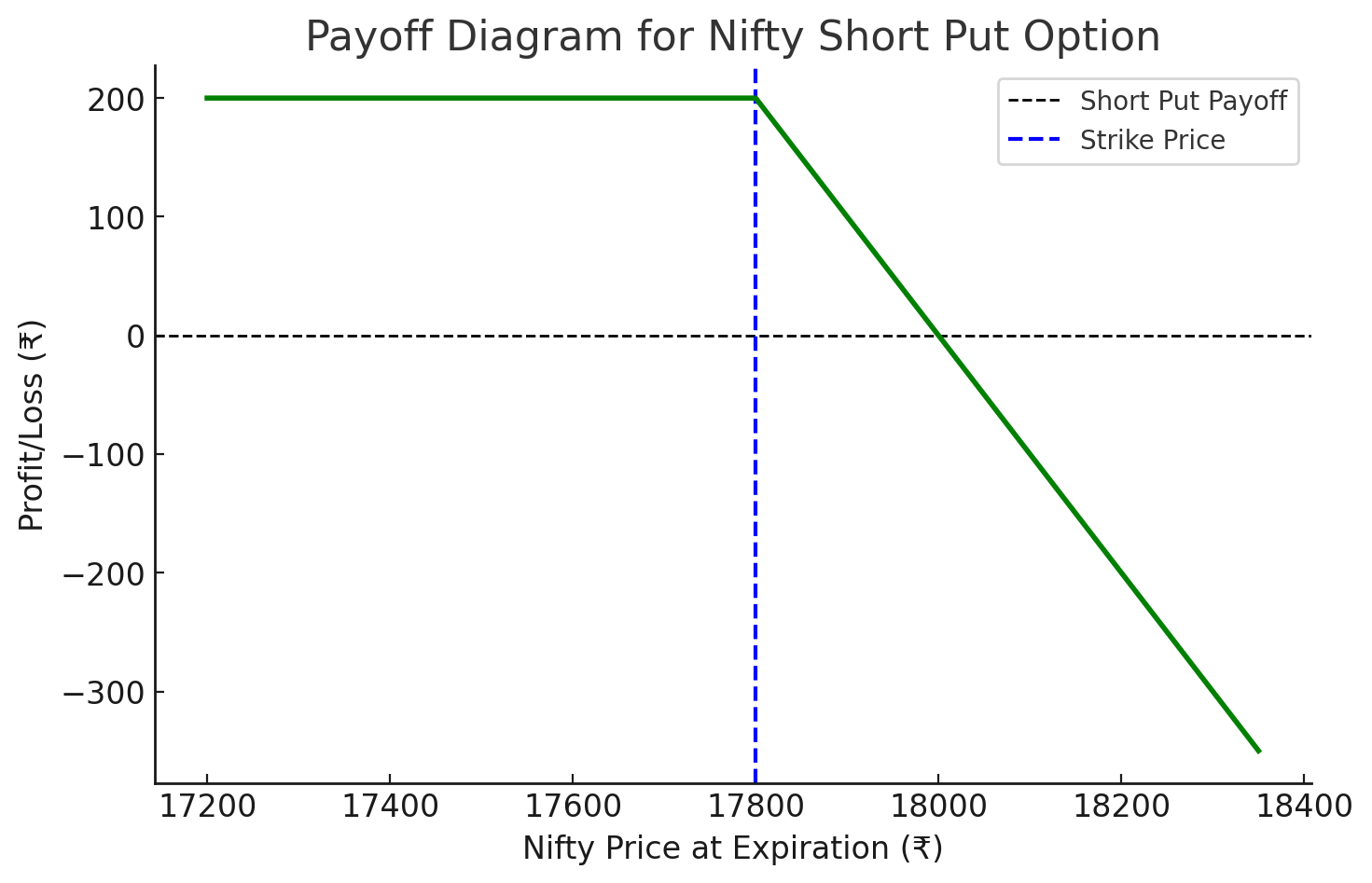
Suppose the Nifty 50 is at 18,000, and a trader believes it will stay above 17,800. They sell a Nifty 17,800 put option at a premium of ₹200.
If Nifty stays above 17,800
- The put option expires worthless
- The trader keeps ₹200 as profit
If Nifty falls below 17,800
- The trader must buy Nifty at 17,800, even if it drops further
- The loss increases as the Nifty falls further
This strategy works best when Nifty stays stable or rises.
Here’s how the payoff would look. In the graph, the profit is capped, and the loss is unlimited.
How and When to Use Short Put Options?
A short put strategy is commonly used when traders expect the price of a stock or index to remain stable or rise moderately over time. By selling a put option, traders receive an upfront premium, which becomes their maximum possible profit if the option expires worthless.
This strategy works best in bullish or neutral market conditions where the underlying asset is expected to stay above the strike price until expiration. Traders often use short puts to generate regular income from option premiums, especially in low-volatility markets.
Some investors also use short put options to potentially buy stocks at lower prices. If the stock price falls below the strike price, the seller may be assigned the shares at the agreed price, which can be useful if they already wanted to own the stock at that level.
Profit and Loss Potential of a Short Put
A short put strategy offers limited profit and potentially significant losses. The maximum profit is restricted to the premium received when selling the put option contract.
However, if the stock price falls sharply below the strike price, the seller may face substantial losses because they may be required to buy the underlying asset at a higher predetermined price. The lower the stock price falls, the larger the loss becomes.
For example, if a trader sells a put option with a strike price of ₹1,000 and receives a premium of ₹50, the maximum profit remains ₹50 per share. But if the stock falls to ₹700, the trader may face a large loss after adjusting for the premium received.
Short Put as a Derivative Instrument
A short put strategy is part of the Derivative (finance) market because the value of the put option depends on the price movement of an underlying asset such as stocks, indices, or commodities.
When traders sell put options, they are essentially taking a position based on the expected future movement of the underlying asset. If the stock price stays above the strike price, the option may expire worthless, allowing the seller to keep the premium as profit.
Short Put vs Long Put
|
Short Put |
Long Put |
|---|---|
|
A short put involves selling a put option to earn premium income. |
A long put involves buying a put option to profit from falling prices. |
|
Traders use short puts when they expect the market to stay stable or rise. |
Traders use long puts when they expect the market to decline. |
|
Maximum profit is limited to the premium received. |
Maximum loss is limited to the premium paid. |
|
Losses can be significant if the stock price falls sharply. |
Profit potential increases as the stock price declines. |
|
Commonly used in bullish or neutral market conditions. |
Commonly used in bearish market conditions. |
Short Put as a Financial Instrument
A short put is considered a speculative Financial instrument strategy used to generate income from option premiums in stable or bullish market conditions.
Unlike directly buying shares, traders use short put options to potentially profit from time decay and stable market movements. However, since the seller may be obligated to buy the underlying asset if the market price falls below the strike price, proper risk management becomes important while using this strategy.
Risks Of Shorting A Put Option
Shorting a put option is an easy way to receive a premium. Before selling a put option, it’s essential to understand the risks involved.
Unlimited Profit Potential:
The option writer receives an upfront premium, but if the stock price falls significantly below the strike price, the seller must buy at the strike price, even if the market price is much lower.
Margin Requirement:
Selling a put option involves a heavy margin, and traders have to maintain a minimum balance in their accounts. But if the stock price drops sharply, the broker may issue a margin call, requiring more funds.
Implied volatility risk:
After shorting a put option, if there is a sudden increase in volatility, this leads to higher prices in the option premium, ultimately leading to losses for the put option writer. This can be managed by avoiding selling low-option contracts.
Advantages Of Short Put Option
Shorting a put option isn’t just about risk; it also comes with some benefits of short put in trading:
Selling Options For Income:
If executed correctly, selling put option contracts and earning premiums is a great way to receive profits from the market.
High Probability Of Profit:
Put option contracts decay in value as they approach the expiration date. Selling them when the markets are not too volatile in nature can give profits in the market.
Conclusion
A short put strategy helps traders earn money by selling put options and collecting a premium. It works best when the market stays stable or goes up. The profit is limited to the premium received, but the risk is high if the stock price drops, as the trader may have to buy it at a loss.
Factors like margin requirements, market volatility, and price drops should be carefully managed. Despite the risks, selling put options can be a good way to earn a steady income, especially in low-volatility markets, making it a popular choice for experienced traders.
Frequently Asked Questions (FAQs)
What is the meaning of a Short Put Option?
A short put option is an options trading strategy where a trader sells a put option contract and receives a premium upfront. The strategy is typically used when the trader expects the price of the underlying asset to remain above the strike price until expiration.
If the option expires worthless, the trader keeps the premium as profit. However, if the market price falls below the strike price, the seller may have to buy the underlying asset at a loss.
How to Calculate Profit from Short Put Options?
The profit from a short put option depends on the premium received and the movement of the underlying asset price.
Profit/Loss = Premium Received − max (Strike Price − Market Price,0)
If the market price stays above the strike price, the option expires worthless, and the trader keeps the full premium as profit. If the market price falls below the strike price, losses begin to increase.
How to sell short put options?
To sell a short put option, a trader first selects an underlying stock or index, chooses a strike price and expiry date, and then sells the put option through a trading platform. In return, the trader receives a premium from the option buyer.
Before selling put options, traders should evaluate market conditions, implied volatility, margin requirements, and overall risk exposure because losses can increase if the underlying asset price falls sharply.
Is the Short Put Option bullish or bearish?
A short put is bullish because the trader expects the stock price to stay the same or go up. If the price remains above the strike price, the trader keeps the premium as profit. If the price falls, they may have to buy the stock at a loss.
Can I exercise a short put?
No, a short put seller cannot exercise the option. Only the buyer of the put option has the right to exercise it. If they do, the seller must buy the stock at the strike price, even if the market price is lower.
|
Related Topics | |
|---|---|
Disclaimer: This content is for educational purposes only and does not constitute financial or investment advice. Investments in securities or other financial instruments are subject to market risk, including partial or total loss of capital. Past performance is not indicative of future results. Always consider your financial situation carefully and consult a licensed financial advisor before making investment or trading decisions.
Table of Content
- Key Takeaways
- What Is Short Put?
- Mechanism Of Short Put
- How and When to Use Short Put Options?
- Profit and Loss Potential of a Short Put
- Short Put as a Derivative Instrument
- Short Put vs Long Put
- Short Put as a Financial Instrument
- Risks Of Shorting A Put Option
- Advantages Of Short Put Option
- Conclusion
- Frequently Asked Questions (FAQs)
Engineered for the obsessed. Built for traders.

Purpose-built terminals.
Zero compromise.
Built for speed.

Plot No 1290, 2nd Floor, 17th Cross, 5th Main, Sector-7, HSR Layout, Bangalore 560102
Follow us on


Mintcap Brokers Private Limited
CIN – U66110KA2023PTC178706 | Registered Address: Plot No 1290, Second Floor, 17th Cross, 5th Main, Sector-7, HSR Layout, Bangalore 560102 | Tel: 080 – 49552310 | Email ID: compliance@capmint.com | SEBI registered Stock Broker: INZ000322732 | NSE Cash/F&O Member ID: 90430 | BSE Cash/F&O Member ID: 6903 | MCX Member ID: 57400 | NCDEX Member ID: 1312 | SEBI registered Depository Participant: IN-DP-806-2025 | CDSL DP ID: 12102300 | NSE Clearing Member code: M70108 | AMFI-Registered Mutual Fund Distributor: ARN-289109 (Valid upto 28-Feb-2027) | Category II Execution Only Platform : E6903
Details of Client Bank Account
Compliance Officer: Ms. Shridevi Vungarala | Email ID: compliance@capmint.com | Tel no. + 91 9035330126 | Grievance Redressal Officer (GRO) – Ms. Shikha Gupta | Email ID: Grievance@capmint.com | Tel no: 9035331595.
Procedure to file a complaint on SEBI SCORES: Register on SCORES portal. Mandatory details for filing complaints on SCORES: Name, PAN, Address, Mobile Number, E-mail ID. Benefits: Effective Communication, Speedy redressal of the grievances. You may refer the website https://scores.sebi.gov.in/ for more information. You may also download the SEBI Scores app to log a complaint Android: https://play.google.com > store > apps > sebiscores iOS: https://apps.apple.com > app > sebiscores
Disclaimer
Investment in the securities market are subject to market risks, read all the related documents carefully before investing. Brokerage will not exceed the SEBI prescribed limit.
Mutual fund investments are subject to market risks, read all scheme related documents carefully before investing. Mutual Funds are not exchange-traded products.
Attention Investor:
- Stock Brokers can accept securities as margin from clients only by way of pledge in the depository system w.e.f. September 1, 2020.
- Update your mobile number & email Id with your stock broker/depository participant and receive OTP directly from depository on your email id and/or mobile number to create pledge.
- Pay 20% as upfront margin of the transaction value to trade in cash market segment.
- Investors may please refer to the Exchange’s Frequently Asked Questions (FAQs) issued vide circular reference NSE/INSP/45191 dated July 31, 2020 and NSE/INSP/45534 dated August 31, 2020 and other guidelines issued from time to time in this regard.
- Check your Securities /MF/ Bonds in the consolidated account statement issued by NSDL/CDSL every month.