

Table of Content
- Key Takeaways
- What Is Leverage In Futures Trading?
- How does Leverage Works in Futures Trading?
- How to Calculate the Leverage?
- Role Of Margin
- Markets that can use Leverage
- Benefits Of Leverage
- Impact Of Leverage On Payoff
- Leverage and Futures Margin Requirements
- Risk Management Strategies
- Common Mistakes Traders Make With Leverage
- Conclusion
- Frequently Asked Questions (FAQs)
- Further Reads:
Link copied!
Leverage in Futures Trading

Leverage in futures trading allows traders to control large positions with a smaller margin deposit. Leverage is calculated by dividing the total value of the underlying asset by the required margin.
Key Takeaways
- Leverage in futures trading means controlling a large trade with a small amount of money. It helps traders make bigger profits but also increases the risk of bigger losses.
- Leverage is calculated using the formula Leverage = Contract Value / Margin Required. This shows how much bigger your position is compared to the money you put in.
- Using leverage wisely is important because it can quickly increase both profits and losses. Stop-loss and proper position sizing help protect against losing too much money.
- Risk management is key when trading with leverage. Traders should never risk more than they can afford and always plan their trades carefully to avoid big losses.
What Is Leverage In Futures Trading?
Leverage creates larger positions for the traders, and this also amplifies both the potential gains and losses, making understanding leverage essential for effective risk management. Leverage is calculated by dividing the total contract value of the underlying by its margin required to hold that position.
Leverage also allows future traders to short their positions without borrowing shares at the market closing, as in intraday trading. Leverage in futures trading helps traders hedge against price fluctuations in stocks, commodities, and currencies. Leverage helps diversify a portfolio without tying up large amounts of capital.
How does Leverage Works in Futures Trading?
Leverage in futures trading allows traders to control a large contract value by depositing only a fraction of the total amount as margin. Instead of paying the full value of the contract, traders only need to maintain the margin required by the exchange.
For example, if a futures contract is worth ₹10 lakh and the required margin is ₹1 lakh, the trader gains exposure to the entire ₹10 lakh position with just ₹1 lakh. This creates a leverage of 10x.
The profit or loss, however, is calculated on the full contract value and not on the margin deposited. This is why even a small movement in the underlying asset can result in significant gains or losses. While leverage improves capital efficiency, it also increases risk, making proper risk management essential.
How to Calculate the Leverage?
Leverage is a double-edged sword; the higher the leverage, the higher the risk, and the higher the profit potential.
Formula of Leverage
Leverage = [Contract Value/Margin].
Example :
Reliance Industries Futures
Reliance share price = ₹2,500
Lot size = 250
Total contract value = ₹2,500 × 250 = ₹6,25,000
Margin required = ₹93,750
Leverage = ₹6,25,000 / ₹93,750 = 6.67x
This means the trader controls ₹6.25 lakh worth of Reliance Futures with just ₹93,750.
Role Of Margin
Margin in futures trading acts as a good-faith deposit, allowing traders to open and maintain positions without borrowing funds. There are two primary types of margins:
Initial Margin
This is the upfront deposit deposited by the trader to open a required position in the futures market. The initial margin depends upon the amount set by the futures exchange and varies depending on the contract’s volatility and the trader’s risk profile.
For instance, in Nifty, to hold a position in futures trading, they should deposit at least 10% of the contract value. Here’s how it will be calculated
Let’s assume a trader wants to buy one lot of Nifty 50 Futures.
- Nifty 50 Current Price = ₹22,000
- Lot Size of Nifty 50 = 50
- Total Contract Value = ₹22,000 × 50 = ₹11,00,000
Thus, the trader needs to deposit ₹1,10,000 to take a ₹11 lakh position in Nifty Futures.
Maintenance Margin
Once a trader opens a position, the maintenance margin is the minimum amount they need to keep in their trading account to continue holding that position. If the account balance falls below this level, the broker sends a margin call, asking the trader to add more funds.
If the trader does not deposit the required amount, the broker may automatically close the position to prevent further losses. This ensures that traders always have enough funds to cover potential losses in the market.
Markets that can use Leverage
Leverage is available across multiple futures markets, allowing traders to participate in different asset classes without committing large amounts of capital.
Equity Futures
Stock futures allow traders to speculate on individual stocks such as Reliance Industries, HDFC Bank, Infosys, or Tata Motors using margin.
Index Futures
Index futures such as Nifty 50, Bank Nifty, FinNifty, and Sensex Futures are among the most actively traded leveraged products in India.
Commodity Futures
Commodities like Gold, Silver, Crude Oil, Natural Gas, Copper, and Agricultural Commodities can be traded through futures contracts with leverage.
Currency Futures
Currency futures enable traders to take positions in currency pairs such as USD/INR, EUR/INR, GBP/INR, and JPY/INR without requiring the full contract value.
Interest Rate Futures
These contracts allow traders and institutions to speculate on or hedge against changes in interest rates using leveraged exposure.
Benefits Of Leverage
Leverage also offers several advantages that can help traders maximise their potential returns. Here are some key benefits of leverage:
Increased Market Exposure
Leverage enables traders to gain exposure to larger positions than their capital would allow in the spot market.
Capital Efficiency
Traders can allocate a smaller portion of their capital to margin, freeing up funds for other investments.
Potential for Higher Returns
One of the biggest advantages of leverage is the ability to generate higher returns from a relatively small investment.
For example, suppose a trader has ₹1 lakh and buys a futures contract worth ₹10 lakh using 10x leverage. If the underlying asset rises by 5%, the contract value increases by ₹50,000.
Without leverage, a ₹1 lakh investment growing by 5% would generate only ₹5,000. However, with leverage, the trader earns ₹50,000 on the same capital, resulting in a 50% return on invested capital.
Impact Of Leverage On Payoff
In futures trading, leverage creates a direct relationship between price movements and a trader’s profit or loss. If the price goes up, the trader makes a profit, and if it goes down, the trader faces a loss. These changes happen in the same proportion as the price of the asset. Leverage increases this effect, meaning both potential profits and losses become larger.
A trader buys one lot of Nifty 50 futures at ₹22,000 with a lot size of 50. The total contract value is ₹11,00,000, but with leverage, they only need to pay a margin of ₹1,10,000.
|
Scenario |
New Nifty Price |
Profit/Loss Calculation |
Result |
|---|---|---|---|
|
If Nifty rises by 200 points |
₹22,200 |
200 × 50 = ₹10,000 |
Profit of ₹10,000 |
|
If Nifty falls by 200 points |
₹21,800 |
200 × 50 = ₹10,000 |
Loss of ₹10,000 |
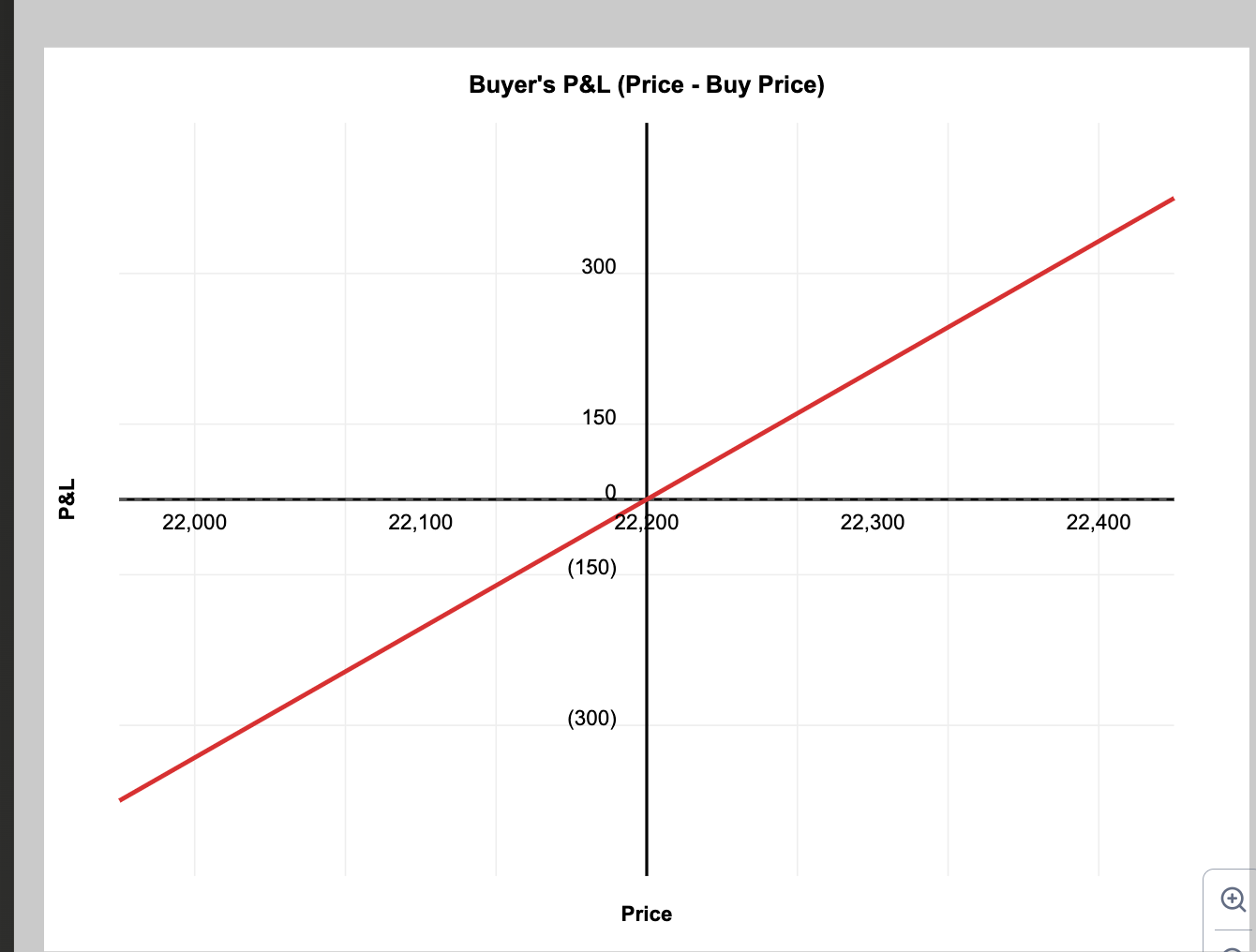
Here’s a pictorial representation of the payoff graph
Leverage and Futures Margin Requirements
Margin acts as a financial safeguard for both traders and brokers when leveraged positions are taken.
Initial Margin
The initial margin is the minimum amount required to open a futures position. It is determined by exchanges based on factors such as volatility, liquidity, and risk associated with the underlying asset.
Higher volatility generally leads to higher margin requirements.
Maintenance Margin
Maintenance margin is the minimum balance traders must maintain after opening a position. If losses reduce the account balance below this level, the broker issues a margin call.
The trader must then deposit additional funds to restore the required margin level. Failure to do so may result in the broker closing the position automatically.
Mark-to-Market Adjustments
Futures positions are settled daily through the mark-to-market process. Profits are credited and losses are debited every trading day. This ensures that leveraged positions remain adequately funded and reduces systemic risk.
Risk Management Strategies
Leverage can boost profits but also increase risks, making risk management crucial. Along with stop-loss, traders use other strategies to control losses and trade safely. Here are some key risk management strategies.
Setting up to limit losses
Leverage increases the scope of profits and losses. Without a stop-loss, a small unfavourable price movement can wipe out a significant portion of a trader’s capital or even lead to forced liquidation by the broker.
Use Appropriate Position Sizing
Position sizing ensures that each trade aligns with your risk tolerance and account size, preventing excessive losses. A common rule is to risk only 1-2% of your capital per trade.
A trader has ₹10 lakh in their trading account and follows the 1% risk rule, meaning they are willing to risk only ₹10,000 per trade.
Scenario: Trading Nifty 50 Futures
- Nifty 50 Price: ₹22,000
- Lot Size: 50
- Total Contract Value: ₹22,000 × 50 = ₹11,00,000
- Margin Required: ₹1,10,000 (10% of contract value)
Now, the trader sets a stop-loss of 100 points on Nifty. If the trade moves against them:
- Loss per lot = 100 × 50 = ₹5,000
Since their risk limit is ₹10,000 per trade, they can take two lots, so the maximum loss would be:
- 2 × ₹5,000 = ₹10,000
Common Mistakes Traders Make With Leverage
Using Maximum Available Leverage
Many beginners use the highest leverage available to maximise profits. While this increases profit potential, it also exposes traders to significant losses from even small market movements.
Trading Without a Stop-Loss
Leverage can amplify losses rapidly. Entering trades without a stop-loss can result in substantial capital erosion or forced liquidation by the broker.
Ignoring Position Sizing
Taking oversized positions relative to account size increases risk. Even experienced traders use position sizing rules to limit losses on individual trades.
Holding Losing Positions Too Long
Some traders avoid booking losses and continue holding losing trades, hoping the market will reverse. In leveraged trading, this can quickly lead to margin calls and account depletion.
Not Understanding Margin Requirements
Many traders focus only on profit potential and overlook margin obligations. Sudden market volatility can increase margin requirements and create unexpected funding needs.
Overtrading
Easy access to leverage can tempt traders to take excessive positions. Frequent trading without a clear strategy often leads to poor decision-making and unnecessary losses.
Conclusion
Leverage in futures trading helps traders control big positions with less money, giving them a chance to earn higher profits. But it also increases the risk of bigger losses. That’s why understanding leverage and managing risk is very important.
Using tools like stop-loss and proper position sizing helps traders avoid losing too much money. Without these, a small price drop can lead to huge losses or even force the broker to close the trade.
Trading with leverage is not just about making big profits. It needs careful planning, discipline, and risk control. Traders should only take risks they can afford and always have a plan to protect their money. By following smart strategies, they can trade safely and improve their chances of success.
Frequently Asked Questions (FAQs)
What does leverage mean in trading?
Leverage allows traders to control a larger market position using a smaller amount of capital. It increases both potential profits and potential losses by magnifying the impact of price movements.
Is profit increased by using leverage?
Yes. Leverage can significantly increase profits because gains are calculated on the full contract value rather than the margin invested. However, losses are also magnified in the same proportion.
What is the maximum leverage in futures trading?
There is no fixed maximum leverage across all futures contracts. Leverage depends on exchange margin requirements, asset volatility, and regulatory guidelines. In India, futures leverage typically ranges between 5x and 15x, though it can vary.
Should I use leverage in my trading?
Leverage can be useful if you understand risk management and have a disciplined trading plan. Beginners should start with lower leverage and focus on protecting capital before seeking higher returns.
Is long-term leverage beneficial?
Long-term use of leverage can be risky because market fluctuations, margin requirements, and rollover costs can accumulate over time. Leverage is generally more suitable for short- to medium-term trading strategies rather than long-term investing.
How to Manage Leverage Responsibly?
To use leverage responsibly:
- Always use a stop-loss.
- Risk only a small percentage of your capital per trade.
- Avoid using maximum leverage available.
- Maintain sufficient margin buffer.
- Diversify positions instead of concentrating risk.
- Follow a predefined trading plan and risk-reward ratio.
Responsible leverage management helps protect capital and improves long-term trading consistency.
How to choose the right leverage for your futures trading strategy?
The ideal leverage depends on your trading style, experience, and risk tolerance.
- Conservative traders may prefer lower leverage (2x–5x).
- Swing traders often use moderate leverage (5x–10x).
- Experienced intraday traders may use higher leverage while maintaining strict risk controls.
A good rule is to choose leverage that allows you to stay within your predefined risk limits, even during volatile market conditions.
What does 20x leverage mean?
20x leverage means you can control a position that is 20 times bigger than the money you put in. This increases both profit and risk. If the price moves in your favour, you earn more, but if it moves against you, losses are also bigger.
What is a formula for leverage in futures trading?
The formula for leverage in futures trading is:
Leverage = Contract Value / Margin Required
This means leverage is calculated by dividing the total value of the trade by the amount of money (margin) you need to put in.
Further Reads:
Disclaimer: This content is for educational purposes only and does not constitute financial or investment advice. Investments in securities or other financial instruments are subject to market risk, including partial or total loss of capital. Past performance is not indicative of future results. Always consider your financial situation carefully and consult a licensed financial advisor before making investment or trading decisions.
Table of Content
- Key Takeaways
- What Is Leverage In Futures Trading?
- How does Leverage Works in Futures Trading?
- How to Calculate the Leverage?
- Role Of Margin
- Markets that can use Leverage
- Benefits Of Leverage
- Impact Of Leverage On Payoff
- Leverage and Futures Margin Requirements
- Risk Management Strategies
- Common Mistakes Traders Make With Leverage
- Conclusion
- Frequently Asked Questions (FAQs)
- Further Reads:
Engineered for the obsessed. Built for traders.

Purpose-built terminals.
Zero compromise.
Built for speed.

Plot No 1290, 2nd Floor, 17th Cross, 5th Main, Sector-7, HSR Layout, Bangalore 560102
Follow us on


Mintcap Brokers Private Limited
CIN – U66110KA2023PTC178706 | Registered Address: Plot No 1290, Second Floor, 17th Cross, 5th Main, Sector-7, HSR Layout, Bangalore 560102 | Tel: 080 – 49552310 | Email ID: compliance@capmint.com | SEBI registered Stock Broker: INZ000322732 | NSE Cash/F&O Member ID: 90430 | BSE Cash/F&O Member ID: 6903 | MCX Member ID: 57400 | NCDEX Member ID: 1312 | SEBI registered Depository Participant: IN-DP-806-2025 | CDSL DP ID: 12102300 | NSE Clearing Member code: M70108 | AMFI-Registered Mutual Fund Distributor: ARN-289109 (Valid upto 28-Feb-2027) | Category II Execution Only Platform : E6903
Details of Client Bank Account
Compliance Officer: Ms. Shridevi Vungarala | Email ID: compliance@capmint.com | Tel no. + 91 9035330126 | Grievance Redressal Officer (GRO) – Ms. Shikha Gupta | Email ID: Grievance@capmint.com | Tel no: 9035331595.
Procedure to file a complaint on SEBI SCORES: Register on SCORES portal. Mandatory details for filing complaints on SCORES: Name, PAN, Address, Mobile Number, E-mail ID. Benefits: Effective Communication, Speedy redressal of the grievances. You may refer the website https://scores.sebi.gov.in/ for more information. You may also download the SEBI Scores app to log a complaint Android: https://play.google.com > store > apps > sebiscores iOS: https://apps.apple.com > app > sebiscores
Disclaimer
Investment in the securities market are subject to market risks, read all the related documents carefully before investing. Brokerage will not exceed the SEBI prescribed limit.
Mutual fund investments are subject to market risks, read all scheme related documents carefully before investing. Mutual Funds are not exchange-traded products.
Attention Investor:
- Stock Brokers can accept securities as margin from clients only by way of pledge in the depository system w.e.f. September 1, 2020.
- Update your mobile number & email Id with your stock broker/depository participant and receive OTP directly from depository on your email id and/or mobile number to create pledge.
- Pay 20% as upfront margin of the transaction value to trade in cash market segment.
- Investors may please refer to the Exchange’s Frequently Asked Questions (FAQs) issued vide circular reference NSE/INSP/45191 dated July 31, 2020 and NSE/INSP/45534 dated August 31, 2020 and other guidelines issued from time to time in this regard.
- Check your Securities /MF/ Bonds in the consolidated account statement issued by NSDL/CDSL every month.