

Link copied!

Stock futures are contract agreements between two parties that have stock as the underlying, and these are bought and sold at a predetermined price on a future date. Stock futures instruments enable stock traders to speculate on the future price movements of individual stocks or to hedge existing positions against potential market volatility.
Key Takeaways
- Stock futures are contracts where buyers and sellers agree to trade a stock at a fixed price on a future date. They help traders profit from price movements without owning the stock and allow investors to reduce risk.
- These contracts follow a standardised process with fixed lot sizes, expiry dates, and margin requirements. Prices depend on factors like the stock’s current price, interest rates, and expected dividends.
- SEBI regulates stock futures in India, ensuring fair trading and limiting excessive speculation through margin rules and position limits.
- Investors use stock futures to protect their portfolios from losses. By taking opposite positions in futures, they can reduce risks during market fluctuations.
What Are Stock Futures?
Stock futures are simply future contracts that have underlying stocks that are bought and sold at a predetermined price on stock exchanges. Stock futures are derivative instruments that are actively traded on exchanges and allow traders and investors to take advantage of price movements in individual stocks without owning the actual shares. Stock futures to predict future price movements of stocks and profit from price fluctuations without holding the underlying shares.Investors/institutional traders with existing stock holdings can use futures contracts to protect their portfolios from unfavourable price movements, reducing risk exposure.
Mechanism Of Stock Futures
Stock futures prices aren’t random; they follow a structured formula based on the current stock price, interest rates, expected dividends, and time left until expiry. But how do these contracts actually work in the market? Let’s break down the mechanism of stock futures from contract initiation to settlement.
Stock Futures are Standardized.
Stock futures are standardised contracts that outline the terms of buying or selling a stock at a future date. These contracts are designed to ensure uniformity in trading and facilitate efficient price discovery. For example, here is an example of Reliance stock futures as the underlying Reliance stock futures. This table highlights that stock futures follow standardised exchange rules, ensuring consistency and transparency across trades.
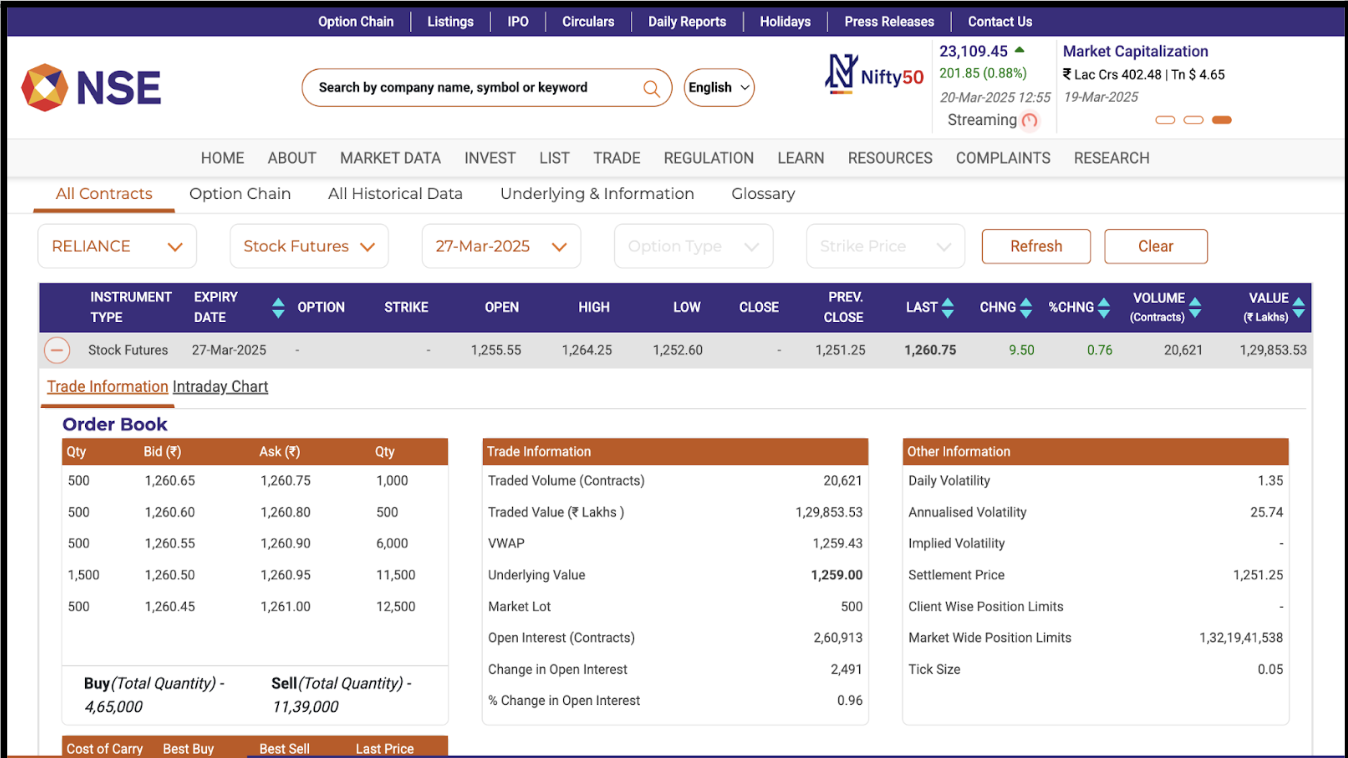
| Specification | Details |
|---|---|
| Lot Size | 500 shares per contract (fixed by the exchange) |
| Expiration Date | 27-Mar-2025 (Last Thursday of March, as per standard futures cycle) |
| Margin Requirement | Initial margin + Mark-to-Market (MTM) margin (determined by the exchange) |
| Settlement | Daily MTM, final settlement via cash or physical delivery (exchange-mandated) |
| Types of Contracts | Near Month (March 2025), Next Month (April 2025), Far Month (May 2025) |
| Liquidity | High (Large-cap stock with a traded volume of 20,621 contracts) |
Pricing of Stock Futures
Stock futures pricing is influenced by multiple factors, primarily determined by the cost-of-carry model. The futures price is derived from the spot price (current stock price) along with adjustments for interest rates, expected dividends, and the time remaining until expiration. Here’s the formula for stock futures:
Futures Price (F) = Spot Price (S) + Carrying Cost – Expected Dividends
Regulatory Environment of Stock Futures in India
India has a well-structured regulatory framework for stock futures trading, ensuring transparency, investor protection, and risk management. The key entities involved in regulating and overseeing the futures market include SEBI (Securities and Exchange Board of India), stock exchanges (NSE & BSE), and clearing corporations.
Key Regulatory Bodies in India
Securities and Exchange Board of India (SEBI) is India’s primary regulator of stock futures and derivatives markets.SEBI sets rules for trading, margin requirements, position limits, and investor protection.SEBI ensures that exchanges and brokers follow fair practices. Implements risk management measures to prevent excessive speculation. Suppose a trader wants to buy Reliance stock futures worth ₹5,00,000. If SEBI mandates a margin of 20%, the trader must deposit ₹1,00,000 upfront, limiting speculative overexposure.
Stock Exchanges: NSE & BSE
Stock futures are traded on the National Stock Exchange (NSE) and Bombay Stock Exchange (BSE) under SEBI regulations. Exchanges provide real-time surveillance to detect unusual trading activity. They set lot sizes for stock futures and monitor liquidity. Ensure compliance with SEBI regulations on trading limits and margin requirements.
Hedging With Stock Futures
Beyond speculation, stock futures serve as a powerful tool for hedging risk. Investors use them to protect their portfolios against market downturns, ensuring stability in volatile conditions. Let’s explore how hedging works with stock futures. Imagine an investor, Raj, who holds 1,000 shares of Infosys in his portfolio. The stock is currently trading at ₹1,600 per share, making his total investment worth ₹16,00,000. Raj is concerned about an upcoming earnings report that could bring volatility to the stock price. To hedge against a possible downturn, he decides to sell Infosys stock futures.
Conclusion
Stock futures are a valuable financial instrument that allows traders and investors to speculate on stock prices or hedge against market risks. These contracts are standardised, ensuring transparency and efficiency in trading. Their pricing is influenced by factors such as spot price, interest rates, dividends, and time to expiration. In India, SEBI regulates stock futures, ensuring fair trading practices and preventing excessive speculation. Whether used for profit-making or risk management, stock futures play an essential role in financial markets. Understanding their mechanism, pricing, and regulations helps investors make informed decisions and manage their investments effectively.
FAQ’s on Stock Futures
What do you mean by index futures?
Index futures are contracts where you agree to buy or sell a stock market index (like Nifty or Sensex) at a fixed price on a future date. They help you bet on or protect yourself against overall market movements without dealing with individual stocks.
What are equity futures?
Equity futures are contracts based on individual company stocks. They let you buy or sell a specific stock (like Reliance or TCS) at a set price on a future date. Traders use them to profit from price changes or to hedge stock investments.
Why do traders use stock futures?
Traders use stock futures for hedging risk, speculating on price movements, and leveraging positions to potentially earn higher returns with lower capital.
What is a margin in stock futures trading?
Margin is the initial deposit required to trade futures, allowing traders to control larger positions with less capital while amplifying both potential profits and losses.
Disclaimer: This content is for educational purposes only and does not constitute financial or investment advice. Investments in securities or other financial instruments are subject to market risk, including partial or total loss of capital. Past performance is not indicative of future results. Always consider your financial situation carefully and consult a licensed financial advisor before making investment or trading decisions.
Engineered for the obsessed. Built for traders.

Purpose-built terminals.
Zero compromise.
Built for speed.

Plot No 1290, 2nd Floor, 17th Cross, 5th Main, Sector-7, HSR Layout, Bangalore 560102
Follow us on


Mintcap Brokers Private Limited
CIN – U66110KA2023PTC178706 | Registered Address: Plot No 1290, Second Floor, 17th Cross, 5th Main, Sector-7, HSR Layout, Bangalore 560102 | Tel: 080 – 49552310 | Email ID: compliance@capmint.com | SEBI registered Stock Broker: INZ000322732 | NSE Cash/F&O Member ID: 90430 | BSE Cash/F&O Member ID: 6903 | MCX Member ID: 57400 | NCDEX Member ID: 1312 | SEBI registered Depository Participant: IN-DP-806-2025 | CDSL DP ID: 12102300 | NSE Clearing Member code: M70108 | AMFI-Registered Mutual Fund Distributor: ARN-289109 (Valid upto 28-Feb-2027) | Category II Execution Only Platform : E6903
Details of Client Bank Account
Compliance Officer: Ms. Shridevi Vungarala | Email ID: compliance@capmint.com | Tel no. + 91 9035330126 | Grievance Redressal Officer (GRO) – Ms. Shikha Gupta | Email ID: Grievance@capmint.com | Tel no: 9035331595.
Procedure to file a complaint on SEBI SCORES: Register on SCORES portal. Mandatory details for filing complaints on SCORES: Name, PAN, Address, Mobile Number, E-mail ID. Benefits: Effective Communication, Speedy redressal of the grievances. You may refer the website https://scores.sebi.gov.in/ for more information. You may also download the SEBI Scores app to log a complaint Android: https://play.google.com > store > apps > sebiscores iOS: https://apps.apple.com > app > sebiscores
Disclaimer
Investment in the securities market are subject to market risks, read all the related documents carefully before investing. Brokerage will not exceed the SEBI prescribed limit.
Mutual fund investments are subject to market risks, read all scheme related documents carefully before investing. Mutual Funds are not exchange-traded products.
Attention Investor:
- Stock Brokers can accept securities as margin from clients only by way of pledge in the depository system w.e.f. September 1, 2020.
- Update your mobile number & email Id with your stock broker/depository participant and receive OTP directly from depository on your email id and/or mobile number to create pledge.
- Pay 20% as upfront margin of the transaction value to trade in cash market segment.
- Investors may please refer to the Exchange’s Frequently Asked Questions (FAQs) issued vide circular reference NSE/INSP/45191 dated July 31, 2020 and NSE/INSP/45534 dated August 31, 2020 and other guidelines issued from time to time in this regard.
- Check your Securities /MF/ Bonds in the consolidated account statement issued by NSDL/CDSL every month.