

Link copied!
Swaptions

A swaption (swap option) is a financial derivative that grants the holder the right, but not the obligation, to enter into an interest rate swap agreement at a specified future date.
Key Takeaways
- A swaption is a contract that gives you the right, but not the need, to enter into an interest rate swap in the future. You pay a small fee for this right, and you can choose whether to use it or not, depending on market conditions.
- There are two main types of swaptions: one lets you pay a fixed rate (payer swaption), and the other lets you receive a fixed rate (receiver swaption). People choose between them based on whether they expect interest rates to go up or down.
- Swaptions can be used in different ways: some can only be used on one date (European), some on any date until expiry (American), and some on a few specific dates (Bermudan). This shows how flexible these contracts can be.
- Swaptions are useful for different purposes, like protecting against rising interest rates, making a profit from rate changes, or adjusting risk in investment portfolios. They give more control over financial decisions without forcing action.
What are Swaptions?
A swaption (short for swap option) is a financial contract that gives someone the right, but not the obligation, to enter into another agreement called an interest rate swap at a future date. In an interest rate swap, two parties agree to exchange interest payments, with one party paying a fixed rate and the other party paying a floating (changing) rate. The person buying the swaption pays a small fee (called a premium) to get this right, but they don’t have to go through with the deal if they don’t want to.
Swaptions are mainly used by large companies and banks to protect themselves from changes in interest rates or to take advantage of expected changes. By using swaptions, they can better manage their financial risks and make smarter decisions about future borrowing or investment plans, without being forced into an agreement they might not want later.
Type Of Swaptions
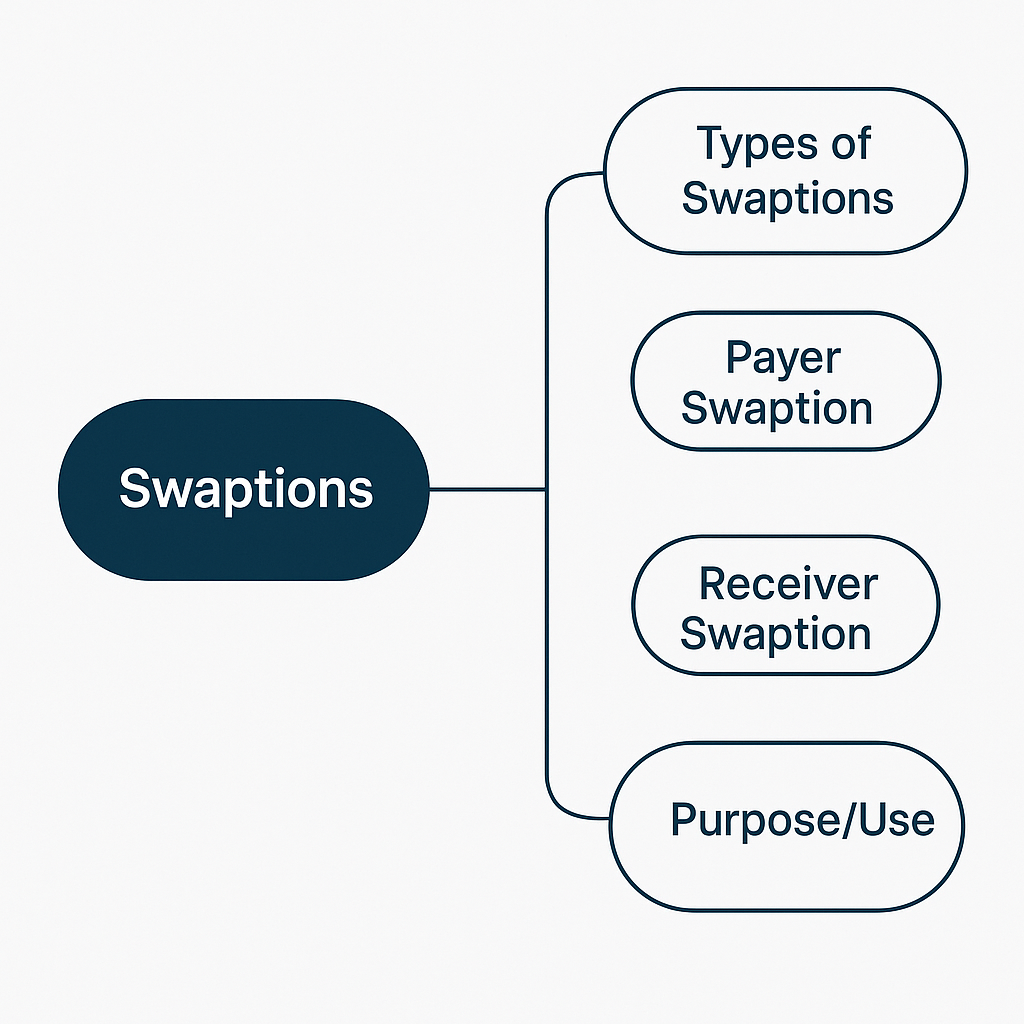
Swaptions are mainly of four types:
Payer Swaption
This type of swaption gives the buyer the right to enter into a swap where they pay a fixed interest rate and receive a floating rate. People usually choose this when they think interest rates will go up in the future. It helps protect them from having to pay higher floating rates later.
Receiver Swaption
This gives the buyer the right to enter into a swap where they receive a fixed interest rate and pay a floating rate. It’s useful when someone expects interest rates to fall. By locking in a higher fixed rate now, they can benefit if floating rates go down later.
Exercise Styles Of Swaptions
Now that we understand what swaptions are and their types, let’s look at another important feature: when you can actually use them. This brings us to the different exercise styles of swaptions.
European Swaption
A European swaption can only be exercised on a specific future date, which is the expiration date. This means the holder must wait until that exact day to decide whether or not to enter the interest rate swap.
While this style is simple and usually cheaper due to limited flexibility, it doesn’t allow the holder to take advantage of favourable interest rate changes before the expiry. It’s best suited for situations where the interest rate movement is expected around a known future event, like a central bank meeting or bond maturity.
In India, most exchange-traded options also follow the European style of expiry, where contracts can be exercised only on the expiry date, not before, making them structurally similar to European swaptions.
American Swaption
An American swaption is the most flexible type. It can be exercised on any day from the agreement date up to and including the expiration date. This gives the holder the freedom to enter the swap whenever market conditions become favourable
Because of this flexibility, American swaptions usually come at a higher cost. They are useful when interest rates are expected to change unpredictably or when the holder wants to respond quickly to shifting economic conditions.
Bermudan Swaption
A Bermudan swaption offers a middle path. It can be exercised on a few pre-decided dates before the expiry, such as quarterly or annually, but not on any random day. This structure provides more flexibility than the European style but is less costly and less open-ended than the American style.
Financial institutions commonly use Bermudan swaptions to manage risk in large, long-term debt structures, where decisions are aligned with scheduled reviews or interest reset dates.
How do Swaptions Work?
Swaptions work by giving the buyer the right, but not the obligation, to enter into an interest rate swap at a future date.
First, the buyer pays a premium to purchase the swaption. This premium is the cost of having the option.
If market conditions become favourable, the buyer can exercise the swaption and enter into the swap agreement. If not, they can simply let it expire.
This makes swaptions useful for managing uncertainty, as they provide flexibility without forcing a decision in advance.
Applications Of Swaptions
Swaptions aren’t just technical tools; they serve real purposes in the financial world. Here’s how they’re commonly used:
Risk Management
Companies often use swaps to protect themselves from rising or falling interest rates. This helps them plan loan repayments with more certainty. By locking in rates or creating optionality, they avoid unexpected financial shocks. It’s especially useful for firms with large debts or future borrowing needs.
Speculation
Traders use swaptions to profit from expected interest rate changes. They get the upside of a potential move without committing to the whole swap. Since there’s no obligation to act, it limits downside risk. It’s a smarter way to take interest rate bets with more control.
Portfolio Optimization
Big institutions use swaps to fine-tune their exposure to interest rate changes. This allows them to balance risk and return across their investment portfolio. Swaptions can add flexibility without fully restructuring holdings. They’re useful in dynamic rate environments to adjust positions efficiently.
Conclusion
Swaptions are powerful financial tools that offer flexibility, protection, and opportunity in managing interest rate risk. Whether it’s through payer or receiver swaptions, or via different exercise styles like European, American, or Bermudan, swaptions allow corporations, traders, and institutions to navigate uncertain market conditions better. They are widely used for risk management, speculation, and portfolio optimisation, giving users control without the obligation to act. While they may seem complex at first, swaptions play a vital role in modern finance by enabling smarter, more strategic interest rate decisions across a variety of market scenarios.
Frequently Asked Questions (FAQs)
What do you Define Swaption?
A swaption (swap option) is a financial contract that gives you the right, but not the obligation, to enter into an interest rate swap on a future date. It’s like booking a future deal to either pay or receive fixed interest, depending on market conditions.
What is an Example of a Swaption?
Imagine a company thinks interest rates will go up. It buys a payer swaption, which lets it pay a fixed rate and receive a floating rate later. If rates rise, the company saves money by locking in the lower fixed rate.
What is the risk of swaptions?
The main risk is premium loss; you pay a fee upfront, and if the market doesn’t move in your favour, the swaption may expire worthless. There’s also market risk if you’re using swaps as part of a bigger strategy.
Is a swaption a call or a put?
Swaptions are not exactly like stock calls or puts, but they are similar. A payer swaption works like a call option on interest rates, while a receiver swaption is more like a put. The terms depend on whether you want to pay or receive fixed rates.
Disclaimer: This content is for educational purposes only and does not constitute financial or investment advice. Investments in securities or other financial instruments are subject to market risk, including partial or total loss of capital. Past performance is not indicative of future results. Always consider your financial situation carefully and consult a licensed financial advisor before making investment or trading decisions.
Engineered for the obsessed. Built for traders.

Purpose-built terminals.
Zero compromise.
Built for speed.

Plot No 1290, 2nd Floor, 17th Cross, 5th Main, Sector-7, HSR Layout, Bangalore 560102
Follow us on


Mintcap Brokers Private Limited
CIN – U66110KA2023PTC178706 | Registered Address: Plot No 1290, Second Floor, 17th Cross, 5th Main, Sector-7, HSR Layout, Bangalore 560102 | Tel: 080 – 49552310 | Email ID: compliance@capmint.com | SEBI registered Stock Broker: INZ000322732 | NSE Cash/F&O Member ID: 90430 | BSE Cash/F&O Member ID: 6903 | MCX Member ID: 57400 | NCDEX Member ID: 1312 | SEBI registered Depository Participant: IN-DP-806-2025 | CDSL DP ID: 12102300 | NSE Clearing Member code: M70108 | AMFI-Registered Mutual Fund Distributor: ARN-289109 (Valid upto 28-Feb-2027) | Category II Execution Only Platform : E6903
Details of Client Bank Account
Compliance Officer: Ms. Shridevi Vungarala | Email ID: compliance@capmint.com | Tel no. + 91 9035330126 | Grievance Redressal Officer (GRO) – Ms. Shikha Gupta | Email ID: Grievance@capmint.com | Tel no: 9035331595.
Procedure to file a complaint on SEBI SCORES: Register on SCORES portal. Mandatory details for filing complaints on SCORES: Name, PAN, Address, Mobile Number, E-mail ID. Benefits: Effective Communication, Speedy redressal of the grievances. You may refer the website https://scores.sebi.gov.in/ for more information. You may also download the SEBI Scores app to log a complaint Android: https://play.google.com > store > apps > sebiscores iOS: https://apps.apple.com > app > sebiscores
Disclaimer
Investment in the securities market are subject to market risks, read all the related documents carefully before investing. Brokerage will not exceed the SEBI prescribed limit.
Mutual fund investments are subject to market risks, read all scheme related documents carefully before investing. Mutual Funds are not exchange-traded products.
Attention Investor:
- Stock Brokers can accept securities as margin from clients only by way of pledge in the depository system w.e.f. September 1, 2020.
- Update your mobile number & email Id with your stock broker/depository participant and receive OTP directly from depository on your email id and/or mobile number to create pledge.
- Pay 20% as upfront margin of the transaction value to trade in cash market segment.
- Investors may please refer to the Exchange’s Frequently Asked Questions (FAQs) issued vide circular reference NSE/INSP/45191 dated July 31, 2020 and NSE/INSP/45534 dated August 31, 2020 and other guidelines issued from time to time in this regard.
- Check your Securities /MF/ Bonds in the consolidated account statement issued by NSDL/CDSL every month.