

Table of Content
Link copied!
Law of Diminishing Marginal Utility

The Law of Diminishing Marginal Utility is a principle rooted in utility theory that explains how consumer behaviour is shaped by the satisfaction derived from consuming additional units of a good or service.
Key Takeaways
- The Law of Diminishing Marginal Utility explains that additional units of a good provide less satisfaction than previous ones.
- It helps consumers make balanced choices by distributing their resources across different goods.
- Businesses use this principle to design pricing strategies like discounts and bundles.
- The concept supports the understanding of demand behaviour and consumer equilibrium in economics.
💡 Good to Know: The term “marginal” in economics simply means “additional” or “extra.” So, marginal utility refers to the extra satisfaction gained from consuming one more unit of a good or service.
Understanding the Law of Diminishing Marginal Utility
The Law of Diminishing Marginal Utility is a fundamental concept in economics that explains how the additional satisfaction or benefit a consumer gains from consuming one more unit of a good or service decreases as they consume more of it. In simple terms, the more you consume of something, the less utility or satisfaction you get from each additional unit. This principle is based on the idea that human wants are limited, so the intensity of desire for a good declines after a certain point.
For example, consider a person drinking glasses of water when they are thirsty. The first glass gives them the highest level of satisfaction because it quenches their thirst. The second glass still offers satisfaction, but less than the first. By the third or fourth glass, the utility keeps dropping, and eventually, drinking more water may even become unpleasant. This illustrates how marginal utility decreases with each additional unit consumed.
How does the Law of Diminishing Marginal Utility work?
The Law of Diminishing Marginal Utility works by showing how satisfaction changes as consumption increases. Initially, consuming the first unit of a product provides the highest level of satisfaction because it fulfils the most urgent need. As more units are consumed, the need gradually gets satisfied, and each additional unit provides less satisfaction than the previous one.
This continues until a point where consuming another unit provides no additional satisfaction at all. If consumption continues beyond this point, the utility may even become negative, meaning the extra unit creates discomfort rather than satisfaction.
For example, imagine eating slices of pizza when you’re hungry. The first slice feels extremely satisfying, the second still tastes great, the third is enjoyable but less exciting, and by the fourth or fifth slice, you may no longer want to eat. The satisfaction from each additional slice keeps falling, even though the total amount consumed increases.
This principle helps explain why consumers eventually stop buying additional units of the same product and instead choose different goods that offer greater satisfaction.
Importance of Everyday Choices
The Law of Diminishing Marginal Utility plays a crucial role in shaping our daily decisions as consumers. It helps explain why we often stop consuming a product after a certain point, even if it’s still available or affordable. By understanding this concept, individuals can make more balanced and satisfying choices in how they spend their money, time, and resources.
Buying Food
When you’re very hungry, the first plate of biryani delivers maximum satisfaction. However, with each additional serving, the enjoyment begins to fade. Eventually, eating more may offer little to no pleasure at all.
Shopping Discounts
The excitement of buying the first discounted item may feel rewarding. But as you purchase more similar products, the perceived value or thrill from each additional item gradually lessens.
Recognising how marginal utility declines allows consumers to avoid overindulgence and make wiser, more fulfilling decisions that maximise overall satisfaction.
Total Utility vs. Marginal Utility
Although they are closely related, total utility and marginal utility measure different aspects of consumer satisfaction.
|
Total Utility |
Marginal Utility |
|---|---|
|
Total satisfaction is received from consuming all units of a good. |
Additional satisfaction is gained from consuming one extra unit. |
|
Usually increases as consumption rises, but at a decreasing rate. |
Declines as more units are consumed. |
|
Reaches its maximum when marginal utility becomes zero. |
Can eventually become zero or even negative after excessive consumption. |
|
Helps measure overall consumer satisfaction. |
Helps determine whether consuming one more unit is worthwhile. |
Visualising the Concept: Graphs and Illustrations
Understanding the Law of Diminishing Marginal Utility becomes easier when supported by visual tools. The law of diminishing marginal utility diagram and graph help bring clarity to how satisfaction changes with each additional unit consumed and how consumers make decisions accordingly.
Marginal Utility Curve
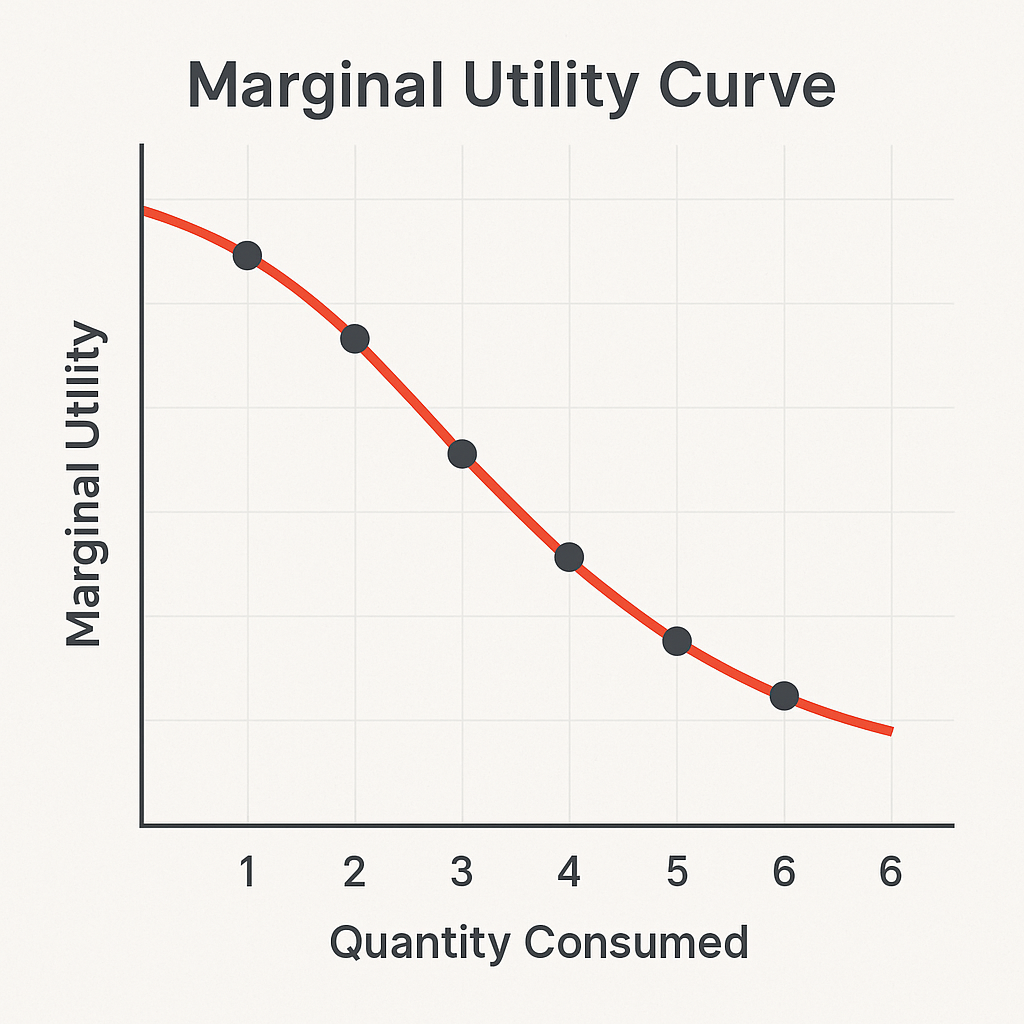
The Marginal Utility Curve shows the relationship between the quantity of a good consumed and the marginal utility derived from each unit. As the quantity increases, the curve slopes downward, indicating that the additional satisfaction from consuming each new unit decreases.
Consumer Choice Illustration
Consumers have limited resources (like money, time, or energy), and they aim to distribute these efficiently across different goods or services. A basic illustration can show two goods and how a consumer allocates resources to maximise overall satisfaction, usually balancing utility until the marginal utility per unit of cost is equalised across options.
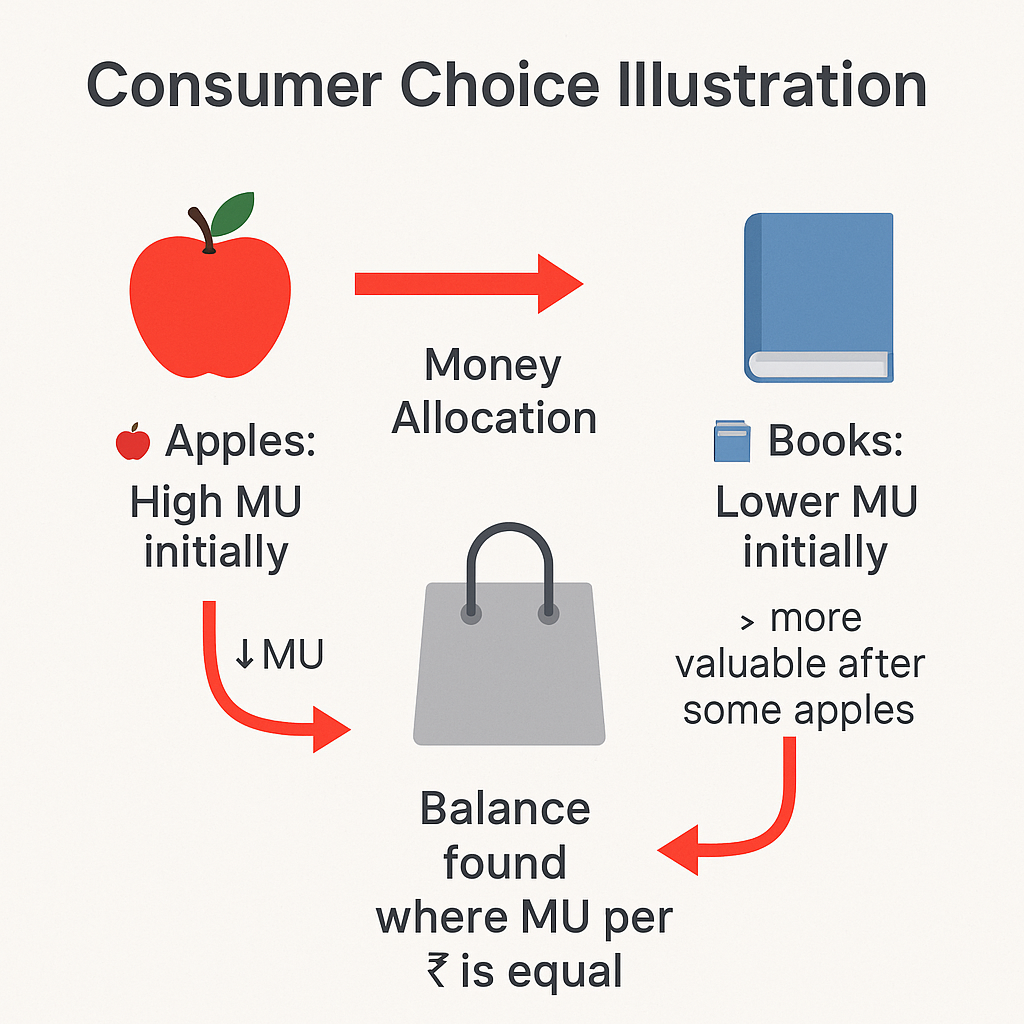
These graphical and pictorial tools not only simplify the concept but also highlight how the law applies in real-life scenarios, from food consumption to budgeting and resource allocation. They help us visualise the invisible trade-offs we make every day in pursuit of maximum satisfaction.
Examples of the Law of Diminishing Marginal Utility
The Law of Diminishing Marginal Utility can be observed in many everyday situations.
Eating Food
The first slice of pizza when you’re hungry provides the highest satisfaction. Every additional slice gives slightly less enjoyment until you no longer want another slice.
Watching Movies
Watching your favourite movie for the first time is exciting. Watching it repeatedly still provides enjoyment, but the excitement gradually decreases because the novelty disappears.
Shopping
Buying a new pair of shoes may feel rewarding. Purchasing a second or third pair within the same week offers much less satisfaction because your immediate need has already been fulfilled.
Mobile Phones
Buying the latest smartphone provides significant satisfaction. Buying another similar phone immediately afterwards offers much lower utility because one phone already meets your needs.
Streaming Services
Subscribing to one OTT platform gives access to plenty of entertainment. Adding a second platform increases satisfaction, but subscribing to five or six services usually provides much smaller additional value.
Mathematical Interpretation of the Law of Diminishing Marginal Utility
Economists measure utility using two related concepts: Total Utility (TU) and Marginal Utility (MU).
Formula
Marginal Utility (MU) = Change in Total Utility ÷ Change in Quantity Consumed
Or,
MU = ΔTU / ΔQ
Where:
- MU = Marginal Utility
- ΔTU = Change in Total Utility
- ΔQ = Change in Quantity Consumed
Practical Applications of Diminishing Marginal Utility
The Law of Diminishing Marginal Utility is not just a theoretical concept; it has meaningful applications in everyday decision-making, business strategy, and personal finance. Recognising how satisfaction declines with each additional unit consumed can lead to smarter, more efficient choices.
Pricing Strategies
Businesses often use this principle to shape their pricing models. For example, restaurants may offer discounts on second meals or combo offers, knowing that a customer’s willingness to pay full price decreases after the first purchase. Promotions like “buy one, get one at 50% off” are rooted in this concept to boost sales by offsetting declining utility.
Resource Allocation
This law influences how individuals allocate limited resources like money and time. Rather than spending entirely on one product or service, consumers spread their expenditure to get maximum overall satisfaction. For instance, subscribing to two different streaming platforms often feels more valuable than overusing just one.
Consumer Behavior
Diminishing marginal utility helps explain consumer preference for variety over volume. Instead of buying large quantities of a single item, people tend to choose assortments, such as a mix of snacks, because the satisfaction from consuming one type repeatedly declines after a point.
Impact of Diminishing Marginal Utility on Consumer Choices
The Law of Diminishing Marginal Utility plays a crucial role in shaping consumer decisions and influencing overall market behaviour. As satisfaction from each additional unit of a good decreases, it affects how individuals spend and how markets respond.
Equilibrium in Consumer Choices
Consumers aim to maximise total satisfaction by allocating their limited resources across various goods and services. As the marginal utility of one item falls, they shift consumption toward others, leading to a balanced distribution of spending that reflects individual preferences.
Influence on Market Demand
As consumers experience decreasing utility from additional units of a product, their desire to continue purchasing at the same rate declines. This results in a tapering of overall demand, which businesses must consider when setting prices and managing supply.
Impact of Diminishing Marginal Utility on Pricing
Businesses often use the Law of Diminishing Marginal Utility when designing pricing strategies because they understand that consumers are willing to pay less for additional units of the same product.
Quantity Discounts
Retailers offer discounts on bulk purchases because the perceived value of each additional unit decreases. Lower prices encourage consumers to buy more despite declining utility.
Bundle Pricing
Restaurants, OTT platforms, and retailers bundle products together to increase perceived value. Since consumers derive lower utility from buying multiple units of the same item, combining complementary products creates higher overall satisfaction.
Promotional Offers
Offers like “Buy One Get One Free” or “Buy Two Get One Free” are based on diminishing marginal utility. They compensate consumers for the lower satisfaction from additional units by reducing the effective price.
Price Discrimination
Companies often charge premium prices to early buyers who receive high utility from a product. As demand shifts to more price-sensitive consumers, businesses lower prices to match declining willingness to pay.
Discuss the relationship between diminishing marginal utility and opportunity cost
The Law of Diminishing Marginal Utility is closely linked to the concept of opportunity cost because consumers have limited income and must choose how to spend it.
As the marginal utility of one product decreases, consumers begin comparing the satisfaction they could receive by purchasing a different product instead. The opportunity cost of buying another unit of the same product is the satisfaction they give up from consuming an alternative good.
For example, after buying three cups of coffee in a day, the fourth cup provides very little additional satisfaction. Instead of buying another coffee, a consumer may choose to buy a sandwich or save the money. The enjoyment from the sandwich represents the opportunity cost of purchasing another coffee.
This relationship explains why consumers diversify their spending across different products instead of repeatedly purchasing the same item.
Limitations of the Law of Diminishing Marginal Utility
Although the Law of Diminishing Marginal Utility is widely accepted, it does not apply in every situation.
Utility cannot Be Measured Precisely
Satisfaction is subjective and varies from person to person. There is no universal unit to accurately measure utility.
Different Consumer Preferences
People have different tastes, habits, and income levels. A product that provides low utility to one consumer may continue providing high utility to another.
Luxury and Collectable Goods
Collectors may derive increasing satisfaction from acquiring rare paintings, luxury watches, or vintage cars, making the law less applicable.
Addictive Goods
For products like cigarettes, alcohol, or addictive digital content, consumers may continue consuming despite declining satisfaction due to addiction rather than rational choice.
Changing Preferences
Consumer preferences constantly evolve with trends, technology, and lifestyle changes. New experiences can reset utility and temporarily increase satisfaction.
Assumes Rational Behaviour
The law assumes consumers behave rationally, but emotional buying, impulse purchases, and behavioural biases often influence real-world decisions.
Conclusion
The Law of Diminishing Marginal Utility is a key principle in economics that explains how satisfaction decreases with each additional unit consumed. It influences consumer behaviour, pricing strategies, and market demand. By understanding this concept, individuals can make more balanced choices, allocate resources wisely, and avoid overconsumption. Businesses also apply this law to design effective pricing and promotional strategies. Visual tools like utility curves and resource allocation diagrams further enhance comprehension. Ultimately, recognising the diminishing value of repeated consumption leads to smarter decisions in both personal finance and broader economic contexts, improving overall satisfaction and efficiency.
Frequently Asked Questions (FAQs)
What is the Law of Diminishing Marginal Utility?
The Law of Diminishing Marginal Utility is an economic concept stating that as a person consumes more units of a good or service, the additional satisfaction gained from each new unit gradually decreases.
What is the Law of Diminishing Marginal Utility in a Sentence?
As a person consumes more of a product, the extra satisfaction from each additional unit becomes smaller.
What is the Law of Diminishing Marginal Product in Simple Words?
It means that if you keep adding more of one input, like workers, while keeping other inputs the same, the extra output from each new worker will eventually decrease.
What is the Law of Diminishing Marginal Utility in IB Economics?
In IB Economics, it refers to how consumers experience less satisfaction from each additional unit of a good, influencing how they allocate resources to maximise total utility.
Who introduced the law of diminishing marginal utility?
The concept was independently developed during the 19th century by economists William Stanley Jevons, Carl Menger, and Léon Walras as part of the Marginal Revolution in economics. Later, economists such as Alfred Marshall popularised the concept by integrating it into modern price and demand theory.
What are the exceptions to the law of diminishing marginal utility?
The law may not apply in certain situations where satisfaction does not decline with additional consumption. Common exceptions include collecting rare items, addictive products, hobbies, money accumulation, and luxury or prestige goods. In these cases, psychological or emotional factors may outweigh the normal decline in utility.
What are the assumptions of diminishing marginal utility?
The Law of Diminishing Marginal Utility is based on several assumptions:
- The consumer behaves rationally.
- Units consumed are identical in quality and size.
- Consumption is continuous without long gaps.
- Consumer tastes and preferences remain constant.
- Income and prices do not change during consumption.
- Utility can be measured conceptually for analysis.
- The product satisfies a single, specific want.
Disclaimer: This content is for educational purposes only and does not constitute financial or investment advice. Investments in securities or other financial instruments are subject to market risk, including partial or total loss of capital. Past performance is not indicative of future results. Always consider your financial situation carefully and consult a licensed financial advisor before making investment or trading decisions.
Engineered for the obsessed. Built for traders.

Purpose-built terminals.
Zero compromise.
Built for speed.

Plot No 1290, 2nd Floor, 17th Cross, 5th Main, Sector-7, HSR Layout, Bangalore 560102
Follow us on


Mintcap Brokers Private Limited
CIN – U66110KA2023PTC178706 | Registered Address: Plot No 1290, Second Floor, 17th Cross, 5th Main, Sector-7, HSR Layout, Bangalore 560102 | Tel: 080 – 49552310 | Email ID: compliance@capmint.com | SEBI registered Stock Broker: INZ000322732 | NSE Cash/F&O Member ID: 90430 | BSE Cash/F&O Member ID: 6903 | MCX Member ID: 57400 | NCDEX Member ID: 1312 | SEBI registered Depository Participant: IN-DP-806-2025 | CDSL DP ID: 12102300 | NSE Clearing Member code: M70108 | AMFI-Registered Mutual Fund Distributor: ARN-289109 (Valid upto 28-Feb-2027) | Category II Execution Only Platform : E6903
Details of Client Bank Account
Compliance Officer: Ms. Shridevi Vungarala | Email ID: compliance@capmint.com | Tel no. + 91 9035330126 | Grievance Redressal Officer (GRO) – Ms. Shikha Gupta | Email ID: Grievance@capmint.com | Tel no: 9035331595.
Procedure to file a complaint on SEBI SCORES: Register on SCORES portal. Mandatory details for filing complaints on SCORES: Name, PAN, Address, Mobile Number, E-mail ID. Benefits: Effective Communication, Speedy redressal of the grievances. You may refer the website https://scores.sebi.gov.in/ for more information. You may also download the SEBI Scores app to log a complaint Android: https://play.google.com > store > apps > sebiscores iOS: https://apps.apple.com > app > sebiscores
Disclaimer
Investment in the securities market are subject to market risks, read all the related documents carefully before investing. Brokerage will not exceed the SEBI prescribed limit.
Mutual fund investments are subject to market risks, read all scheme related documents carefully before investing. Mutual Funds are not exchange-traded products.
Attention Investor:
- Stock Brokers can accept securities as margin from clients only by way of pledge in the depository system w.e.f. September 1, 2020.
- Update your mobile number & email Id with your stock broker/depository participant and receive OTP directly from depository on your email id and/or mobile number to create pledge.
- Pay 20% as upfront margin of the transaction value to trade in cash market segment.
- Investors may please refer to the Exchange’s Frequently Asked Questions (FAQs) issued vide circular reference NSE/INSP/45191 dated July 31, 2020 and NSE/INSP/45534 dated August 31, 2020 and other guidelines issued from time to time in this regard.
- Check your Securities /MF/ Bonds in the consolidated account statement issued by NSDL/CDSL every month.