
Link copied!
The Harsh Reality of Full-Time Trading: Why Yogesh Nanda Says ₹1 Lakh Isn't Enough

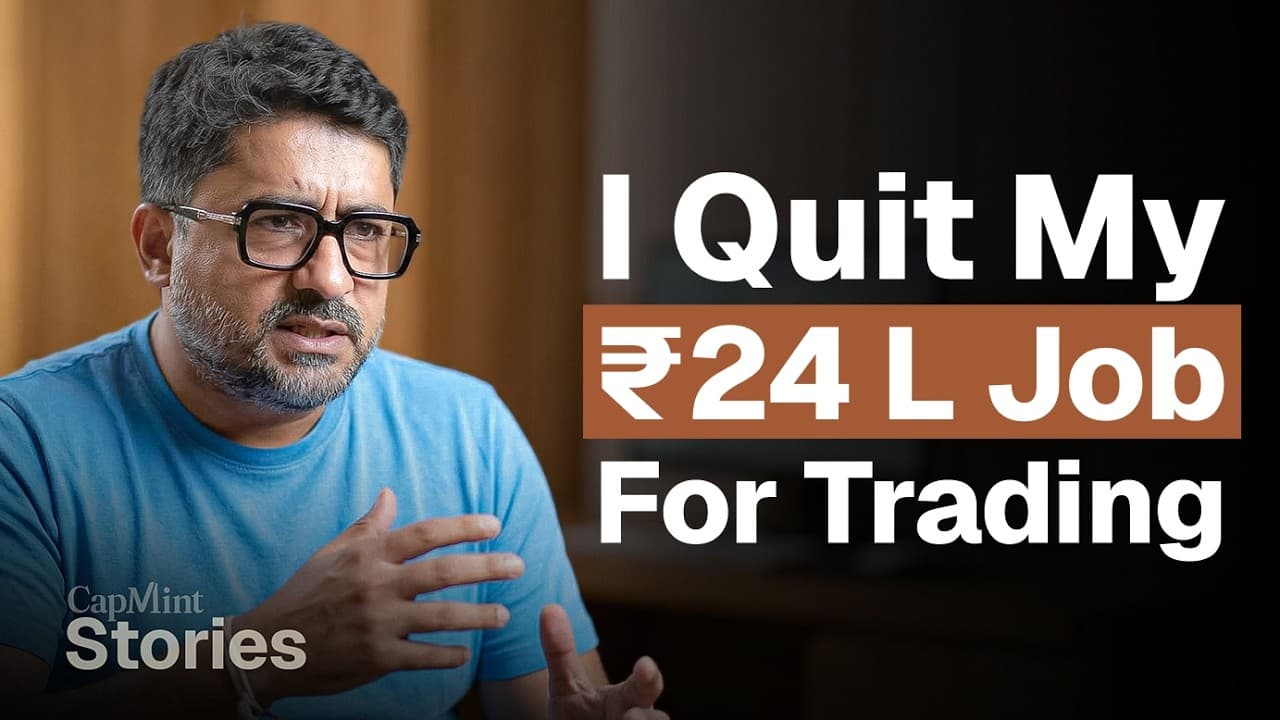
Before quitting a stable, high-paying corporate job to trade the markets full-time, there is one critical question every trader must answer: Exactly how much capital do I need to survive? In this episode of CapMint Stories, veteran Chartered Accountant and full-time trader Yogesh Nanda shares the brutal financial realities of relying on the stock market for a living.
“If I met my 20-year-old self who wanted to start full-time trading with ₹1 Lakh, I would tell him: ₹1 Lakh is good for learning, but it is not good for trading. Trading is a money game.”
Growing up in a cramped 150-square-foot room in Mumbai, Yogesh pursued CA simply to lift his family out of financial scarcity. After securing a lucrative corporate job, he entered the euphoric 2007 bull market, turning ₹3 Lakhs into ₹12 Lakhs using heavily leveraged futures, only to lose it all when the 2008 subprime crisis hit. This devastating blow forced him to step away, respect risk, and spend three years mastering cash equities before he dared to trade options again. Yogesh breaks down his transition into algorithmic trading, the hidden risks of broker glitches that cost him ₹7.5 Lakhs in a single day, and why relying solely on option selling won’t build long-term wealth. Most importantly, he provides a mathematical framework for calculating the exact corpus required to quit your day job safely.
Key Takeaways:
-
The Full-Time Capital Formula: Yogesh warns that trading with just ₹1 Lakh is a hobby, not a career. To find your “freedom number,” define your monthly expenses and assume a highly conservative 2% monthly return. If you need ₹50,000 a month to live, you need at least ₹25 Lakhs in capital before you even consider quitting your job.
-
The “M3” Framework: When prioritizing Mind (Psychology), Money (Risk Management), and Method (Strategy), Yogesh insists that “Mind” is by far the most critical. You can have a mediocre strategy, but with a disciplined mindset and strict risk management, you can still be highly profitable.
-
The Hidden Risks of Algos: While algorithmic trading solves the emotional flaws of manual execution, it introduces systemic risks. Yogesh lost ₹7.5 Lakhs in a single day due to a broker glitch that prevented stop-loss orders from executing. Always have contingency plans for technology failures.
-
Options Create Income, Cash Creates Wealth: While option selling provides the consistent monthly cash flow needed to survive full-time trading, true wealth compounding happens in the cash market. Yogesh uses Relative Strength analysis to identify outperforming sectors and ride multi-bagger stocks that you cannot capture through options.
Today, Yogesh relies on a disciplined routine of pre-market analysis, automated trading, and long-term investing to maintain his freedom. We at CapMint believe his story proves that passion alone will not sustain a full-time trading career; you must treat your capital with the precision of an accountant to survive the volatility.
Disclaimer: This content is for educational purposes only and does not constitute financial or investment advice. Investments in securities or other financial instruments are subject to market risk, including partial or total loss of capital. Past performance is not indicative of future results. Always consider your financial situation carefully and consult a licensed financial advisor before making investment or trading decisions.
Related Videos

The ₹3 Lakh Wake-Up Call: How Arjun Tandon Mastered Systematic Trading?
Watch Arjun Tandon’s unbelievable evolution from an unfulfilled PwC chartered accountant to a disciplined, full-time systematic trader.
74.66K views
23 mins
From a ₹50 Lakh Drawdown to Directional Option Selling with AI: Ravi’s Story
Watch Ravi’s evolution from an exhausted daily expiry seller who took a devastating ₹50 Lakh hit, to a selective directional trader using custom AI tools to ruthlessly manage risk.
19.88K views
21 mins
Raahi Bhushan on Algos, AI, and Surviving a Massive Market Rally
Watch Raahi Bhushan’s unbelievable evolution from a successful EdTech founder to an algorithmic options trader navigating massive ₹99 Lakh drawdowns and the impending AI revolution.
7.59K views
16 mins
Blowing Up Twice to Managing ₹750 Crores: The Story Behind QC Alpha
Watch the incredible evolution of a trader who started with a ₹8,000 salary, survived a debilitating chronic illness, blew up his account twice, and ultimately built a quantitative firm managing over ₹750 Crores.
8.82K views
19 mins
Surviving a ₹1.5 Crore Single-Day Loss: How Sanket Became a Fund Manager
Watch Sanket’s unbelievable evolution from a struggling student who failed the 12th grade to a highly respected institutional fund manager steering a massive ₹300 Crore portfolio.
8.48K views
19 mins
Lost ₹50 Lakhs in Trading. Now Manages ₹200 Crores: The Darshan Rathod Story
Watch Darshan Rathod’s incredible journey of blowing ₹50 Lakhs of his father's hard-earned money on reckless trading tips, hitting absolute rock bottom, and eventually bouncing back to manage over ₹200 Crores in capital.
23.09K views
21 mins
From a Delivery Boy to a Full-Time Option Seller: The Kundan Prajapati Story
Watch Kundan Prajapati’s raw and inspiring journey of fighting his way back from absolute financial ruin, working exhausting 11-hour shifts as a delivery boy just to fund his dream of becoming a full-time option seller.
96.47K views
25 mins
Trading, Philanthropy, and Detachment: The Dhiraj Sinha Story
Watch Dhiraj Sinha’s incredible transition from being an IT leader to finding peace, profitability, and purpose as a full-time option seller and philanthropist.
54.03K views
22 mins
Zero Loss-Making Years: The 0.3% Risk Rule of Algo Trader Aseem Singhal
Watch Aseem Singhal’s incredible journey of transitioning from the intense floors of Deutsche Bank and JP Morgan to running his own highly successful algorithmic trading desk, all without a single loss-making year in the last seven years.
10.50K views
21 mins

Shankar Nath's Journey: Why Knowing Your "Freedom Number" is the Ultimate Market Edge
Watch Shankar Nath’s incredible journey of turning a highly risky ₹5.5 Lakh personal loan into a staggering ₹7.5 Crore equity portfolio, ultimately giving him the freedom to walk away from a Senior VP role and start his own YouTube channel.
23.68K views
24 mins
Fired With a ₹35 Lakh Loan: How Aseem Juneja Built 'A Digital Blogger'
Watch Aseem Juneja’s incredible journey of getting fired from his dream corporate job while sitting on a massive ₹35 Lakh student loan, only to bounce back and build the educational empire, 'A Digital Blogger'.
54.89K views
20 mins

From IIT Bombay to 84% XIRR: The Rahul Poonia Story
Watch Rahul Poonia’s fascinating journey from cracking IIT Bombay and working as a high-paid software developer to ultimately quitting his tech career to pursue full-time swing trading.
22.70K views
16 mins
From Zero Capital to Algorithmic Mastery: The Rakesh Pujara Story
Watch Rakesh Pujara’s incredible journey of losing his entire borrowed capital during the 1992 market crash, spending a decade paying off the debt, and ultimately rising to become a pioneer in algorithmic trading.
22.91K views
21 mins
From Losing ₹10 Lakh to Building AlgoFox: The Kushal Jain Story
Watch Kushal Jain's incredible journey of bouncing back from devastating early losses to co-founding AlgoFox, ultimately reducing his daily screen time to just 10 minutes.
1.02L views
23 mins
Kunj Gala’s Journey: From a Chawl to a ₹100 Crore Advisory Firm
Watch Kunj Gala’s inspiring journey of rising from a lower-middle-class Mumbai chawl to becoming a highly successful mutual fund manager, and ultimately, building his own ₹100 Crore advisory firm
34.08K views
17 mins
From a Secure Govt Job to a ₹7 Crore Portfolio: The Praful Kulkarni Story
Watch Praful Kulkarni’s incredible journey of turning a ₹20 Lakh account into a ₹7 Crore portfolio by walking away from a secure PSU job and a top-tier medical seat.
1.30L views
19 mins
The Trap of Overtrading: How One Simple Rule Changed Anuj Niranjan's Life
Learn how Anuj went from placing 30 trades a day to just 3 a month. We explore the deep psychology of trading and true freedom in this CapMint Story.
3.40L views
18 mins
Overcoming an ₹11 Lakh Loss: How Santosh Used Spirituality to Master Trading
Watch Santosh’s incredible story of losing ₹11 Lakh in a single session and how Ironman training and meditation transformed his trading mindset.
51.06K views
15 mins
Quitting a Safe Job to Trade: How Nishit Mehta Rebuilt After a 35% Loss
In this episode of CapMint Stories, professional trader Nishit Mehta shares his turbulent journey of quitting his secure bank job at 30, only to face a crushing 35% loss in his capital due to a lack of strategy and over-leveraging.
81.97K views
13 mins
Engineered for the obsessed. Built for traders.

Purpose-built terminals.
Zero compromise.
Built for speed.

Plot No 1290, 2nd Floor, 17th Cross, 5th Main, Sector-7, HSR Layout, Bangalore 560102
Follow us on


Mintcap Brokers Private Limited
CIN – U66110KA2023PTC178706 | Registered Address: Plot No 1290, Second Floor, 17th Cross, 5th Main, Sector-7, HSR Layout, Bangalore 560102 | Tel: 080 – 49552310 | Email ID: compliance@capmint.com | SEBI registered Stock Broker: INZ000322732 | NSE Cash/F&O Member ID: 90430 | BSE Cash/F&O Member ID: 6903 | MCX Member ID: 57400 | NCDEX Member ID: 1312 | SEBI registered Depository Participant: IN-DP-806-2025 | CDSL DP ID: 12102300 | NSE Clearing Member code: M70108 | AMFI-Registered Mutual Fund Distributor: ARN-289109 (Valid upto 28-Feb-2027) | Category II Execution Only Platform : E6903
Details of Client Bank Account
Compliance Officer: Ms. Shridevi Vungarala | Email ID: compliance@capmint.com | Tel no. + 91 9035330126 | Grievance Redressal Officer (GRO) – Ms. Shikha Gupta | Email ID: Grievance@capmint.com | Tel no: 9035331595.
Procedure to file a complaint on SEBI SCORES: Register on SCORES portal. Mandatory details for filing complaints on SCORES: Name, PAN, Address, Mobile Number, E-mail ID. Benefits: Effective Communication, Speedy redressal of the grievances. You may refer the website https://scores.sebi.gov.in/ for more information. You may also download the SEBI Scores app to log a complaint Android: https://play.google.com > store > apps > sebiscores iOS: https://apps.apple.com > app > sebiscores
Disclaimer
Investment in the securities market are subject to market risks, read all the related documents carefully before investing. Brokerage will not exceed the SEBI prescribed limit.
Mutual fund investments are subject to market risks, read all scheme related documents carefully before investing. Mutual Funds are not exchange-traded products.
Attention Investor:
- Stock Brokers can accept securities as margin from clients only by way of pledge in the depository system w.e.f. September 1, 2020.
- Update your mobile number & email Id with your stock broker/depository participant and receive OTP directly from depository on your email id and/or mobile number to create pledge.
- Pay 20% as upfront margin of the transaction value to trade in cash market segment.
- Investors may please refer to the Exchange’s Frequently Asked Questions (FAQs) issued vide circular reference NSE/INSP/45191 dated July 31, 2020 and NSE/INSP/45534 dated August 31, 2020 and other guidelines issued from time to time in this regard.
- Check your Securities /MF/ Bonds in the consolidated account statement issued by NSDL/CDSL every month.