

Table of Content
- Key Takeaways
- Understanding Sector Funds
- Types of Sector Funds
- List of Sector Mutual Funds
- How Do Sector Funds Work?
- Key Features of Sector Funds
- Risks in Sector Funds
- Benefits of Sector Funds
- Who Should Invest in Sector Funds?
- How to Invest in Sector Mutual Funds?
- Taxation for Sector Mutual Funds
- Conclusion
- Frequently Asked Questions (FAQs)
Link copied!
Sector Funds

Sector funds are mutual funds that invest exclusively in a single industry or sector, such as IT, banking, or automobiles, allowing investors to benefit from the growth potential of a specific industry or sector.
Key Takeaways
- Sector funds invest in a specific industry or economic sector like pharma, FMCG, IT, or energy.
- Sector funds carry high risk due to their concentrated exposure, but can deliver strong returns during sector uptrends.
- Sector funds are suitable for informed investors with a tactical or high-conviction outlook on a particular sector.
- Sector funds are ideal for medium to long-term investment horizons, not suitable for beginners or conservative investors.
What are Sector Funds?
Sector funds focus on one industry, like pharma, tech, auto, etc., not the whole market. They can surge in an up-cycle and slip just as fast when the cycle turns. You can use them as concentrated satellites around a diversified core, sized modestly. Outcomes of these funds depend on sector-specific drivers, regulation, input costs, currency, and demand cycles, so timing and discipline matter.
Example: SBI Healthcare Opportunities Fund sticks to pharma and healthcare names, drug makers, hospitals, and diagnostics. It tends to do well when approvals flow (USFDA), export pricing holds up, and a weaker INR boosts dollar revenues; it struggles when regulation tightens, pricing pressure hits generics, or the rupee strengthens.
Types of Sector Funds
Sector funds can be categorised based on the industry or economic segment they primarily invest in. Each type offers exposure to a specific sector and is influenced by different market, economic, and regulatory factors.
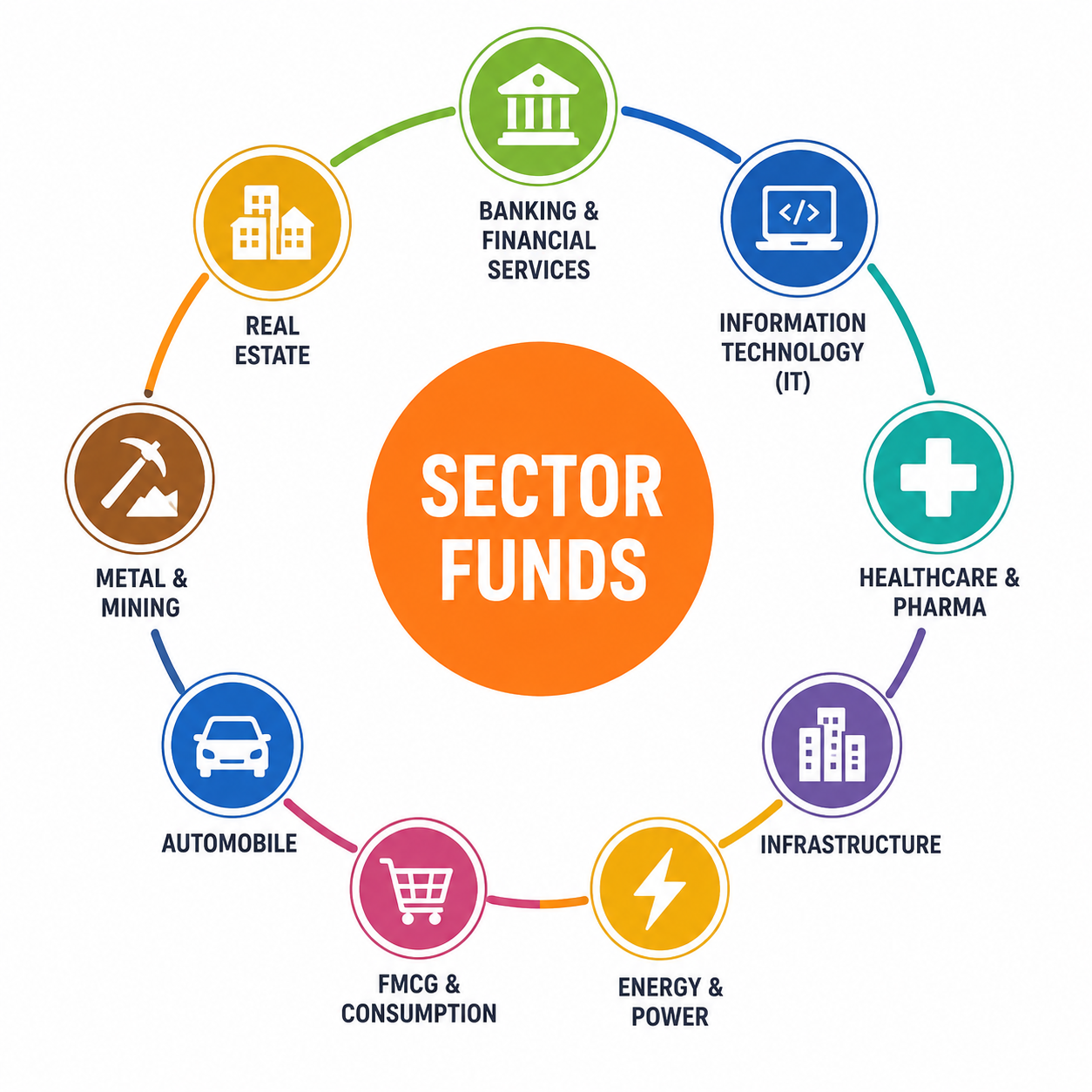
Banking and Financial Services Funds
These funds invest in banks, non-banking financial companies (NBFCs), insurance companies, and other financial institutions. Their performance is closely linked to interest rates, credit growth, economic expansion, and financial sector reforms.
Examples: HDFC Bank, ICICI Bank, Bajaj Finance, SBI.
Information Technology (IT) Funds
IT sector funds invest in software companies, technology service providers, and digital businesses. They are often influenced by global technology spending, currency movements, and demand for digital transformation services.
Examples: Infosys, TCS, HCL Technologies, Wipro.
Healthcare and Pharma Funds
Healthcare funds focus on pharmaceutical companies, hospitals, diagnostics businesses, and healthcare service providers. Regulatory approvals, healthcare demand, research developments, and export opportunities significantly impact this sector.
Examples: Sun Pharmaceutical Industries, Dr.Reddy’s Laboratories, Apollo Hospitals, Cipla.
Infrastructure Funds
Infrastructure funds invest in companies involved in construction, engineering, utilities, transportation, and capital goods. Government spending, infrastructure projects, and economic growth are key drivers of performance.
Examples: Larsen & Toubro (L&T), NTPC, UltraTech Cement, Adani Ports.
Energy and Power Funds
These funds invest in companies engaged in oil & gas, renewable energy, power generation, and energy distribution. Their returns are affected by commodity prices, energy demand, government policies, and global supply conditions.
Examples: Reliance Industries, ONGC, NTPC, Tata Power.
FMCG and Consumption Funds
FMCG sector funds focus on companies producing everyday consumer goods such as food products, beverages, personal care items, and household essentials. Consumer spending, inflation, and rural demand play an important role in determining returns.
Examples: Hindustan Unilever (HUL), ITC, Nestlé India, Britannia Industries.
Automobile Funds
Automobile sector funds invest in vehicle manufacturers, auto component producers, and related businesses. Their performance depends on consumer demand, fuel prices, interest rates, and overall economic activity.
Examples: Maruti Suzuki, Tata Motors, Mahindra & Mahindra, Bajaj Auto.
Metal and Mining Funds
These funds invest in companies involved in mining, steel production, and metal processing. Global commodity prices, industrial demand, and infrastructure spending are major factors influencing this sector.
Examples: Tata Steel, JSW Steel, Hindalco Industries, Coal India.
Real Estate Funds
Real estate sector funds provide exposure to property developers, construction companies, and real estate-related businesses. Interest rates, property demand, and economic conditions significantly affect their performance.
Examples: DLF, Godrej Properties, Oberoi Realty, Prestige Estates Projects.
List of Sector Mutual Funds
The list of the top 10 sector mutual funds is as follows:
|
Fund Name |
3-Year CAGR (%) |
5-Year CAGR (%) |
|---|---|---|
|
Quant Infrastructure Fund |
20.92 |
33 |
|
ICICI Prudential Commodities Fund |
16.89 |
30.27 |
|
DSP Healthcare Fund |
23.62 |
29.34 |
|
ICICI Prudential Technology Fund |
11.38 |
29.14 |
|
SBI Healthcare Opportunities Fund |
24.98 |
28.72 |
|
Tata Digital India Fund |
N/A |
N/A |
|
Motilal Oswal Large and Midcap Fund |
3.8 |
N/A |
|
ICICI Prudential Infrastructure Fund |
16.89 |
30.27 |
|
Nippon India Pharma Fund |
Around 21.50 |
N/A |
|
ICICI Prudential Energy Opportunities |
N/A |
N/A |
How Do Sector Funds Work?
The fund manager of a sector fund selects stocks strictly from one particular sector. For instance, in an IT sector fund, investments may include large-cap firms like Infosys and TCS, as well as mid- and small-cap IT service providers and software developers.
These funds can be:
- Actively managed: Fund manager actively picks stocks within the sector.
- Passively managed: The fund mirrors a sectoral index like Nifty Pharma or Nifty Bank.
Returns are highly sensitive to developments within the chosen sector. Events like regulatory changes, demand-supply shifts, global cues, or technological disruptions can have a big impact on these funds.
Key Features of Sector Funds
This section explains what makes sector funds unique in terms of risk, return potential, diversification, and timing.
Concentration Risk
With exposure to only one sector, these funds can be extremely volatile. A downturn in the chosen sector can significantly impact overall returns. Since there’s no diversification, any negative news in the sector could drastically affect fund performance.
High Return Potential
In a bull run for the sector, returns can outperform diversified equity funds. If timed right, they can generate substantial alpha. These funds benefit immensely when a sector is trending due to demand, government policies, or global cues.
Low Diversification
Minimal risk spreading; performance is not cushioned by other sectors. This narrow exposure makes them highly dependent on sector-specific developments. Investors face heightened volatility as there’s no fallback from unrelated industries during downturns.
Timing-Sensitive
Entry and exit timing are crucial due to the cyclical nature of many sectors. Poor timing can lead to major underperformance. Investors need strong analytical skills to judge when a sector is about to perform or lag.
Risks in Sector Funds
Understanding the risks is essential before investing in sector funds, as they come with higher volatility and concentration.
Cyclicality
Many sectors, like auto and metal, follow boom-bust cycles. Poor timing can lead to underperformance. Investors may enter too late or exit too early, affecting long-term portfolio returns.
Regulatory Risk
Sector funds are highly sensitive to policy moves; for instance, a price cap on drugs can hit pharma stocks. Sector funds are highly exposed to policy decisions, sudden legal reforms, or unexpected regulatory crackdowns.
Global Impact
The IT and energy sectors are heavily influenced by global events and currency movements. Sector performance can swing wildly due to trade wars, geopolitical instability, or foreign market conditions.
High Volatility
Single-sector exposure means no buffer during market downturns. A bad quarter or sector-specific crisis can lead to sharp NAV declines and prolonged underperformance.
Benefits of Sector Funds
These funds offer targeted exposure to growing industries and help investors tap into specific opportunities across the economic cycle.
Focused Growth
Perfect for investors with strong views on a sector’s future. Offers the potential to benefit from targeted economic or regulatory tailwinds. This concentrated exposure can amplify returns if the sector sees strong earnings growth and investor interest.
Tactical Allocation
Useful for satellite allocation in a core-satellite portfolio approach. Allows investors to take short-term bets on high-performing or turnaround sectors. It enables strategic rebalancing based on changing economic trends and sector rotations in the market.
Alpha Generation
Potential to outperform the market when the chosen sector is in favour. Enables sharp returns when timed during sector uptrends. Skilled investors can use research insights to capture excess returns over broader equity indices.
Short-Term Plays
Can be used for short- to medium-term opportunities based on market trends. Flexibility to align with current events and macroeconomic shifts. These funds allow agility and adaptability to take advantage of temporary opportunities or news-driven rallies.
Who Should Invest in Sector Funds?
Sector funds are best suited for:
Experienced investors
Who can monitor sector trends and have the knowledge to evaluate market timing and industry-specific developments.
High-risk Takers
People with the ability to absorb short-term volatility and invest based on macroeconomic or policy-based sector forecasts.
Tactical Investors
They are looking for short-term thematic opportunities that align with their sector-specific insights or temporary mispricings.
Sector Enthusiasts
With deep knowledge and conviction in an industry, willing to hold through cycles to realise the theme’s potential.
How to Invest in Sector Mutual Funds?
Choose your sector (and why)
Pick one industry you actually get, like pharma, IT, or banks. Then write down the reasons you believe it’ll grow.
Pick the fund style
If you want low cost and no stock-picking, go index/ETF that tracks an index or a sector. If you’re okay with higher fees and variance for potential outperformance, go for active funds.
Finish KYC and pick the plan
Do/verify KYC on your AMC app or platform. Prefer the Direct plan (lower fee) if you don’t need advice; use the Regular if you do.
Decide how to put money in
Use a SIP to average in over time, or a lump sum (or 2–3 staggered chunks) if you already have cash and conviction.
Set a safety cap
Keep total sector-fund exposure small, ~5–10% of your portfolio, so one theme can’t sink you.
Compare shortlists quickly
Check expense ratio, past drawdowns, top holdings, AUM/liquidity, and (for index funds) tracking error; also note any exit load.
Place the order correctly
Select Growth (usually best for compounding) unless you specifically want payouts (IDCW). Buy via your platform/AMC.
Review and rebalance
Look quarterly: trim if it shoots past your cap, add only if the thesis still holds and valuations aren’t frothy, and exit if the thesis breaks (regulation turns, earnings downgrade cycle, or momentum dies).
Taxation for Sector Mutual Funds
In India, sector mutual funds are treated as equity-oriented schemes because they invest more than 65% of their portfolio in equities of a particular sector. This means they follow the same tax rules as diversified equity funds.
Short-Term Capital Gains (STCG)
If units are sold within 12 months, gains are taxed at 20% (flat rate).
Long-Term Capital Gains (LTCG)
If units are sold after 12 months, gains above ₹1.25 lakh in a financial year are taxed at 12.5%.
Dividends (IDCW)
Any dividend received is added to your income and taxed as per your slab. TDS at 10% is deducted if the total dividend from a fund exceeds ₹5,000 in a financial year.
In simple terms, sector funds carry the same tax treatment as other equity funds, so investors benefit from lower tax rates compared to debt or international FoFs. However, because these are high-risk funds, taxation should only be a secondary consideration; the primary focus should be on managing sector-specific risks.
Conclusion
Sector funds can be powerful tools in the hands of knowledgeable investors. When timed correctly, they can deliver impressive returns by riding a sector boom. However, their narrow focus also makes them risky. Always ensure that exposure to sector funds forms only a small percentage of your overall portfolio. Diversification, regular monitoring, and a clear exit strategy are key to using sector funds effectively.
Frequently Asked Questions (FAQs)
Are sector funds good for beginners?
No, they are risky and better suited for experienced investors who understand sector-specific dynamics. Beginners may find the volatility overwhelming and hard to manage, especially without deep industry or market knowledge.
Can I invest in sector funds via SIP?
Yes, SIPs are available and can help reduce timing risk, but the sector exposure still carries high concentration risk. SIPs bring investment discipline, but the theme’s risk profile still needs to be actively monitored.
How long should I stay invested in a sector fund?
At least 3-5 years, or as long as your conviction in the sector remains strong. Regular review is essential. Long holding periods allow trends to mature and reduce the impact of short-term sector volatility.
Disclaimer: This content is for educational purposes only and does not constitute financial or investment advice. Investments in securities or other financial instruments are subject to market risk, including partial or total loss of capital. Past performance is not indicative of future results. Always consider your financial situation carefully and consult a licensed financial advisor before making investment or trading decisions.
Table of Content
- Key Takeaways
- Understanding Sector Funds
- Types of Sector Funds
- List of Sector Mutual Funds
- How Do Sector Funds Work?
- Key Features of Sector Funds
- Risks in Sector Funds
- Benefits of Sector Funds
- Who Should Invest in Sector Funds?
- How to Invest in Sector Mutual Funds?
- Taxation for Sector Mutual Funds
- Conclusion
- Frequently Asked Questions (FAQs)
Engineered for the obsessed. Built for traders.

Purpose-built terminals.
Zero compromise.
Built for speed.

Plot No 1290, 2nd Floor, 17th Cross, 5th Main, Sector-7, HSR Layout, Bangalore 560102
Follow us on


Mintcap Brokers Private Limited
CIN – U66110KA2023PTC178706 | Registered Address: Plot No 1290, Second Floor, 17th Cross, 5th Main, Sector-7, HSR Layout, Bangalore 560102 | Tel: 080 – 49552310 | Email ID: compliance@capmint.com | SEBI registered Stock Broker: INZ000322732 | NSE Cash/F&O Member ID: 90430 | BSE Cash/F&O Member ID: 6903 | MCX Member ID: 57400 | NCDEX Member ID: 1312 | SEBI registered Depository Participant: IN-DP-806-2025 | CDSL DP ID: 12102300 | NSE Clearing Member code: M70108 | AMFI-Registered Mutual Fund Distributor: ARN-289109 (Valid upto 28-Feb-2027) | Category II Execution Only Platform : E6903
Details of Client Bank Account
Compliance Officer: Ms. Shridevi Vungarala | Email ID: compliance@capmint.com | Tel no. + 91 9035330126 | Grievance Redressal Officer (GRO) – Ms. Shikha Gupta | Email ID: Grievance@capmint.com | Tel no: 9035331595.
Procedure to file a complaint on SEBI SCORES: Register on SCORES portal. Mandatory details for filing complaints on SCORES: Name, PAN, Address, Mobile Number, E-mail ID. Benefits: Effective Communication, Speedy redressal of the grievances. You may refer the website https://scores.sebi.gov.in/ for more information. You may also download the SEBI Scores app to log a complaint Android: https://play.google.com > store > apps > sebiscores iOS: https://apps.apple.com > app > sebiscores
Disclaimer
Investment in the securities market are subject to market risks, read all the related documents carefully before investing. Brokerage will not exceed the SEBI prescribed limit.
Mutual fund investments are subject to market risks, read all scheme related documents carefully before investing. Mutual Funds are not exchange-traded products.
Attention Investor:
- Stock Brokers can accept securities as margin from clients only by way of pledge in the depository system w.e.f. September 1, 2020.
- Update your mobile number & email Id with your stock broker/depository participant and receive OTP directly from depository on your email id and/or mobile number to create pledge.
- Pay 20% as upfront margin of the transaction value to trade in cash market segment.
- Investors may please refer to the Exchange’s Frequently Asked Questions (FAQs) issued vide circular reference NSE/INSP/45191 dated July 31, 2020 and NSE/INSP/45534 dated August 31, 2020 and other guidelines issued from time to time in this regard.
- Check your Securities /MF/ Bonds in the consolidated account statement issued by NSDL/CDSL every month.