

Link copied!
How to Check Your Demat Account Number

Placing a trade, applying for an IPO, or shifting to a new broker all require your Demat account number. The reason is simple: this number tells the system where your shares should be stored. Just like a bank needs your account number to hold your money, the stock market needs your Demat number to hold your shares safely. Without it, any investment-related process cannot be completed properly.
This article covers how to check your Demat account number clearly and practically, so you can find it quickly without any confusion.
What Is a Demat Account Number?
Before getting into how to check a Demat account number, let’s quickly understand what it actually is.
A Demat account number is a unique identifier associated with your Demat account. This account holds your shares, ETFs, bonds, and other securities in electronic form. Whenever you buy or sell shares for delivery, this number is used in the background to record ownership.
Many people confuse this with their trading account ID. Both are different. Your trading account helps you place buy or sell orders, while your Demat account holds the securities after the trade is completed. So when someone asks how to check a Demat account, they’re usually referring to checking details related to this Demat account, especially the account number. This distinction becomes practically relevant during broker transfers or off-market share transfers, where the Demat account number is specifically required and the trading account ID will not work as a substitute.
Demat Account Number Format Explained
Understanding the Demat account number format makes everything much clearer.
In India, Demat accounts are maintained with two depositories. The Demat account number format differs based on the depository, as shown below:
| Depository | Demat Account Number Format |
|---|---|
| NSDL | Starts with “IN” followed by 14 digits (16 characters total) |
| CDSL | 16-digit numeric code |
This difference often confuses investors, but both formats serve the same purpose. A quick way to remember:
If the number begins with letters (“IN”), it’s NSDL; if it’s entirely numeric, it’s CDSL.
Most brokers in India are registered with both depositories, though each individual account is linked to only one. Knowing which depository your account belongs to becomes relevant when you need to provide details for corporate actions, dividend mandates, or inter-depository transfers.
Where to Find Your Demat Account Number
Now that you understand what a Demat account number looks like, let’s move to the most important part: where you can actually find it. In most cases, the number is already available to you; you just need to know the right place to look.
1. Welcome Kit (Received from Depository Participant or Stock Broker)
When you open a Demat account, your broker or depository participant sends a welcome email to your registered email ID. This email usually contains a PDF attachment. Inside that document, look for the BO ID (Beneficiary Owner Identification Number). This BO ID is your Demat account number.
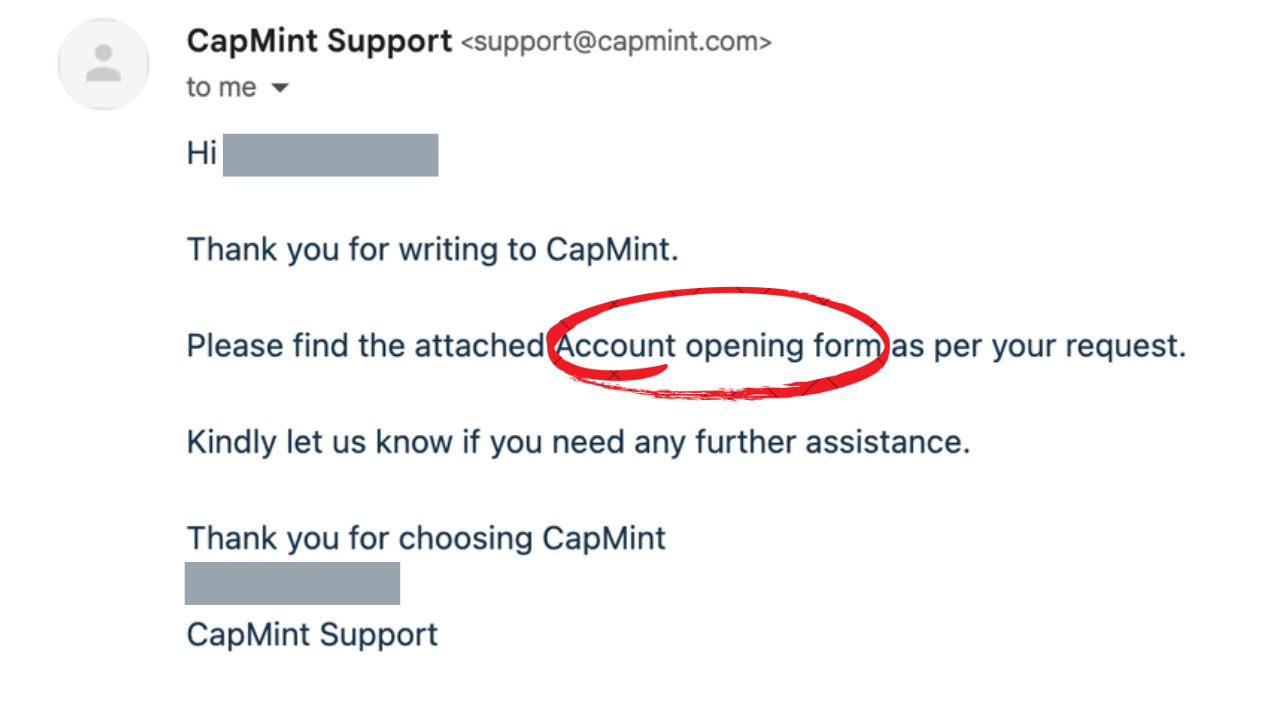
If you’re checking old emails, search for keywords like “Welcome Letter”, “Account Opening”, or your broker’s name. On Gmail, searching “BO ID” or “Demat account” along with your broker’s name usually brings up the relevant email within the first few results. The welcome email is typically sent within 24–48 hours of account activation, so filtering by the approximate date you opened the account can also help narrow the search.
2. Consolidated Account Statement (Received from Depository)
The depository periodically sends a Consolidated Account Statement (CAS) to your registered email ID. This statement shows all your holdings and transactions in one place. At the top of the CAS, you will find your BO ID or Demat account number clearly mentioned.
This is one of the most reliable ways to know your Demat account number, especially if you don’t actively use your broker’s app. CAS statements are sent monthly if there has been any transaction activity during the month, or half-yearly if the account has been inactive. The email typically arrives from “donotreply@cdslindia.com” or “ecas@nsdl.co.in” depending on your depository, so checking these sender addresses in your inbox is another quick way to locate it.
3. Customer Support of Your Broker or DP
If none of the above methods works, you can directly contact your broker’s or depository participant’s customer support through phone, email, or live chat. After verifying your registered details, such as PAN, mobile number, or client ID, they will help you retrieve your Demat account number.
Most brokers resolve this within a few minutes over phone or chat. Keep your PAN number and registered mobile handy before calling, as the verification step is mandatory and speeds up the process considerably.
4. CDSL or NSDL Website
If your account is with CDSL, you can also retrieve your BO ID through the CDSL website by registering on their “Easi” or “Easiest” portal using your PAN and registered email. For NSDL accounts, the “IDeAS” portal serves a similar purpose. Both portals allow you to view your holdings, transaction history, and account details independently of your broker’s platform, which can be useful if you’re between brokers or have trouble accessing your broker’s app.
How to Know Your Demat Account Number Via CapMint
If you have opened a Demat account with CapMint, here’s how you can find your Demat account number via the CapMint app.
- Open your CapMint app.
- Log in using biometrics or credentials.
- On the homepage, click on your profile icon.
- Then click on “Account Details.”
- Scroll down to “Demat acc number/BOID.”
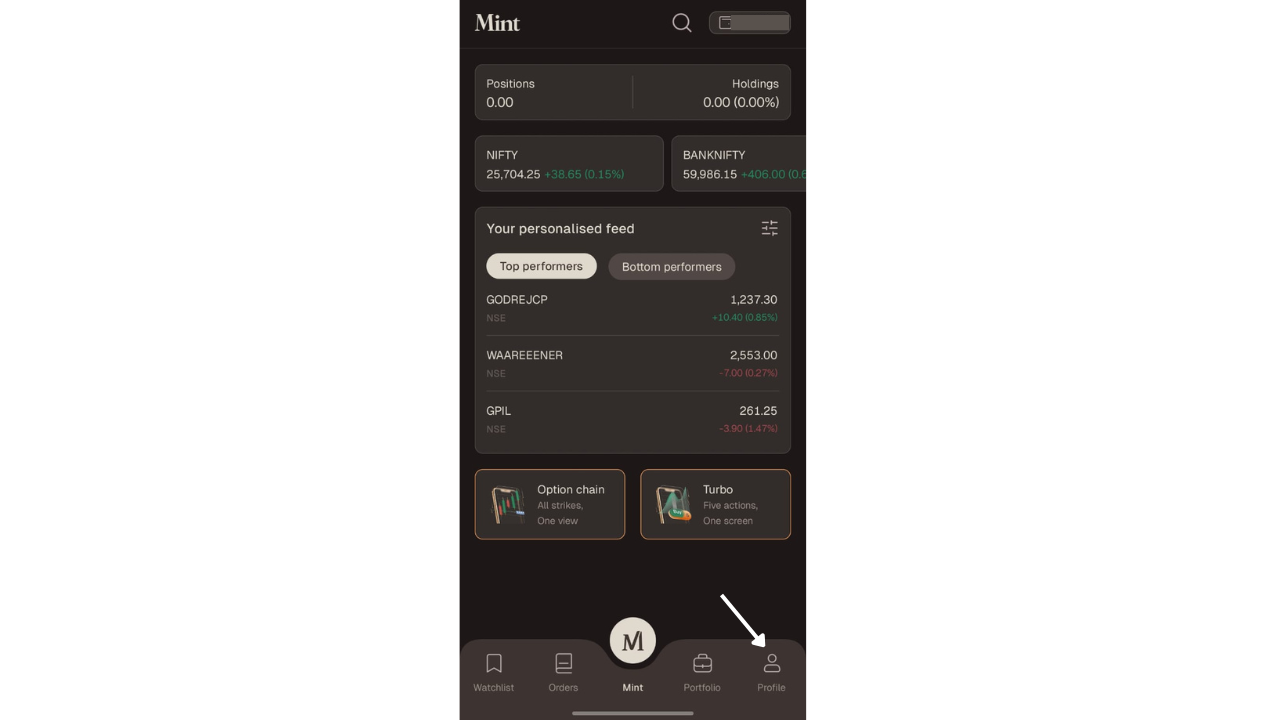
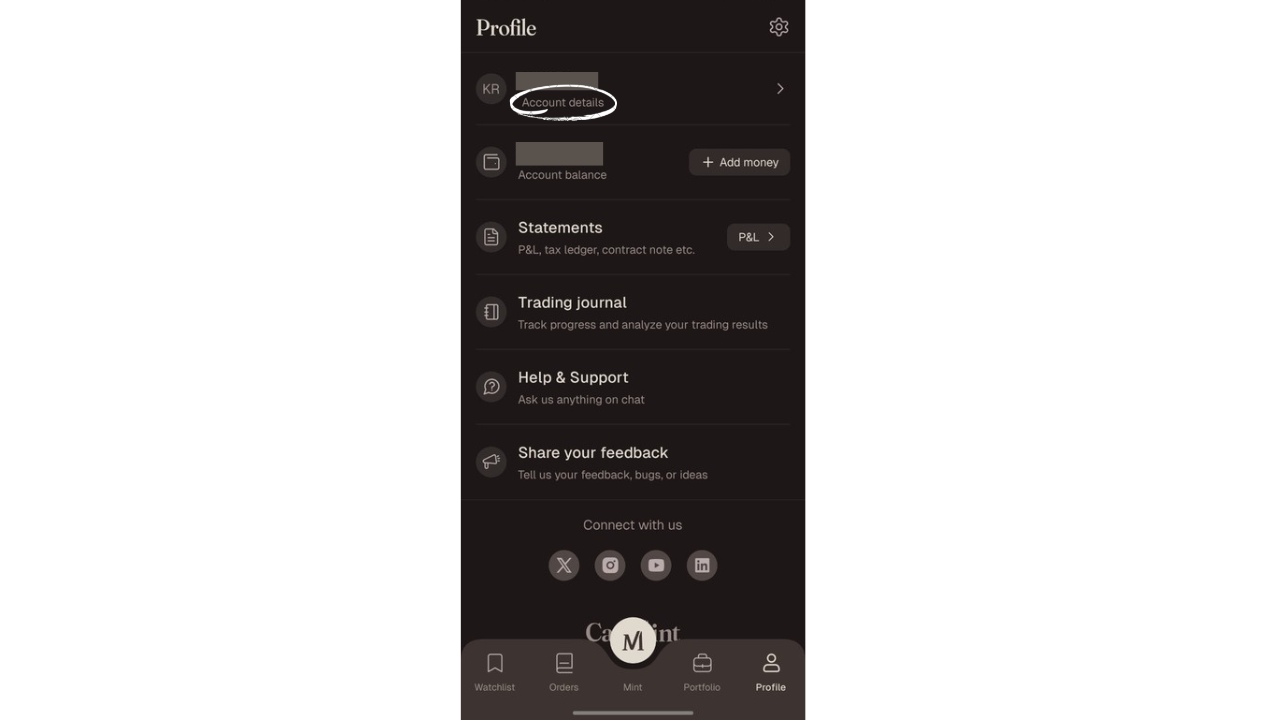
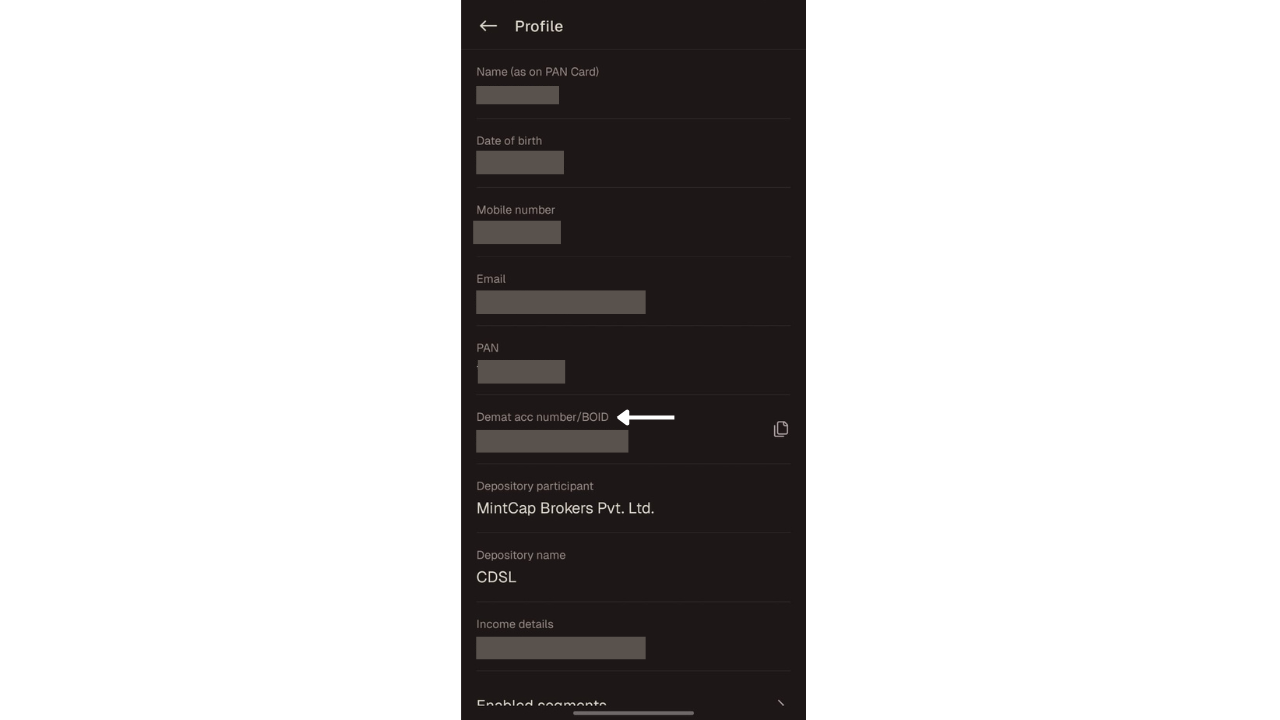
The number displayed here can be copied directly, which is useful when filling out IPO applications or initiating broker transfers where you need to enter the number accurately. A single digit entered incorrectly in the BO ID during an off-market transfer can cause the transaction to fail, so copying rather than manually typing is the safer approach.
Common Situations Where You’ll Need Your Demat Account Number
While the Demat account number may seem like a background detail, there are several specific situations where having it readily accessible saves time:
IPO Applications
When applying for an IPO through UPI-based ASBA, the application form requires your DP ID and client ID, which together form your Demat account number. An incorrect entry here can lead to application rejection.
Broker Transfers
If you’re shifting from one broker to another, the new broker will ask for your existing Demat account number to initiate the transfer of holdings. The transfer process typically takes 3–5 working days once initiated.
Off-Market Transfers
Transferring shares directly to another person’s Demat account, such as a family member, requires both the sender’s and receiver’s BO IDs. This is done through a Delivery Instruction Slip (DIS) or the online equivalent on your broker’s platform.
Pledging Shares for Margin
When pledging shares as collateral for F&O trading, the system uses your Demat account number to identify and mark the pledged holdings. The pledge request is processed through the depository and typically reflects within one working day.
Conclusion
Your Demat account number is important for almost every stock market-related activity. Once you know where to check it, the process becomes simple and quick. Whether you look through your welcome kit, CAS statement, broker app, depository portal, or contact support, the number is always accessible; you just need to know where to find it. Keeping it saved in a secure note on your phone or in a password manager is a practical habit that avoids last-minute scrambling during IPO applications or broker transfers.
Frequently Asked Questions (FAQs)
What is a BO ID in a Demat account?
A BO ID (Beneficiary Owner Identification Number) is the same as your Demat account number. It is the unique code that identifies your Demat account with the depository and is used for all transactions involving the transfer or holding of securities.
Is a Demat account number and a trading account number the same?
No, they are different. The trading account number is used to place buy and sell orders, while the Demat account number is used to store shares in electronic form after settlement. Your broker provides both, but they serve distinct functions. You can verify this by checking your broker’s app, where the two numbers are listed separately under account details.
How do I know if my Demat account is with NSDL or CDSL?
Check the format of your Demat number. If it starts with “IN”, it belongs to NSDL. If it is a 16-digit numeric code, it belongs to CDSL. You can also check your CAS email: if it comes from an NSDL email address, your account is with NSDL, and similarly for CDSL.
Can I have multiple Demat account numbers?
Yes, you can open multiple Demat accounts with different brokers, as long as each account is linked to your PAN card. Every new account will have its own unique Demat account number. However, maintaining multiple accounts means your holdings may be scattered across depositories, which can make portfolio tracking more cumbersome. The CAS statement consolidates holdings across all Demat accounts linked to a single PAN, which helps maintain an overall view.
What should I do if I can’t find my Demat account number anywhere?
If the welcome email, CAS statements, and broker app are all inaccessible, contacting your broker’s customer support is the most direct route. Alternatively, you can register on the CDSL Easi or NSDL IDeAS portal using your PAN and registered email to retrieve your account details independently. In rare cases where the registered email itself has been lost, visiting your broker’s nearest branch with valid ID proof can help reset access and recover your account information.
Disclaimer: This content is for educational purposes only and does not constitute financial or investment advice. Investments in securities or other financial instruments are subject to market risk, including partial or total loss of capital. Past performance is not indicative of future results. Always consider your financial situation carefully and consult a licensed financial advisor before making investment or trading decisions.
Engineered for the obsessed. Built for traders.

Purpose-built terminals.
Zero compromise.
Built for speed.

Plot No 1290, 2nd Floor, 17th Cross, 5th Main, Sector-7, HSR Layout, Bangalore 560102
Follow us on


Mintcap Brokers Private Limited
CIN – U66110KA2023PTC178706 | Registered Address: Plot No 1290, Second Floor, 17th Cross, 5th Main, Sector-7, HSR Layout, Bangalore 560102 | Tel: 080 – 49552310 | Email ID: compliance@capmint.com | SEBI registered Stock Broker: INZ000322732 | NSE Cash/F&O Member ID: 90430 | BSE Cash/F&O Member ID: 6903 | MCX Member ID: 57400 | NCDEX Member ID: 1312 | SEBI registered Depository Participant: IN-DP-806-2025 | CDSL DP ID: 12102300 | NSE Clearing Member code: M70108 | AMFI-Registered Mutual Fund Distributor: ARN-289109 (Valid upto 28-Feb-2027) | Category II Execution Only Platform : E6903
Details of Client Bank Account
Compliance Officer: Ms. Shridevi Vungarala | Email ID: compliance@capmint.com | Tel no. + 91 9035330126 | Grievance Redressal Officer (GRO) – Ms. Shikha Gupta | Email ID: Grievance@capmint.com | Tel no: 9035331595.
Procedure to file a complaint on SEBI SCORES: Register on SCORES portal. Mandatory details for filing complaints on SCORES: Name, PAN, Address, Mobile Number, E-mail ID. Benefits: Effective Communication, Speedy redressal of the grievances. You may refer the website https://scores.sebi.gov.in/ for more information. You may also download the SEBI Scores app to log a complaint Android: https://play.google.com > store > apps > sebiscores iOS: https://apps.apple.com > app > sebiscores
Disclaimer
Investment in the securities market are subject to market risks, read all the related documents carefully before investing. Brokerage will not exceed the SEBI prescribed limit.
Mutual fund investments are subject to market risks, read all scheme related documents carefully before investing. Mutual Funds are not exchange-traded products.
Attention Investor:
- Stock Brokers can accept securities as margin from clients only by way of pledge in the depository system w.e.f. September 1, 2020.
- Update your mobile number & email Id with your stock broker/depository participant and receive OTP directly from depository on your email id and/or mobile number to create pledge.
- Pay 20% as upfront margin of the transaction value to trade in cash market segment.
- Investors may please refer to the Exchange’s Frequently Asked Questions (FAQs) issued vide circular reference NSE/INSP/45191 dated July 31, 2020 and NSE/INSP/45534 dated August 31, 2020 and other guidelines issued from time to time in this regard.
- Check your Securities /MF/ Bonds in the consolidated account statement issued by NSDL/CDSL every month.