

Table of Content
- How to Check Allotment of IPO
- Documents and Details Required
- Things to Keep in Mind While Checking IPO Allotment Status
- What If You Don't Get an Allotment?
- How to Increase Your Chances of Getting an IPO Allotment
- Impact of Grey Market Premium (GMP) on Investors and Where to Check
- Conclusion
- Frequently Asked Questions (FAQs)
Link copied!
How to Check IPO Allotment Status

Applying for an IPO is always exciting. But once the bidding closes, the wait to know if you got an allotment can feel too long. The good news is, you don’t have to wait for your broker’s update. There are faster ways to check your IPO allotment status a day or two earlier, if you know where to look.
How to Check Allotment of IPO
You can check the allotment status of an IPO once the allotment process is completed. There are 3 places where you can check your IPO allotment status. We will list all three of them based on where you can check the status, from the earliest to the latest.
Use the Registrar’s Website (Fastest Update)
Registrars like Link Intime, KFinTech, and Bigshare usually update allotment results the earliest, often by early evening on the allotment date. By visiting their websites, you can perform an IPO allotment status check online by PAN number, Application Number, or DP ID. The registrar’s site is considered the most accurate and first point of update for your IPO application status.
On Link Intime:
- Select the IPO you applied for
- Enter any one detail: PAN, Application No., DP/Client ID, or Account No./IFSC
- Click Submit to view your allotment status instantly
On KFinTech:
- Select the IPO you applied for
- Enter any one detail: Application No., Demat Account, or PAN
- Click Submit to check your allotment status
On Bigshare:
- Select any server (Server 1, 2, or 3)
- Choose the IPO you applied for
- Enter any one detail: Application No., Beneficiary ID, or PAN
- Click Search to view your allotment status
One practical tip: on allotment day, all three servers on Bigshare tend to get congested between 6 PM and 8 PM when most applicants check simultaneously. Trying Server 2 or Server 3 first, or waiting until after 9 PM, often results in faster page loads.
List of All Registrars for IPO Allotments
Here is the list of all the registrars we discussed above and more:
| IPO Registrars | IPO Allotment Link |
|---|---|
| MUFG Intime India Pvt. Ltd. | Check Here |
| KFin Technologies Pvt. Ltd. | Check Here |
| Bigshare Services Pvt. Ltd | Check Here |
| Cameo Corporate Services Ltd | Check Here |
| Skyline Financial Services Pvt. Ltd. | Check Here |
| Maashitla Securities Pvt. Ltd. | Check Here |
| Purva Sharegistry India Pvt. Ltd. | Check Here |
| Integrated Registry Management Services | Check Here |
| MAS Services Limited | Check Here |
The vast majority of mainboard IPOs in India are handled by Link Intime or KFinTech, so these two portals are the ones most applicants will use. The others handle a smaller share of issues, typically SME IPOs or less frequent mainboard offerings.
Visit the Stock Exchange Website
Both NSE and BSE have dedicated portals for IPO allotment. You simply need to enter details like your PAN, Application Number, or Demat account ID to view your IPO allotment status.
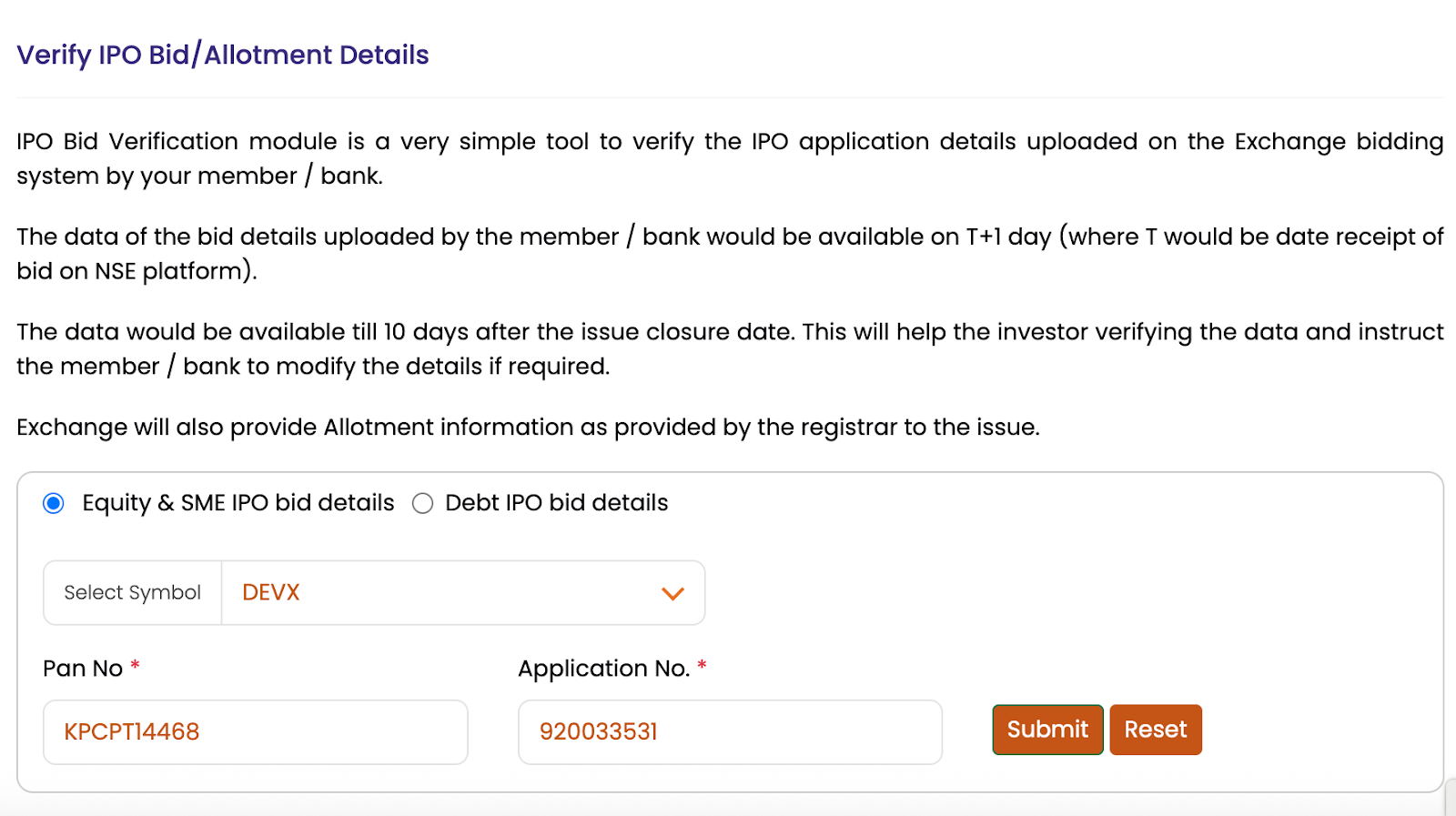
Steps to Check IPO Allotment on NSE:
- Go to the NSE IPO allotment status page.
- Select the IPO symbol from the drop-down list of recently listed companies.
- Enter your Application Number.
- Click Get Data to view your status.
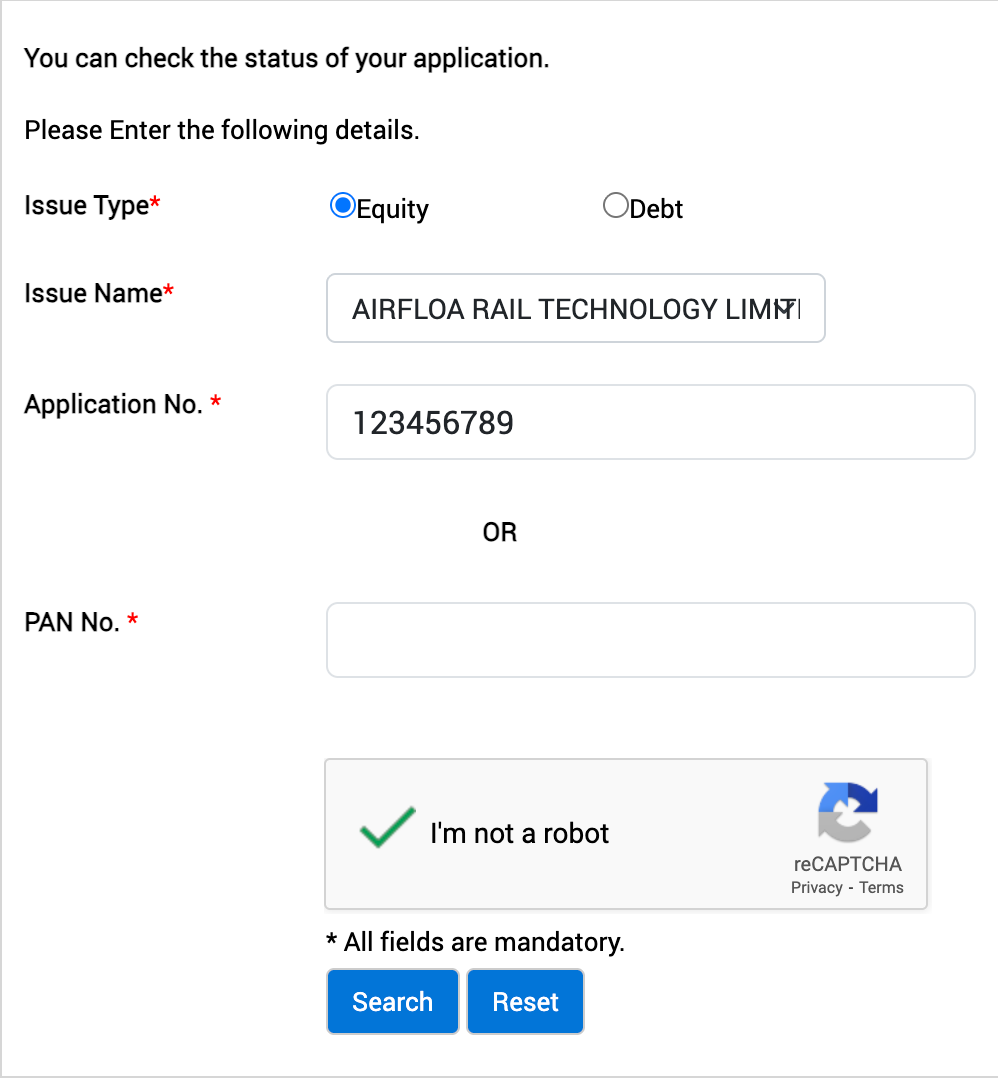
Steps to Check IPO Allotment on BSE:
- Visit the BSE IPO allotment status page.
- Select the Issue Type.
- Choose the IPO you applied for from the drop-down list.
- Enter your Application Number or PAN.
- Click Search to view your allotment status.
The BSE portal tends to be slightly more user-friendly for first-time checkers since it allows lookup by PAN, whereas the NSE portal requires the Application Number. If you didn’t save your application number, checking on BSE with your PAN is the easier route.
Through Your Broker/Trading Platform (Slowest Update)
Most brokers, like CapMint and others, provide allotment updates on their platforms. You just need to log in to your account, go to the IPO section, and then check your application status. Better yet, the shares will start reflecting in your demat account a day before the listing if the shares were allotted to you. This is a convenient option for those who regularly use broker platforms for IPO investing.
The delay with broker platforms is typically 12–24 hours compared to the registrar’s website. For applicants who want to know their status as early as possible, particularly for planning whether to sell on listing day, checking the registrar’s site first saves that waiting time.
Documents and Details Required
To check your IPO allotment status, you should keep the following details handy:
- PAN number
- Application number
- Demat/DP ID
These details are essential whether you are checking on NSE, BSE, or registrar websites. Without them, you won’t be able to complete the process of checking the IPO allotment. It is a good habit to screenshot your application confirmation immediately after applying, since retrieving the application number later, especially if you applied via UPI, can sometimes require going through your bank’s transaction history, which is more cumbersome.
Things to Keep in Mind While Checking IPO Allotment Status
If you cannot see your IPO status on one exchange (BSE or NSE), try checking on the other exchange’s website. The same goes for the registrar, because sometimes the server of one website may get too much traffic at the same time.
The registrar’s website is usually the fastest and most reliable place to check allotment on the allotment date.
Your broker/demat account will show allotted shares only a day or two later, and before the listing day.
Another point worth noting: if the allotment page shows your PAN but says “Not Allotted” or shows zero shares, that is a confirmed result, not a loading error. Many applicants refresh repeatedly thinking the page hasn’t loaded properly, but a result showing zero shares simply means the lottery did not go in your favour for that particular issue.
What If You Don’t Get an Allotment?
If your IPO status shows “No allotment,” don’t worry, it’s more common than you think, especially in oversubscribed IPOs. In heavily oversubscribed retail categories, where subscription can exceed 10–15 times, the probability of allotment for a single application is quite low purely because of the lottery mechanism. In such cases, your application money is refunded automatically within 7 working days.
- If you applied via UPI, the blocked amount gets unblocked in your bank account.
- If you applied through ASBA, the refund is processed directly to your linked bank account.
In most cases, the unblocking happens within 2–3 working days of the allotment date, though occasionally it stretches to 5–6 days depending on the bank. If the funds remain blocked beyond 7 working days, contacting your bank directly is usually more effective than reaching out to the registrar or broker.
How to Increase Your Chances of Getting an IPO Allotment
There’s no guaranteed way to secure an IPO allotment since most are decided by a lottery in case of oversubscription.
However, you can make sure you’re doing the right things so your application isn’t rejected or blocked:
- Apply within the IPO window without waiting till the last moment, to avoid UPI or payment failures. UPI mandate failures tend to spike on the final day of bidding, particularly between 2 PM and 4 PM when server load from last-minute applications is highest. Applying on day one or two of the bidding window avoids this entirely.
- Use only one application per PAN since multiple applications under the same PAN get rejected. This rejection is automatic and happens during the registrar’s verification process, so there is no way to rectify it after the fact.
- Ensure sufficient funds in your bank or UPI account so the mandate isn’t declined.
Doing these won’t guarantee allotment, but they ensure your application is valid and has a fair chance in the process. One additional strategy that many retail applicants use is applying from multiple family members’ demat accounts, each linked to a different PAN.
Since allotment in the retail category is done on a per-application basis when oversubscription is high, three separate applications from three family members effectively triple the probability compared to a single application.
Impact of Grey Market Premium (GMP) on Investors and Where to Check
Let’s not leave this topic for later, since it is a deciding factor for traders who apply for IPO for listing gains. Also, before allotment results are out, many investors look at the Grey Market Premium (GMP) to gauge listing expectations. GMP is the premium at which IPO shares are trading in the unofficial market before listing. For example, if the IPO issue price is ₹500 and GMP is ₹100, the expected listing price could be around ₹600 (₹500 + ₹100).
You can check GMP on financial news portals like Moneycontrol, Chittorgarh, IPOCentral, and 5Paisa, which regularly update GMP trends.
But remember, GMP is not official and can change quickly. It’s just market sentiment, not a guarantee of listing gains. GMP figures reported on the evening before listing can differ significantly from what actually happens at the opening bell. There have been cases where a GMP of ₹80–100 the night before translated into a flat or even negative listing the next morning, particularly when broader market sentiment shifted overnight due to global cues. Treating GMP as a rough directional indicator rather than a precise listing price predictor is the more realistic approach.
Conclusion
Checking your IPO allotment status doesn’t have to be a long wait. By using registrar websites, stock exchange portals, or your broker’s platform, you can know the result well before listing day. While allotment itself depends on a lottery system in case of oversubscription, making sure your application is correct and complete gives you the best chance of success. Whether you get an allotment or not, the process is transparent, refunds are quick, and there’s always another IPO around the corner.
Frequently Asked Questions (FAQs)
How soon can I check my IPO allotment status?
You can usually check IPO allotment status on the registrar’s website by the evening of the allotment date, typically between 6 PM and 10 PM once the basis of allotment is finalised. Stock exchange portals (BSE/NSE) may update later, and brokers usually reflect it a day before listing.
Why is my IPO status not showing on the website?
On the allotment day, registrar and exchange websites often experience heavy traffic because many investors try to check their status at the same time. If your status does not appear immediately, wait for some time and try again later. You can also check the status on another portal, such as the registrar’s website or the stock exchange website. If the IPO name itself doesn’t appear in the drop-down menu yet, it means the allotment data hasn’t been uploaded and you’ll need to check back in a few hours.
What happens if I don’t get IPO shares?
If you do not receive IPO allotment, the funds blocked in your bank account through UPI or ASBA are released automatically. The amount usually gets unblocked within a few working days, and you do not need to take any additional action.
What time is the IPO allotment done?
IPO allotment is usually finalised on the allotment date mentioned in the IPO schedule. In most cases, the process is completed in the evening, typically between 6 PM and 10 PM, once the registrar finalises the basis of allotment and verifies all applications. The exact time can vary depending on the number of applications and the registrar handling the IPO.
How do I know if I am allotted to the IPO?
You can check your IPO allotment status in several ways. The most common method is visiting the registrar’s website and entering details such as your PAN number, application number, or DP ID to see whether shares have been allotted. You can also check the status on the BSE or NSE IPO allotment pages. Many broker platforms also update the allotment status in the IPO section once it is finalised. If shares have been allotted, they will also appear in your demat account holdings a day before listing.
Can I improve my IPO chances?
You can improve your chances of IPO allotment by following a few practical steps. Applying through multiple eligible family accounts can increase the probability since allotment is done per PAN. Always apply at the cut-off price to ensure your application remains valid if the issue is priced at the upper end of the band. Also, avoid submitting multiple applications using the same PAN, as such applications are rejected during verification. Keeping your UPI app updated and applying early in the bidding window also helps avoid technical rejections that can invalidate an otherwise valid application.
Disclaimer: This content is for educational purposes only and does not constitute financial or investment advice. Investments in securities or other financial instruments are subject to market risk, including partial or total loss of capital. Past performance is not indicative of future results. Always consider your financial situation carefully and consult a licensed financial advisor before making investment or trading decisions.
Table of Content
- How to Check Allotment of IPO
- Documents and Details Required
- Things to Keep in Mind While Checking IPO Allotment Status
- What If You Don't Get an Allotment?
- How to Increase Your Chances of Getting an IPO Allotment
- Impact of Grey Market Premium (GMP) on Investors and Where to Check
- Conclusion
- Frequently Asked Questions (FAQs)
Engineered for the obsessed. Built for traders.

Purpose-built terminals.
Zero compromise.
Built for speed.

Plot No 1290, 2nd Floor, 17th Cross, 5th Main, Sector-7, HSR Layout, Bangalore 560102
Follow us on


Mintcap Brokers Private Limited
CIN – U66110KA2023PTC178706 | Registered Address: Plot No 1290, Second Floor, 17th Cross, 5th Main, Sector-7, HSR Layout, Bangalore 560102 | Tel: 080 – 49552310 | Email ID: compliance@capmint.com | SEBI registered Stock Broker: INZ000322732 | NSE Cash/F&O Member ID: 90430 | BSE Cash/F&O Member ID: 6903 | MCX Member ID: 57400 | NCDEX Member ID: 1312 | SEBI registered Depository Participant: IN-DP-806-2025 | CDSL DP ID: 12102300 | NSE Clearing Member code: M70108 | AMFI-Registered Mutual Fund Distributor: ARN-289109 (Valid upto 28-Feb-2027) | Category II Execution Only Platform : E6903
Details of Client Bank Account
Compliance Officer: Ms. Shridevi Vungarala | Email ID: compliance@capmint.com | Tel no. + 91 9035330126 | Grievance Redressal Officer (GRO) – Ms. Shikha Gupta | Email ID: Grievance@capmint.com | Tel no: 9035331595.
Procedure to file a complaint on SEBI SCORES: Register on SCORES portal. Mandatory details for filing complaints on SCORES: Name, PAN, Address, Mobile Number, E-mail ID. Benefits: Effective Communication, Speedy redressal of the grievances. You may refer the website https://scores.sebi.gov.in/ for more information. You may also download the SEBI Scores app to log a complaint Android: https://play.google.com > store > apps > sebiscores iOS: https://apps.apple.com > app > sebiscores
Disclaimer
Investment in the securities market are subject to market risks, read all the related documents carefully before investing. Brokerage will not exceed the SEBI prescribed limit.
Mutual fund investments are subject to market risks, read all scheme related documents carefully before investing. Mutual Funds are not exchange-traded products.
Attention Investor:
- Stock Brokers can accept securities as margin from clients only by way of pledge in the depository system w.e.f. September 1, 2020.
- Update your mobile number & email Id with your stock broker/depository participant and receive OTP directly from depository on your email id and/or mobile number to create pledge.
- Pay 20% as upfront margin of the transaction value to trade in cash market segment.
- Investors may please refer to the Exchange’s Frequently Asked Questions (FAQs) issued vide circular reference NSE/INSP/45191 dated July 31, 2020 and NSE/INSP/45534 dated August 31, 2020 and other guidelines issued from time to time in this regard.
- Check your Securities /MF/ Bonds in the consolidated account statement issued by NSDL/CDSL every month.