

Table of Content
- Key Takeaways
- What Is The Shareholding Pattern?
- Types of Shareholding Patterns
- Why Shareholding Patterns Matter to Investors?
- How to Read Shareholding Patterns?
- How to Access Shareholding Patterns?
- Risks and Red Flags in Shareholding Patterns
- Shareholding Patterns and Market Impact
- SEBI Guidelines for Shareholding Pattern
- Frequently Asked Questions (FAQs)
Link copied!
Shareholding Pattern (SHP)

A shareholding pattern refers to the distribution of a company’s shares among its shareholders, showing the percentage of ownership held by different types of investors.
Key Takeaways
- Shareholding patterns reveal a company’s ownership structure, helping investors assess promoter confidence, institutional involvement, and public participation.
- High promoter shareholding signals commitment, while significant institutional holdings reflect stability and growth prospects.
- Red flags such as high promoter pledging and sudden reductions in institutional holdings often signal financial stress or declining investor confidence.
What Is The Shareholding Pattern?
A shareholding pattern is an official disclosure released by a publicly listed company every quarter, mandated by SEBI to ensure transparency about the ownership structure of the company. It reports all shareholders holding more than 1% of shares in the company’s financial statements. Shareholders are categorised into various types, like retail investors, institutional investors, and promoters.
Types of Shareholding Patterns
In a company, there are different types of shareholders, and those holding more than 1% of the shares are accounted for in the company’s financial statements. The table below summarises the various shareholding patterns:
Promoter Shareholding:
This refers to the percentage of shares held by the company’s founders or promoters, including their relatives and entities controlled by them. A higher promoter holding often indicates strong confidence in the business and long-term commitment, but very high concentration may also reduce public participation.
Public Shareholding:
This includes the percentage of shares held by the general public, such as retail investors and institutions. A higher public shareholding improves liquidity in the stock and ensures broader participation in the company’s ownership.
Domestic Institutional Investors (DII):
These are shares held by India-based institutions like banks, mutual funds, insurance companies, and pension funds. DIIs usually invest based on detailed research and long-term strategies, and their participation can add stability to the stock.
Foreign Institutional Investors (FII):
This represents shares held by foreign institutions such as global mutual funds, investment banks, and insurance companies. FII activity is closely watched because large inflows or outflows can significantly impact stock prices and overall market sentiment.
Mutual Fund Holdings:
This shows the portion of shares held specifically by mutual funds or asset management companies. Higher mutual fund participation often reflects institutional confidence, as these funds invest after thorough analysis and research.
Retail and Other Shareholding:
This category includes shares held by individual retail investors, high-net-worth individuals, family offices, and sometimes the government. It represents the broader investor base and can influence stock behaviour through collective buying or selling trends.
Why Shareholding Patterns Matter to Investors?
A company’s shareholding pattern shows who holds power, who shows confidence, and how the market views the business. Tracking these details helps investors spot signals of stability, risk, and growth potential.
Control and Decision-making
Promoter shareholding is crucial as it indicates how much control the company’s founders or key supporters have over the business. While a high promoter shareholding can signal strong confidence in the company, it also means the public holds a smaller portion of shares, limiting external influence. A higher percentage of promoter holding is often viewed positively by investors as it suggests the promoters are committed to the company’s success.
Institutional Confidence
Institutional investors include Domestic Institutional Investors (DIIs) and Foreign Institutional Investors (FIIs). A more significant portion of shares held by institutional investors often indicates strong stability and confidence in the company’s growth prospects. Their involvement suggests that the company is well-regarded and likely to experience steady growth, as institutional investors typically conduct thorough research before making significant investments.
Retail Investor Participation
High retail and mutual fund holdings reflect broader confidence in the company’s performance, showing the sentiment of individual investors and mutual fund managers. Additionally, a high public shareholding, particularly from retail investors, generally improves liquidity. This makes it easier to buy or sell shares without causing significant price fluctuations, enhancing the stock’s overall market stability.
Trend and Changes Over Time
It is equally important to track how shareholding patterns evolve over different quarters. Increases or decreases in holdings by promoters, institutions, or mutual funds can highlight shifts in confidence, reveal potential risks, or signal new growth opportunities.
How to Read Shareholding Patterns?
The shareholding pattern of a company plays a crucial role in influencing its stock value, making it essential for investors to understand it before investing. Here’s how to read and interpret a company’s shareholding pattern:
Steps to read the shareholding pattern
- First, read the percentage of the promoter shareholding pattern; as we discussed, a higher rate of promoters shows they have confidence in the company.
- See the institutional investors’ percentage. A good percentage shows the robust stability of the company as well as future growth prospects.
- Evaluate the holdings of retail investors and mutual funds as they reflect broader market confidence in the company’s performance.
- A higher percentage of public shareholding, especially from retail investors, indicates better liquidity, making the stock more accessible to buy or sell without significant price changes.
- Also, check the trend and changes in shareholding over time, as increasing or decreasing stakes by promoters, institutions, or mutual funds can reveal shifts in confidence and signal potential risks or opportunities.
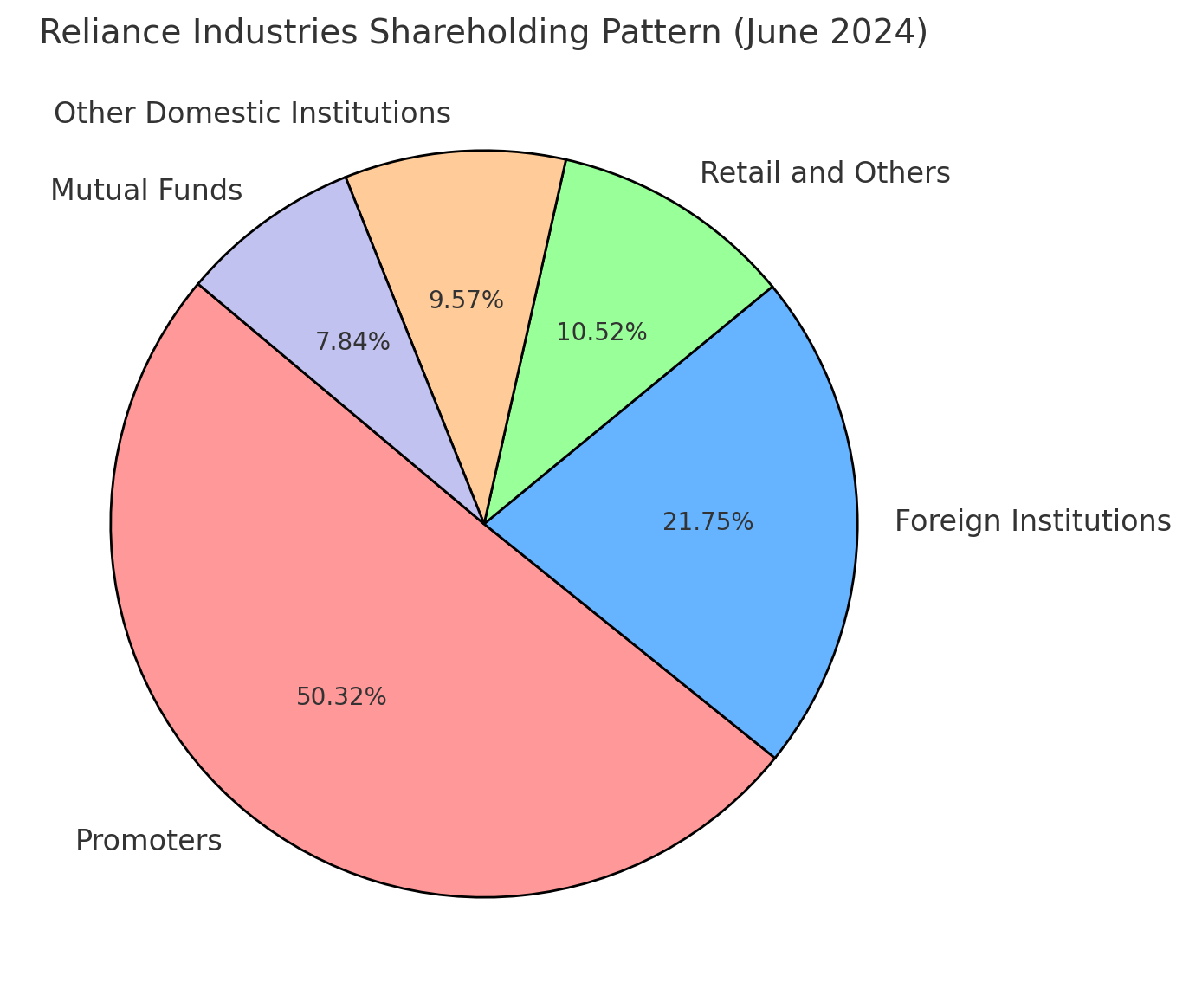
The shareholding pattern of Reliance in the June quarter shows strong confidence from promoters (50.33%) and significant institutional investment (31.32%), reflecting stability and growth prospects. Retail and mutual fund holdings indicate broader market confidence, while public shareholding enhances liquidity for the stock.
What does decreasing or increasing promoter holding indicate?
Shuffling of shares in the shareholding pattern of a company requires caution. A decrease in promoter holding may indicate a need for capital or reduced confidence in the company, which could be a sign of future risks.
On the other hand, an increase in promoter holding suggests belief in the company’s future growth, as they are investing their own money into the business. This can positively influence investor sentiment, showing that insiders believe in the company’s growth potential and stability.
Shuffling of shares in the shareholding pattern of a company requires caution. A decrease in promoter holding may indicate a need for capital or reduced confidence in the company, which could be a sign of future risks. On the other hand, an increase in promoter holding suggests belief in the company’s future growth, as promoters are investing their own money into the business. This often boosts investor sentiment, showing confidence in growth and stability. However, investors should always research the reason behind changes in promoter holding to properly assess potential risks.
How to Access Shareholding Patterns?
Shareholding patterns can be found on stock exchanges like NSE and BSE in the corporate filing or disclosure sections. Companies are required to update the shareholding pattern every quarter. Additionally, there are several online platforms where investors can easily access a company’s shareholding pattern.
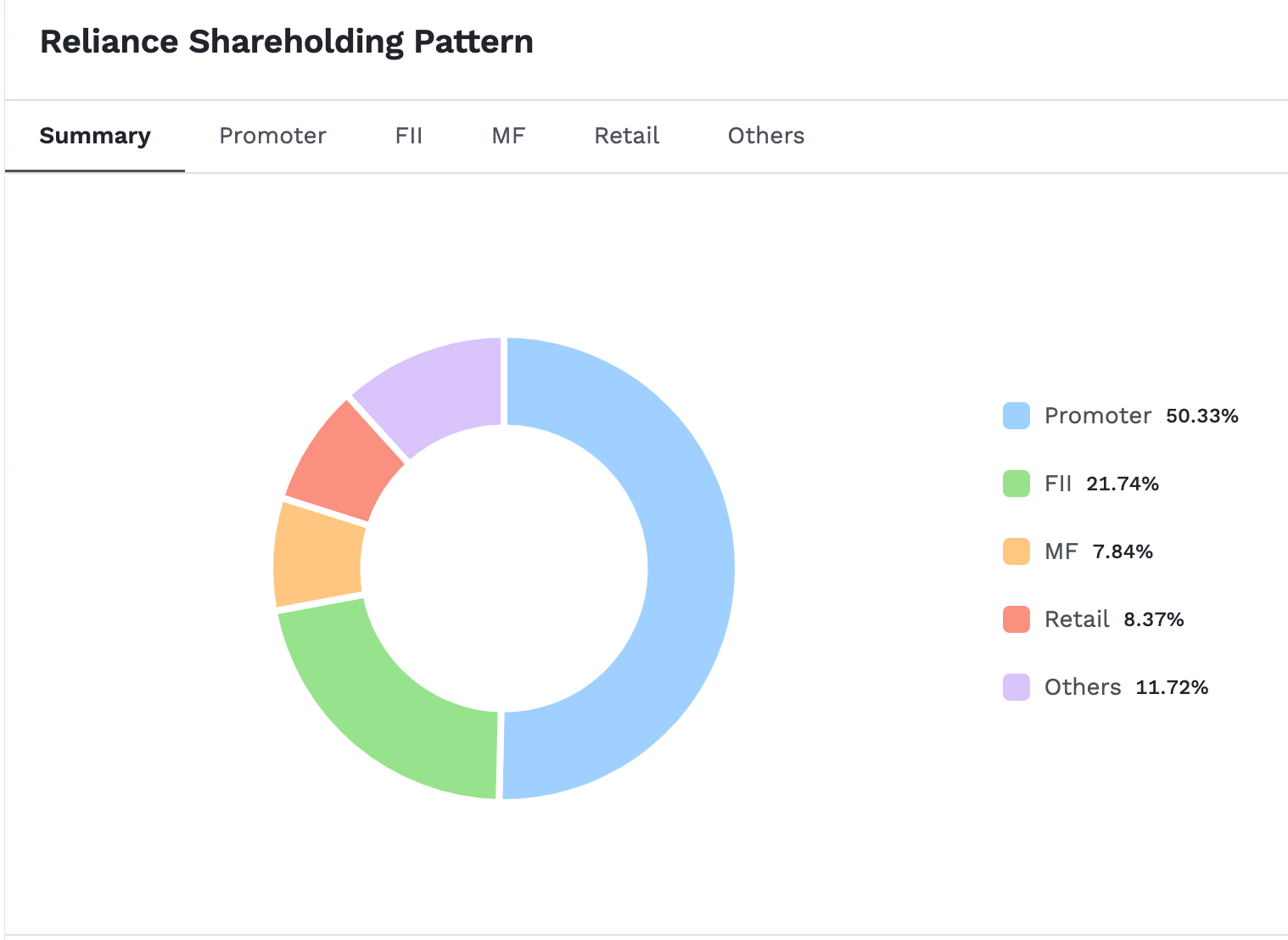
The image shows Reliance Industries’ shareholding pattern. You can find the shareholding pattern for each stock on platforms like CapMint, which provide easy access to company shareholding data.
Risks and Red Flags in Shareholding Patterns
High Promoter Pledging: What It Indicates
Pledging means using company shares as collateral to secure loans. A higher level of promoter pledging can signal financial stress or cash flow issues within the company or in the promoters’ finances. This indirectly affects shareholders because if the promoters default, lenders may sell the pledged shares, reducing promoter holding in the company.
Sudden reduction in institutional holdings
When FIIs and DIIs suddenly reduce their holdings, it indicates that large investors are losing confidence in the company. This could be due to changes in the country’s macroeconomic conditions, with political concerns often playing a pivotal role. During elections, if the ruling party wins, it typically leads to a bull market, attracting significant foreign investment into specific stocks.
Disproportionate public shareholding in small companies
Disproportionate public shareholding in small companies may indicate low promoter confidence, limited institutional interest, and higher price volatility. It can also raise concerns about corporate governance and signal potential risks due to a lack of strong oversight.
Shareholding Patterns and Market Impact
Adani Group (Adani Enterprises, Adani Power, etc.) illustrates how shareholding structure can influence market perception. With promoter holdings above 70% in several entities, the group has delivered strong financial performance.
However, the excessively high concentration of promoter ownership, particularly through offshore holdings, has raised concerns about public float, transparency, and regulatory compliance. This example highlights how different shareholding patterns can directly affect investor confidence and attract regulatory scrutiny.
SEBI Guidelines for Shareholding Pattern
- A company is required to disclose the names of individuals or entities holding more than 1% of its shares, and this disclosure must be updated within 21 days after the close of each quarter.
- Listed companies must maintain a minimum public shareholding of 25%, and non-compliance requires corrective action within a stipulated timeframe.
Frequently Asked Questions (FAQs)
What is SHP in the stock market?
SHP, or shareholding pattern, is the official disclosure of a company’s share distribution among its investors. All investors holding more than one per cent of the company’s shares are included in the shareholding pattern.
Where can I find the shareholding pattern of a company?
The shareholding pattern of a company can be easily accessed on platforms like CapMint, which provide detailed ownership data and make it convenient for investors to track changes in promoter, institutional, and public holdings.
What is the 75% shareholding rule?
Promoters of a publicly listed company should not hold more than 75% of the company’s shares. If their holding exceeds this limit, they are required to dilute or sell the excess, as mandated by SEBI to ensure minimum public shareholding and promote fair, transparent market practices.
Disclaimer: This content is for educational purposes only and does not constitute financial or investment advice. Investments in securities or other financial instruments are subject to market risk, including partial or total loss of capital. Past performance is not indicative of future results. Always consider your financial situation carefully and consult a licensed financial advisor before making investment or trading decisions.
Table of Content
- Key Takeaways
- What Is The Shareholding Pattern?
- Types of Shareholding Patterns
- Why Shareholding Patterns Matter to Investors?
- How to Read Shareholding Patterns?
- How to Access Shareholding Patterns?
- Risks and Red Flags in Shareholding Patterns
- Shareholding Patterns and Market Impact
- SEBI Guidelines for Shareholding Pattern
- Frequently Asked Questions (FAQs)
Engineered for the obsessed. Built for traders.

Purpose-built terminals.
Zero compromise.
Built for speed.

Plot No 1290, 2nd Floor, 17th Cross, 5th Main, Sector-7, HSR Layout, Bangalore 560102
Follow us on


Mintcap Brokers Private Limited
CIN – U66110KA2023PTC178706 | Registered Address: Plot No 1290, Second Floor, 17th Cross, 5th Main, Sector-7, HSR Layout, Bangalore 560102 | Tel: 080 – 49552310 | Email ID: compliance@capmint.com | SEBI registered Stock Broker: INZ000322732 | NSE Cash/F&O Member ID: 90430 | BSE Cash/F&O Member ID: 6903 | MCX Member ID: 57400 | NCDEX Member ID: 1312 | SEBI registered Depository Participant: IN-DP-806-2025 | CDSL DP ID: 12102300 | NSE Clearing Member code: M70108 | AMFI-Registered Mutual Fund Distributor: ARN-289109 (Valid upto 28-Feb-2027) | Category II Execution Only Platform : E6903
Details of Client Bank Account
Compliance Officer: Ms. Shridevi Vungarala | Email ID: compliance@capmint.com | Tel no. + 91 9035330126 | Grievance Redressal Officer (GRO) – Ms. Shikha Gupta | Email ID: Grievance@capmint.com | Tel no: 9035331595.
Procedure to file a complaint on SEBI SCORES: Register on SCORES portal. Mandatory details for filing complaints on SCORES: Name, PAN, Address, Mobile Number, E-mail ID. Benefits: Effective Communication, Speedy redressal of the grievances. You may refer the website https://scores.sebi.gov.in/ for more information. You may also download the SEBI Scores app to log a complaint Android: https://play.google.com > store > apps > sebiscores iOS: https://apps.apple.com > app > sebiscores
Disclaimer
Investment in the securities market are subject to market risks, read all the related documents carefully before investing. Brokerage will not exceed the SEBI prescribed limit.
Mutual fund investments are subject to market risks, read all scheme related documents carefully before investing. Mutual Funds are not exchange-traded products.
Attention Investor:
- Stock Brokers can accept securities as margin from clients only by way of pledge in the depository system w.e.f. September 1, 2020.
- Update your mobile number & email Id with your stock broker/depository participant and receive OTP directly from depository on your email id and/or mobile number to create pledge.
- Pay 20% as upfront margin of the transaction value to trade in cash market segment.
- Investors may please refer to the Exchange’s Frequently Asked Questions (FAQs) issued vide circular reference NSE/INSP/45191 dated July 31, 2020 and NSE/INSP/45534 dated August 31, 2020 and other guidelines issued from time to time in this regard.
- Check your Securities /MF/ Bonds in the consolidated account statement issued by NSDL/CDSL every month.